


🌱 Welcome to this week’s issue of Clarity Letters from Mindset Rebuild, providing you with a small, honest move to start the week.
✌️ One idea you can run today.
🙌 One useful page and one quiet win.
🫶 New here? Join for free to get Mondays in your inbox.
Some weeks don’t crash; they slide
You answer messages, attend meetings, handle a dozen minor tasks, and still end the day unsure of what truly progressed.
That’s drift.
Not dramatic. Just a slow sideways pull that draws attention without triggering alarms.
I reach for something small and steadfast when that feeling arises: two questions on a single page.
They’re old, borrowed from Benjamin Franklin, and still work amid modern noise.
Franklin led a busy life: printing and publishing in Philadelphia, organising the Library Company (1731) and the Union Fire Company (1736), serving in the Pennsylvania Assembly, spending years in London, then the Declaration of Independence (1776) and the Constitution (1787).
For a man with that calendar, his daily frame stayed simple:
Morning: What good shall I do this day?
Evening: What good have I done today?
Read beyond the antique phrasing, and you’ll see a clean operating idea: point yourself on purpose, then check if your feet follow.
No moral theatre. Course correction.
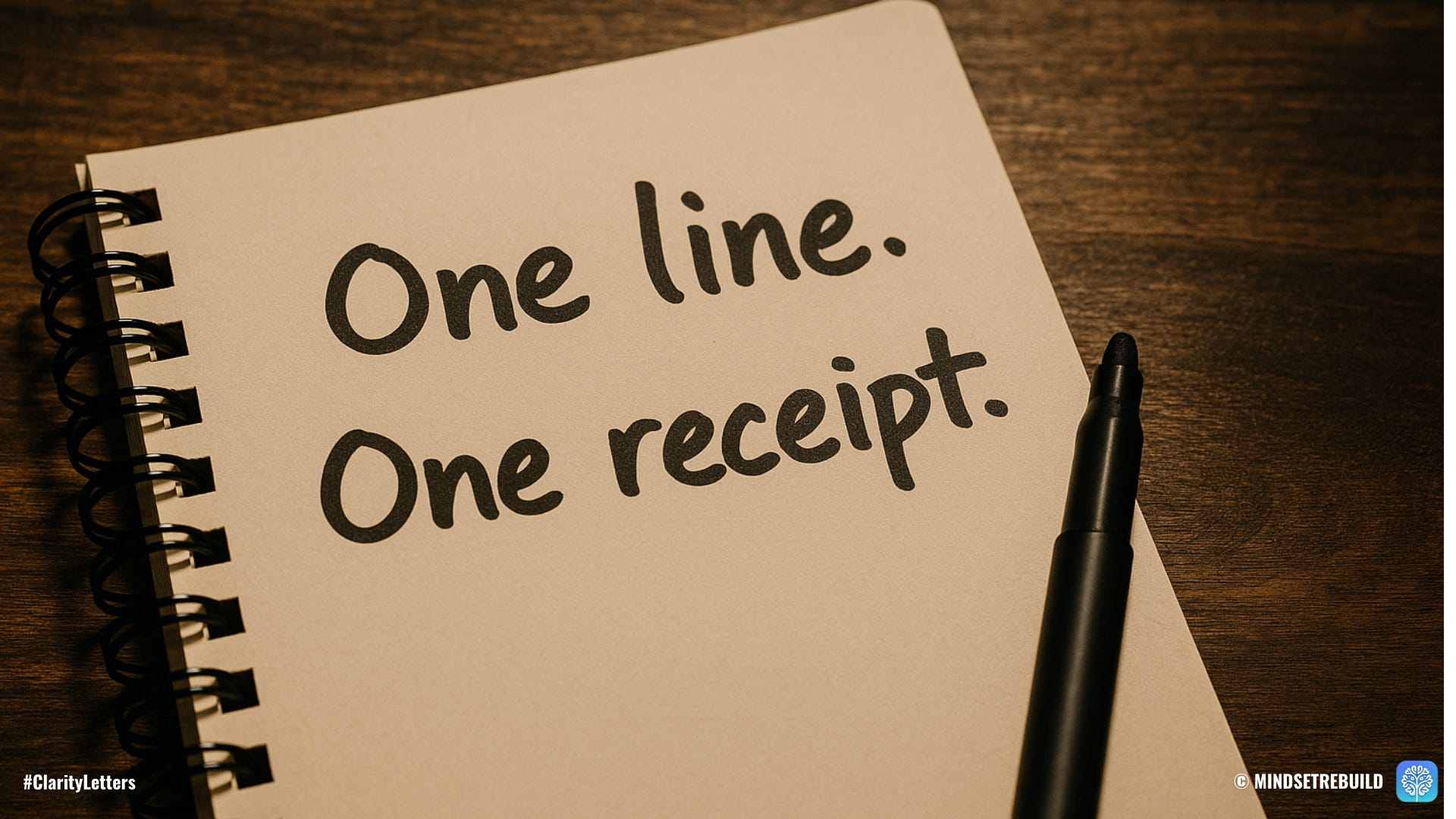
Here’s how I run a modern version that fits crowded days and still gives you a receipt.
Point the day with one line
Open your notes. Write one line that provides something another person can use by 5 p.m. Keep the words dull and clear.
“Post a 1-page handoff that cuts rework.”
“Record a 90-second explanation I can paste into replies.”
“Decide who owns the launch brief for 60 days and post it.”
If it takes more than twenty seconds to write, it’s just a wish. Refine it so clearly that a stranger could tell if it actually occurred.
Now add a tiny field beneath it:
Receipt I’ll show: link, file name, or the exact sentence you’ll post.
Drift hides in intentions. Evidence pulls it into daylight.
Run the middle like a kitchen-table test
Franklin’s life was busy with committees; yours is busy with threads. Keep the middle small enough to handle interruptions.
Think like a kitchen-table experiment.
Aim (1 line): “Find the correct asset in ≤30 seconds.”
Materials (3): current template, shared drive, two examples.
Procedure (3): rename → link → sanity-check with one person.
Result (1): “Found in 18 seconds; two clicks.”
You don’t need new tools to do this. Work with what’s already in the room.
Constraint shapes the test, not a reason to avoid it.
Teach once, lightly
Once the thing exists, convert it into a tiny asset someone else can use today: a single page, a 90-second screen recording, or a two-line note that removes one step for another human.
Don’t aim for a library. Teach it once, lightly, and move on.
Ask one question when you share it:
Did this remove a step?
The answer will tell you whether you created help or just more surface area.
The evening score (ninety seconds, not a journal)
Franklin’s second question closes the loop: What good have I done today?
Score it, don’t narrate it.
Did the thing exist? Yes/No.
If no, what took the time instead (one phrase)?
What’s the smallest salvage move tomorrow (one line)?
Close the page.
This is not a performance review. It’s drift detection.
You’ll know fast if your week is on rails or wandering.
Why this helps calm the room
I like ambitious plans. They make me feel productive before anything exists.
The days I write a single morning line and score it at night, the week gets lighter, even if my calendar doesn’t.
The receipt is the difference. It turns a hope into a thing.
Your brain relaxes because the day has edges again.
This is also contagious.
A one-page handoff beats three reminders. A short clip beats a meeting. A named owner with a review date beats a circular thread.
People mirror clarity.
Run it with your team (five minutes)
In stand-up or a quick async check-in, ask each person to post one morning line and a receipt.
No speeches. Just lines.
The next day, open with the ninety-second score.
You’ll see drift earlier and fix it faster because the work lives where people can point to it.
That’s a wrap (one quiet win this week)
Write one morning line that creates a receipt by 5 p.m.
Name the receipt now.
Tonight, score it in ninety seconds.
Tomorrow, do it again.
Three runs and the sideways pull eases.
With steady curiosity,
~Warren
P.S.
If choosing that one area feels heavier than it should, that’s usually the early signal of an identity shift. Message me with the area you want to feel lighter first — I’ll help you name what’s actually shifting underneath.