


🌱 Welcome to this week’s issue of Clarity Letters from Mindset Rebuild, providing you with a small, honest move to start the week.
✌️ One idea you can run today.
🙌 One useful page and one quiet win.
🫶 You’re on the free plan: Monday’s Clarity Letters and Friday’s The Shift. If you want the mid-week build notes and copy-ready cards, upgrade for Wednesday’s Leadership Architecture.
Some weeks begin with noise that doesn’t match the calendar.
Nothing major changed, yet a few decisions feel heavier than they should.
I’ve started to treat that feeling as a signal. Not a crisis, just a nudge to look for the question I’ve been avoiding.
Lately, my question is simple: What am I pretending to know this week?
I like answers. Plans, too.
But there’s a cost to pretending.
When I say “this should work,” I often mean “I don’t want to examine the parts.”
The week slows down there, at the place I don’t want to look.
A scientist who kept the door open
When I get precious about certainty, I think about Richard Feynman.
He once said, “The first principle is that you must not fool yourself, and you are the easiest person to fool.”
He’d earned the right to big statements by then (Nobel Prize in 1965), but his favourite tools were still small: notebooks, observations, a willingness to let an outcome contradict a hunch.
What I carry from him isn’t the medal; it’s the posture.
Let the unknown sit in the chair. Watch the thing. Write what happened. If it doesn’t match the guess, change the guess.
That humility calms a founder’s week.
Most of us aren’t proving physics; we’re deciding which message to ship, how a handoff actually begins, or whether a price has a story people believe.
The work gets easier when a question is allowed to hang in the room long enough to show us what’s true.
The quiet inventory
Here’s a light pass I’ve been running that doesn’t feel like homework. It works in your head while the kettle warms.
Pick three parts of your week: message, process, and decision.
For each one, ask:
What am I saying I know?
What do I actually see?
Two lines per item. Sentence fragments count.
You may notice the gap immediately.
The “clear” message remains in a draft that no one has read.
The process that “saves time” starts with a question no one wants to ask.
The decision that “everyone agrees with” exists only in the room where it was made.
None of this is a failure. It’s what we discover when we stop pretending.
If that feels like a lot, choose only one thing. One message, one step, or one choice.
The point isn’t to build a system. It’s to locate the spot where reality and assumption are not friends yet.
The small promise that changes the feel
When I see the gap, I don’t try to fix the whole machine. I make a small promise to the day:
By 5 p.m., something will exist that another person can use.
This isn’t a performance challenge. It’s a way to re-enter the work with fewer illusions.
One page that names who owns a recurring choice and when we’ll look again.
One paragraph that a real buyer replied to.
One checklist that prevents the same question tomorrow.
Small, specific, visible.
Feynman would call that an experiment. I think of it as a receipt. The day feels lighter when a receipt exists.
A story to carry this week
Reading back through Feynman’s habits, I’m struck by how he put pressure on the observation, not the ego.
If the note in the margin contradicted the idea he loved, the note won.
That steadiness doesn’t come from self-doubt; it comes from respect for what is.
There’s a workable parallel for operators: give your week one place where observation gets priority.
If the message line people answered isn’t the one you favoured, keep the one they answered.
If the handoff that prevents rework isn’t pretty, keep the plain working version until you learn how to make it simple and clear.
If a decision only travels when it lives on a small page with a review date, give it a home and a date ... no speeches required.
Relief appears as soon as observation takes the lead. Not because the puzzle is solved, but because you’ve stopped gambling against the week.
Questions I’m carrying (borrow any)
I’m keeping these three close for the next few days. If any of them nudge you, take them.
Where am I confident out loud but uncertain on paper?
What did I expect last week that never happened—and what actually did?
If I could keep one receipt from today, what would deserve the folder?
No tricks.
No “five steps.”
Just questions that make it harder to fool myself when I’m tired, and the calendar looks louder than it is.
A simple way to close the loop tonight
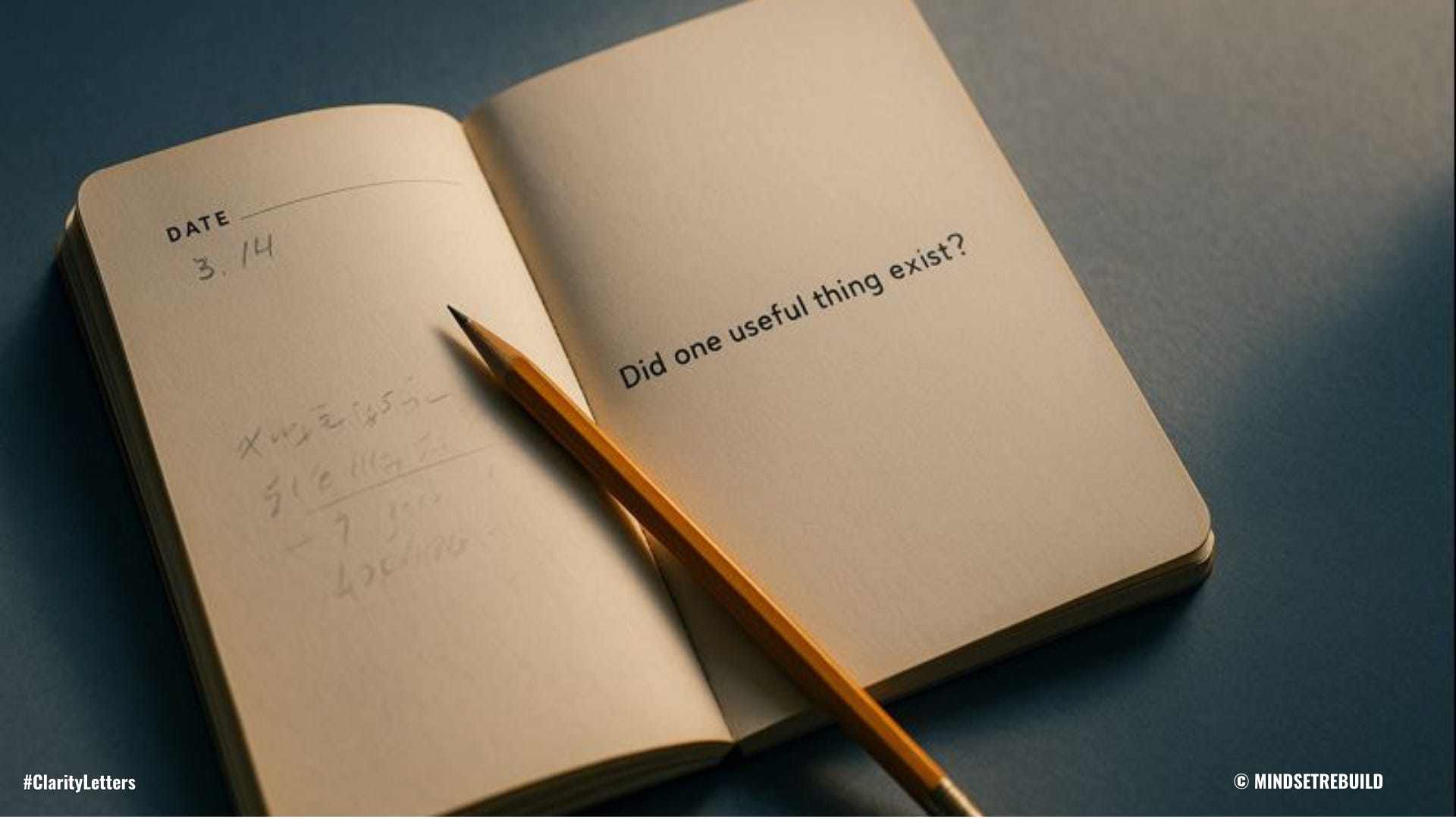
Before bed, look once at the day. One line is enough:
Did one useful thing exist?
What did it teach me?
If nothing existed, that’s a note too. You’ll see why by mid-week.
If something did, paste the link where you can find it tomorrow without thinking.
That’s how a week keeps its edges.
Why this matters now
Founders and operators live in moving weather.
The calendar encourages performance, not observation.
We can design around that. A few honest notes, one small promise, and the habit of letting the unknown keep its chair; this steadies a week without numbing it.
If this letter did anything for you, I suspect it was the feeling of not being sold to.
I’m trying to keep that intact.
We can be serious about the work and light about ourselves at the same time.
With a clear head and a lighter grip,
—Warren
P.S.
If you’d like a quiet 90 minutes to examine one knot with me, no slides, just clear observation and a workable next step, the Clarity Sprint is open. If you’re unsure, reply with one sentence about the knot and I’ll point you to the simplest first move.