


✌️ Welcome to the CEO Life OS newsletter from Mindset Rebuild, where we bring deep thinking for proactive leaders in a few sharp minutes each week.
🙌 One big idea, one small play you can turn into one quiet win this week.
🫶 Forwarded by a friend? Join free—or upgrade for first access to templates.
👉 And you can always check out the archives to find more from Mindset Rebuild.
today’s topic
Some mornings don’t need a bigger plan. They need one small test that makes the day honest.
That’s the spirit today: a gentler cadence that still creates motion.
We’ll take our cue from a scientist who worked with what he had, learned in public, and turned constraints into options other people could use.
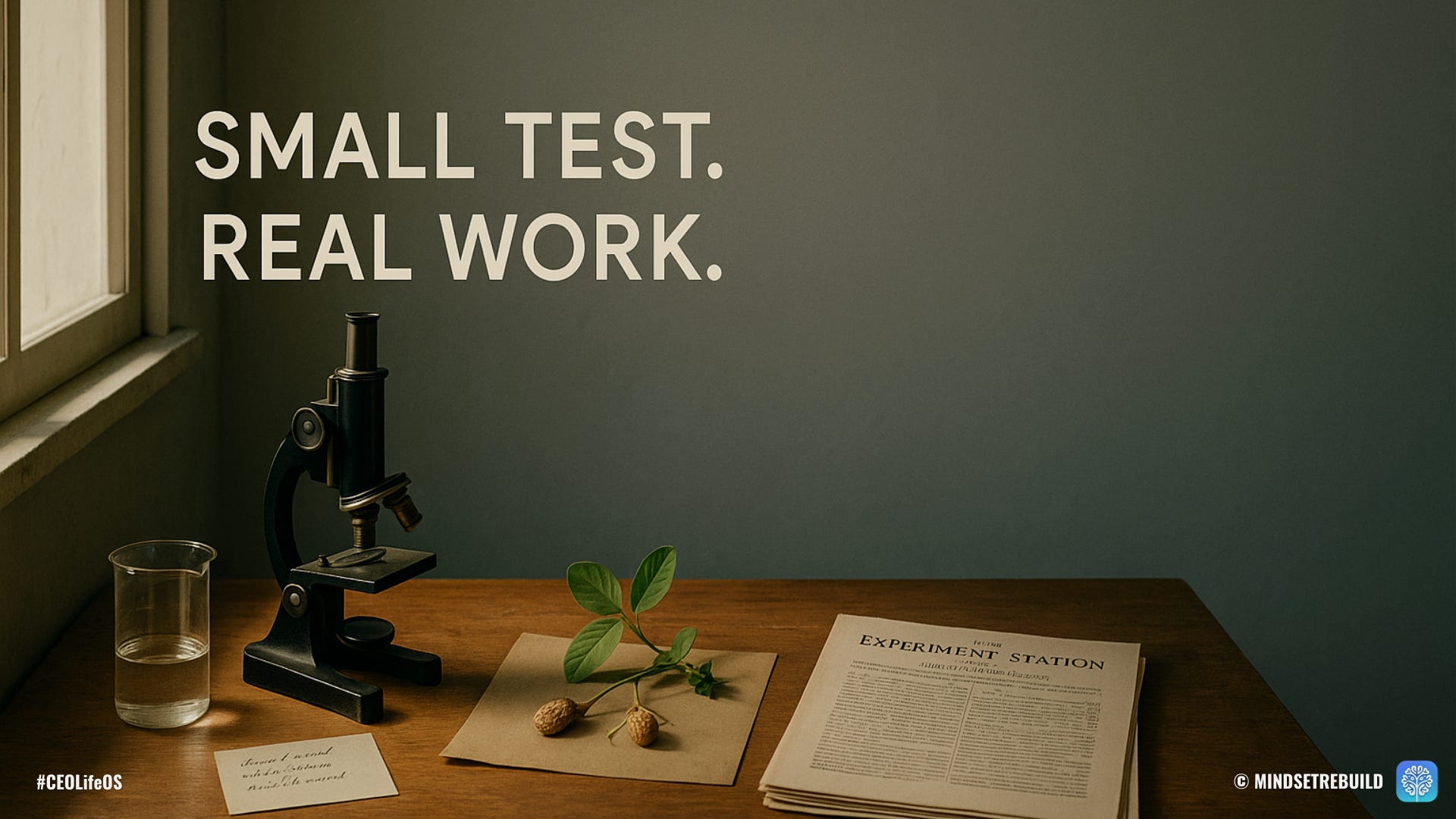
the historical heartbeat: how Carver turned mornings into momentum
George Washington Carver rose before dawn at Tuskegee Institute in Alabama.
He walked the fields, paid attention to light and soil, then returned to a modest lab and ran small experiments.
Born into slavery near the end of the Civil War, he grew up with limited means.
He built progress through curiosity + constraint: try something small, write what happened, teach the part he now knew.
Here are a few grounded facts worth carrying:
In 1896, Booker T. Washington invited Carver to lead agriculture at Tuskegee Institute.
Southern soil was exhausted by cotton monoculture. Carver promoted crop rotation with legumes and sweet potatoes to restore nitrogen.
He published dozens of Tuskegee bulletins in plain language so farmers could run the methods at home—step-by-step instructions, sketches, recipes, and uses for new crops.
The “Jesup wagon” (a mobile classroom funded by New York financier Morris K. Jesup) carried demonstrations and tools to rural communities.
Carver explored hundreds of potential uses for crops (dyes, paints, soaps, flours, oils). Some ideas stayed experimental; others became everyday helpers. The point was always practical service.
Carver’s power wasn’t rooted in mythic genius in a huge lab. It was daily, reliable experiments that a neighbour could replicate.
A morning walk. A test that fits before lunch. A bulletin that spreads the word.
Here’s the guiding principle I’ve stolen from Carver:
Perform a quick experiment that you can finish by noon, then teach the part you already understand.
modern translation: a kinder routine that still makes something real
Let’s keep the tone human. No heroics. Just three practices you can carry out this week.
1) early minutes, single test
Give your first quiet block to one experiment that can produce a visible note. Keep it small enough to finish in a sitting.
Pick a question you already live with.
Examples: “What would make this handoff easier?” “What’s the shortest version of this page that still helps?” “Which 90-second explanation would stop the repeat DMs?”Run the test with what you have.
Draft a micro-checklist. Record a quick voiceover. Try a new file naming pattern on one deliverable.Write three lines in your week-book.
What I tried. What I saw. What I’ll try next.
This creates a private signal that the day can follow.
2) the kitchen-table experiment
Carver worked under tight constraints. You can use yours as creative boundaries, not excuses.
Choose one constraint (time, budget, tools).
Draft a “kitchen-table” card:
Aim (one sentence): e.g., “Make our handoff findable in 30 seconds.”
Materials (three items): current template, shared drive, two example files.
Procedure (three steps): rename, link, sanity check with one colleague.
Result (one line): “Found it in 18 seconds; 2 clicks.”
Photograph or link the card where work lives.
The card is small on purpose so the experiment happens.
3) teach once, lightly
Carver didn’t hoard the method. He taught in plain words through bulletins and live demos.
Pick one person who benefits from what you learned.
Share a one-page note or a 60–90 second clip that someone else could run today.
Invite a single response: “Does this save a step?” or “Where does this break for you?”
Teaching turns fear into stewardship. It also anchors the lesson in your own head.
a human note from my desk
Over the years, I’ve come to realize that I am both a night owl and a morning person.
I work best when the morning feels sacred and scrappy.
Not precious; just mine.
On days I name a small test, the noise lowers.
When I write the three lines, I stop pretending.
When I teach once before the week ends, courage grows roots.
If you’ve been waiting for perfect conditions, Carver would hand you a pencil and point you to the nearest table.
what this gives your team
Less drift. A named experiment shrinks indecision.
Shared language. A simple card or page other people can quote.
Transferable learning. One small note they can run without you.
None of this requires a new platform.
It simply asks for early minutes, one question, and a note someone can use.
that’s a wrap (one quiet win this week)
Close the tab, open your week:
Name your test:
This week I’ll try ______ and write 3 lines about what I see.Block your early minutes:
Make them yours on the calendar.Teach once:
One page or one clip a friend or teammate can use today.
If you want company, reply with your one-line test. I read every note.
With steady curiosity,
~Warren
p.s.
What small experiment would you want a co-pilot to help you run this month?
Click the button below to book a call. 👇
Regarding the topic of the article, while I appreciate the wisdom of George Washington Carver's small experiments and steady progress, I wonder if this gentle cadence is always practicall for the demands of a modern CEO though you've certainly highlighted a truly insightful historical figure.