


Welcome to this issue of Clarity Letters from Mindset Rebuild.
If your roadmap says Q1 but key calls keep slipping into “we’ll revisit,” you’re not dealing with slow execution. You’ve got invisible decisions gating everything downstream. This is a quick look at how that decision backlog forms, what it quietly costs, and the simple decision log habit that gets the quarter moving again.
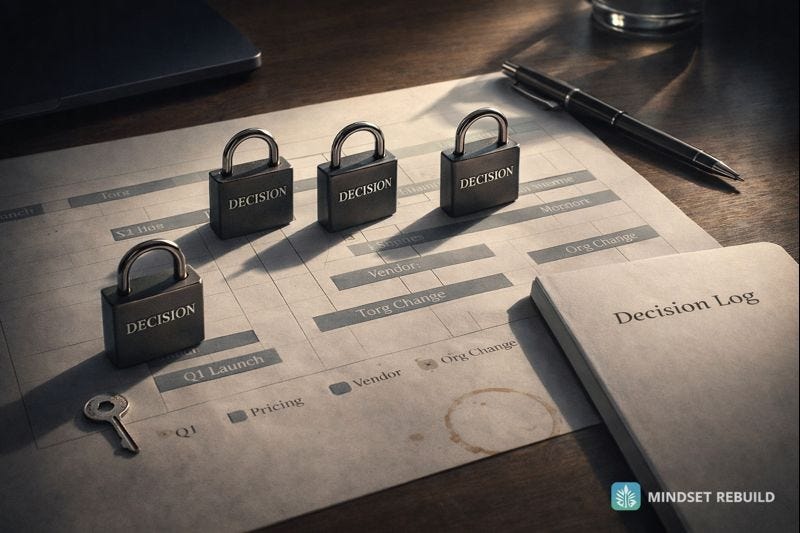
Your Roadmap says Q1, but your decisions say “Maybe”.
You’ve seen this movie.
Your roadmap is crisp. The dates look confident. The work is neatly broken down into boxes.
Your team says, “We’re on it.”
And then three decisions sit in limbo, like abandoned shopping carts in the middle of the aisle. Nobody owns them. Nobody’s tracking them. Nobody’s willing to say, “This is the call, and I’m responsible for the consequences.”
So the quarter starts to slip.
Not because your team is slow.
Because your decisions are invisible.
The quiet gap between “work” and “progress”
Most teams track tasks obsessively.
They track bugs, features, story points, sprint velocity, burn-down charts, cycle time, and throughput. They can tell you exactly what moved from “In Progress” to “Done” at 3:42 PM on Tuesday.
But ask a simple question:
What are the top 10 decisions currently blocking your roadmap?
And you get blinking.
Or you get vague answers like:
“We’ve got a few things in flight.”
“We’re still aligning.”
“We’re waiting on more input.”
That right there is the gap.
Teams can feel the drag, but they can’t point to the source.
Because tasks are visible.
Decisions usually are not.
And decisions gate everything.
You can’t ship the feature until the pricing model is finalized.
You can’t hire until headcount is approved.
You can’t change the org until someone owns the trade-offs.
You can’t commit to a vendor until someone defines what “good enough” means.
So the roadmap becomes a work of fiction.
A well-formatted fiction. A polite fiction. A fiction everybody wants to believe because the alternative is admitting you’re blocked by something with no Jira ticket.
The “decision tax” nobody budgets for
I’ve been watching this pattern for decades across operations teams and executive rooms.
Most teams carry 8 to 12 unresolved decisions at any time. Sometimes more. They just don’t call them that.
They call them:
“Open questions”
“Things to revisit”
“Items to socialize”
“We should talk about that”
“Let’s put a pin in it”
Which is a lovely way of saying:
“This is important, but I don’t want to touch it.”
Every unresolved decision is a silent tax on velocity.
Not a dramatic tax.
A slow leak.
A quiet siphon that turns a strong team into a coordination machine.
Here’s what that tax looks like in real life:
People keep starting work that might get thrown away.
People keep pausing work “until we know.”
Meetings multiply because the decision keeps reopening.
Stakeholders keep asking for updates because nothing is actually closed.
The team’s confidence drops, not because they can’t execute, but because they can’t commit.
And the nastiest part?
It rarely shows up as “We are blocked.”
It shows up as “We are busy.”
Busy is what decision drag looks like when it puts on a suit.
The three decision types that quietly your wreck Q1
Most decision backlogs aren’t random. They cluster around the same categories.
1) Money decisions
Pricing model. Packaging. Discount rules. Budget approvals. Vendor spend.
These sit forever because money decisions force trade-offs that make people uncomfortable.
If you raise the price, someone worries about churn.
If you lower the price, someone worries about the margin.
If you choose Vendor A, someone worries about speed.
If you choose Vendor B, someone worries about security.
So teams keep “discussing” money decisions, as if the discussion itself is progress.
It isn’t.
2) Ownership decisions
Decision rights. Role clarity. Who owns what? Who is accountable for what outcome?
These are the ones that look like “team problems” but are actually “structure problems.”
When ownership is fuzzy, everyone hedges.
When everyone hedges, nothing closes.
When nothing closes, the quarter bleeds out.
3) Scope decisions
What is in? What is out? What is “done”? What is “later”? What is “never”?
Scope decisions die in committees because nobody wants to be the person who says no.
So teams keep saying yes, and then wonder why they can’t ship.
A roadmap is just a list of scope decisions written on a calendar.
If you do not close scope decisions, the calendar becomes a wish.
Why smart teams still get stuck
This is the part I want to be careful with, because it matters.
Decision drag is not a sign your team is dumb.
It’s usually the opposite.
Smart teams get stuck because they can see all the angles.
They can see the risks. They can see the second-order effects. They can see the downside of every option. They can see the political landmines.
So they compensate by reaching for process.
More meetings. More docs. More alignment. More input.
And that can be useful, right up until the moment it becomes avoidance.
There’s a simple test:
If you have more clarity, but still no owner and no close-by date, you are not progressing. You are buffering.
Buffering feels productive. It feels responsible. It feels like “leadership.”
But buffering is just indecision with better lighting.
The fix: Make decisions visible, ownable, and reviewable
The fix is not complicated, but it is uncomfortable at first because it forces reality into the room.
You need a Decision Log.
Not a fancy one. Not a tool rollout. Not a culture initiative. Not a giant framework.
A decision log is just a list that makes the invisible visible.
It stops decisions from being hidden in meetings.
It turns “we should talk about that” into something concrete you can close.
Your Decision Log needs five fields
Decision
Write it as a yes/no or a clear choice.
Bad: “Pricing.”
Good: “Do we move to usage-based pricing for Tier 2, yes or no?”Owner
One person accountable for closure. Not a committee.
You can consult others. But someone must own the call.Close-by date
Not “ASAP.” Not “soon.” An actual date.Trade-off
Name the cost.
Speed vs. certainty. Margin vs. growth. Simplicity vs. flexibility.Status
Open, in review, decided, blocked (and why).
That’s it.
This is not paperwork. This is a visibility tool.
A decision log is how you stop your roadmap from being held hostage by invisible bottlenecks.
“But, Warren, we already have a roadmap.”
Yes. That’s the problem.
Roadmaps track planned work.
Decision logs track the gates that enable planned work.
If you only have a roadmap, you are tracking movement without tracking the locks on the doors.
So the team keeps running into closed doors and calling it “execution”.
Here’s what changes when decisions become visible:
The same decision stops reopening in three meetings because it has a name and an owner.
People stop working on the wrong version of the future because the future is stated.
Stakeholders stop “checking in” because they can see what is actually open.
The team stops confusing activity with progress.
This is why most teams can clear half their decision backlog in two weeks once they actually see it.
Not because the decisions are easy.
Because now the decisions cannot hide.
The weekly ritual that keeps Q1 honest
A decision log only works if it becomes part of your rhythm.
You do not need a new meeting. You need 12 minutes of honesty.
Once a week, review the decision log and ask:
What decisions are past due?
If it’s past due, it is already costing you.What decisions are gating major work?
These are your real priorities, even if they are not on the roadmap.What decisions need a trade-off stated clearly?
If the trade-off is unnamed, the decision will keep floating.What decisions should be killed?
Some decisions do not need to be made. They need to be removed from the system. “Not doing this” is a decision. Make it explicit and move on.
If you do this weekly, your roadmap gets calmer.
Not because you became more motivated.
Because you stopped letting invisible decisions silently run your quarter.
The question nobody wants to ask, but every team needs
If your roadmap is slipping, ask this:
“What decisions are currently blocking downstream work, and who owns each one?”
If you cannot answer that in under 60 seconds, you have found your real bottleneck.
And if your answer sounds like this:
“Well, it depends.”
“We’re waiting on input.”
“It’s kind of shared.”
“We’re still aligning.”
Then your Q1 problem is not execution.
It’s decision ownership.
A quick self-check before you blame the team
Here’s a simple, slightly uncomfortable check that helps.
Look at your last month.
How many times did you say a version of:
“Let’s revisit this next week.”
“We should get more data.”
“Can we take this offline?”
“Let’s see what everyone thinks.”
If it was more than a few times, do not beat yourself up.
Just take it as a signal.
Those phrases show up when the structure is missing.
Language becomes a shield when authority is unclear, and outcomes are unowned.
Fix the structure, and the language changes on its own.
The question that tells you where to start
What decision has been sitting on your team’s backlog for 30+ days?
Not a task. Not an initiative. Not a vague “strategy.”
A decision that gates work.
If you can name that one decision, you can start a decision log today.
And if you start tracking decisions with the same seriousness you track tasks, you will feel the quarter loosen up. The calendar gets quieter. The roadmap gets more honest. The team gets more confident.
Because they are no longer trying to execute through fog.
If you want help identifying where decision drag is costing you the most, take the Decision Drag Audit. It’s a quick diagnostic that shows you which decisions are stuck, why, and the simplest next step to close the loop. It’ll take you 10 minutes to complete, and I’ll send you back a diagnosis (this is not automated; I complete the diagnosis myself).
Oh … and it’s free.