


Welcome to this issue of Clarity Letters from Mindset Rebuild.
If your weekly leadership meeting runs two hours and ends with zero decisions, you’re not stuck on execution. You’re stuck because nobody is naming the constraint, the decider, and the written trade-off in the room. This is a quick look at the simple decision-close pattern that stops the theatre and gets calls made.
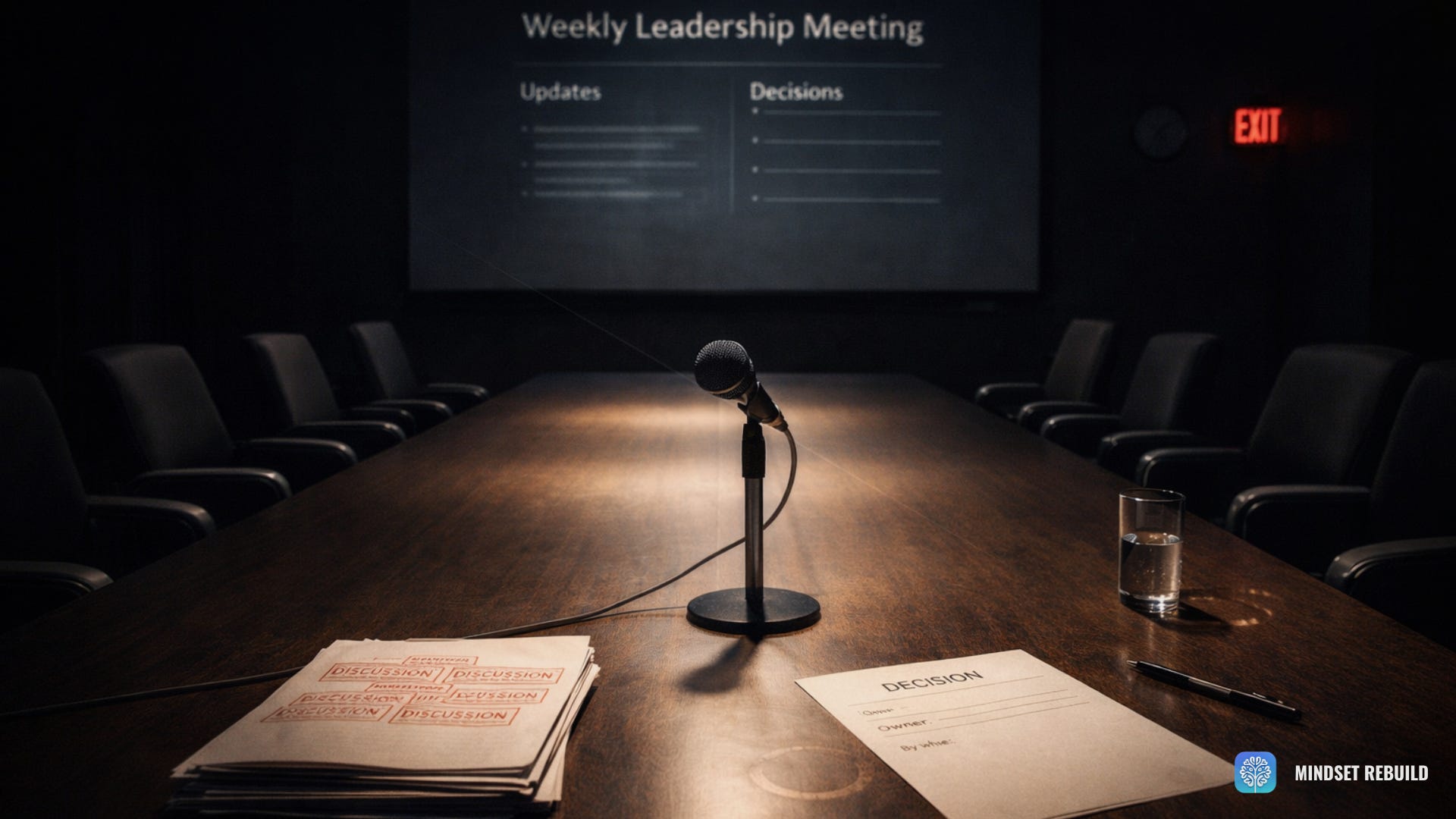
If your weekly leadership meeting runs two hours and ends with zero decisions, you are not collaborating; you are performing.
Let me guess how it goes.
You’ve got the weekly leadership meeting on the calendar like a sacred ritual. Two hours. Same people. Same Zoom link. Same conference room chair that squeaks at the exact moment someone says, “We should probably revisit this.”
Everyone shows up prepared-ish.
Someone has updates. Someone has a spreadsheet. Someone has a slide that looks like it was built at 11:58 PM.
You talk. You debate. You “align.” You nod like adults.
And then the meeting ends with the same outcomes you started with:
No call made.
No owner named.
No trade-off written.
No decision closed.
Just a vague sense that you did something important because it took two hours and involved eight smart people.
That’s not collaboration.
That’s theatre.
And if you’ve been leading long enough, you can feel the difference in your body.
Real collaboration feels like motion.
Theatre feels like a performance.
The worst part is it’s usually well-intended.
People are trying to be thoughtful. They’re trying to include stakeholders. They’re trying to reduce risk.
But when a leadership meeting becomes the place where decisions go to avoid closure, you’ve built a system that rewards talking and punishes deciding.
And then you wonder why the quarter drifts.
The meeting is where the system reveals itself
Every stuck decision eventually lands in a meeting.
And when the meeting doesn’t close it, you haven’t “bought time.”
You’ve scheduled the next performance.
This is where it all shows up:
The constraint nobody named
The ownership that’s still fuzzy
The shadows you’re still debating
The trade-off that everyone feels but nobody wants to write down
A leadership meeting is basically a pressure test for decision hygiene.
When the hygiene is good, the meeting closes loops.
When the hygiene is bad, the meeting becomes a safe place to rehearse opinions.
And here’s the uncomfortable truth:
Teams learn what you reward.
If your leadership team leaves the room without closing anything, you’re not building alignment.
You’re teaching them that talking is safer than deciding.
Two types of meetings, two very different futures
Most leadership meetings fall into one of these two categories.
Meetings that produce updates
These sound like:
“Let’s keep discussing this.”
“I’ll think about it.”
“Can we revisit next week?”
“Let’s get more data.”
“Let’s take it offline.”
Nothing wrong with updates. Updates matter.
But if your leadership meeting is mostly updates and zero closure, you’ve created a very expensive weekly ritual.
It’s the executive version of treadmill running.
You burn energy. You get sweaty. You go nowhere.
Meetings that produce decisions
These sound like:
“Here’s the constraint.”
“Here’s the trade-off.”
“Here’s the call.”
“Here’s who owns it.”
“Next.”
No drama. No grand speeches. No “alignment vibes.”
Just closure.
Decisions don’t require the meeting to feel good.
They require the meeting to be honest.
Why “urgency” is often a lie
One of my early mentors said something that stuck, because it was annoyingly true:
If it’s genuinely urgent, you’ll make the call in the room.
If you defer it, it wasn’t urgent. It was uncomfortable.
That line has a way of sobering up a leadership team.
Because most deferrals are not about time.
They’re about discomfort.
Discomfort with trade-offs.
Discomfort with conflict.
Discomfort with being wrong.
Discomfort with being the name attached to the outcome.
So the group calls the decision “complex” when the real issue is that nobody wants to own the blast radius.
That’s what turns leadership meetings into theatre.
Not incompetence. Not malice.
Avoidance.
The three reasons your meeting keeps producing zero decisions
When a meeting ends with no decisions, it’s usually because at least one of these is missing.
1) The constraint isn’t named
If you can’t state the constraint in one sentence, you’re not solving the same problem.
You’re all solving different limits at the same time.
One person is optimizing for speed.
Another is optimizing for budget.
Another is optimizing for optics.
Another is optimizing for “not getting blamed.”
So the discussion never converges.
It just keeps circling.
A named constraint forces convergence.
“One team, two priorities. Pick one.”
“Budget is capped at $30K.”
“This must ship by March 1st.”
“This customer churn risk is real.”
You do not need perfect constraints.
You need shared constraints.
2) Ownership is fuzzy
If nobody can answer “who owns the call?” in five seconds, you’ve built a meeting that can’t close.
Because a meeting doesn’t make decisions.
A decider makes decisions.
Meetings can inform, debate, and sharpen.
But closure needs ownership.
If the “owner” is a committee, your decision will live forever.
Committees don’t close.
Committees keep things alive.
3) The trade-off is not written down
This is the quiet killer.
If the trade-off lives only in conversation, it resets every week.
Different people remember different versions.
Different people interpret the “direction” differently.
Different people keep lobbying in private because nothing is actually closed.
So the decision reopens.
Again.
And again.
Writing the trade-off down is what turns a discussion into a committed choice.
Option A costs X and delivers Y by Z.
Option B costs A and delivers B by C.
Not a deck. Not a manifesto.
A few sentences.
Just enough to make the choice real.
The “Theatre Loop” that keeps you trapped
Once you see it, you’ll notice it everywhere.
Decision is uncomfortable
Meeting happens
People talk around the discomfort
Everyone leaves “aligned” but nothing is closed
The decision remains open
Work slows downstream
Pressure rises
Next week’s meeting becomes the place to perform concern again
Repeat
This loop has a predictable side effect:
People start bringing more material into the meeting to justify why they can’t decide.
More data. More stakeholders. More analysis.
Not because it’s needed.
Because it provides cover.
The meeting becomes a stage where nobody has to be the villain who closes the loop.
And meanwhile, your organization learns that closure is optional.
The fix: Install a “Decision Close” moment inside the meeting
I’m not asking you to blow up your meeting cadence.
I’m asking you to change the output expectation.
The meeting is not “successful” because everyone spoke.
The meeting is successful because it closes something.
Here’s a simple way to do it.
Step 1: Put “Decision Close” as a standing agenda item
Not “decisions” in general. That becomes vague.
Make it specific:
Decision Close (15 minutes)
That’s the segment where the team must close at least one call.
If you close nothing, the meeting failed.
That may sound harsh.
It’s also accurate.
Step 2: For any decision discussed, force the three lines on the screen
Every time a decision comes up, someone (not you, ideally) writes:
Constraint:
Owner:
Trade-off:
If you can’t fill those lines, stop discussing.
You’re debating fog.
Debating fog feels productive. It isn’t.
Step 3: End with a Decision Memo, not a vague recap
Before the meeting ends, you should have a written record of:
What was decided
Who owns it
By when
What trade-off was accepted
If you don’t have that, your meeting is just a weekly content creation session.
And you already have enough content.
A quick story: the simplest meeting change that saved weeks
I worked with a leadership team that had the classic complaint:
“We have too many meetings.”
That was true.
But the deeper issue was that their meetings didn’t close loops.
So decisions kept reappearing.
They weren’t having “too many meetings.”
They were having the same meeting repeatedly.
We made one change:
At the end of each meeting, they had to close one decision in writing.
One.
Not ten. Not “transform the org.” One real call.
The first week it felt awkward. People squirmed. Someone tried to punt.
The second week it got easier.
By week three, something interesting happened:
The team started doing the work before the meeting to be ready to close.
They stopped showing up with vague updates.
They showed up with options, trade-offs, and a recommended call.
Because now they knew the room was not a stage.
It was a place where decisions landed.
Once that norm changed, the meeting got shorter on its own.
Not because they got better at timeboxing.
Because they stopped rehearsing.
A simple test: was the meeting urgent, or just uncomfortable?
Here’s a question I love because it makes people laugh and then get quiet.
If the decision was truly urgent, why didn’t you decide in the room?
If the answer is “we need more time,” ask:
Time for what?
Time to gather data? Great. Name exactly what data and by when.
Time to consult stakeholders? Great. Name who and by when.
Time to reflect? Fine. Name who owns the reflection and when they’ll close.
But if “more time” is just code for “I don’t want to own the downside,” call it what it is.
Discomfort.
Discomfort is not a reason to defer.
It’s a reason to clarify the trade-off and close.
Meetings aren’t the problem. They’re the system.
Meetings are just a mirror.
They show you what your leadership system rewards.
If your meetings consistently end with no decisions, your system rewards:
caution
deferral
ambiguity
safety-through-talk
And your org learns to optimize for that.
If you want a team that moves, you need meetings that close.
Not because you’re impatient.
Because drift is expensive.
The question
What decision is your team discussing that should have been made two meetings ago?
You already know which one it is.
It’s the one that makes you sigh when it shows up on the agenda.
It’s the one that keeps returning like a bad sequel.
That decision is not stuck because it’s hard.
It’s stuck because your system is allowing it to stay open.
If you can’t get clear answers after trying, that’s when having someone outside the team helps.
I run a 90-minute working session that surfaces the real constraint, assigns clear ownership, and produces a written Decision Memo within 48 hours to keep it closed.
I take 2 Sprints per week.
If you’ve got a decision that’s been stuck for 3+ weeks, DM me.