


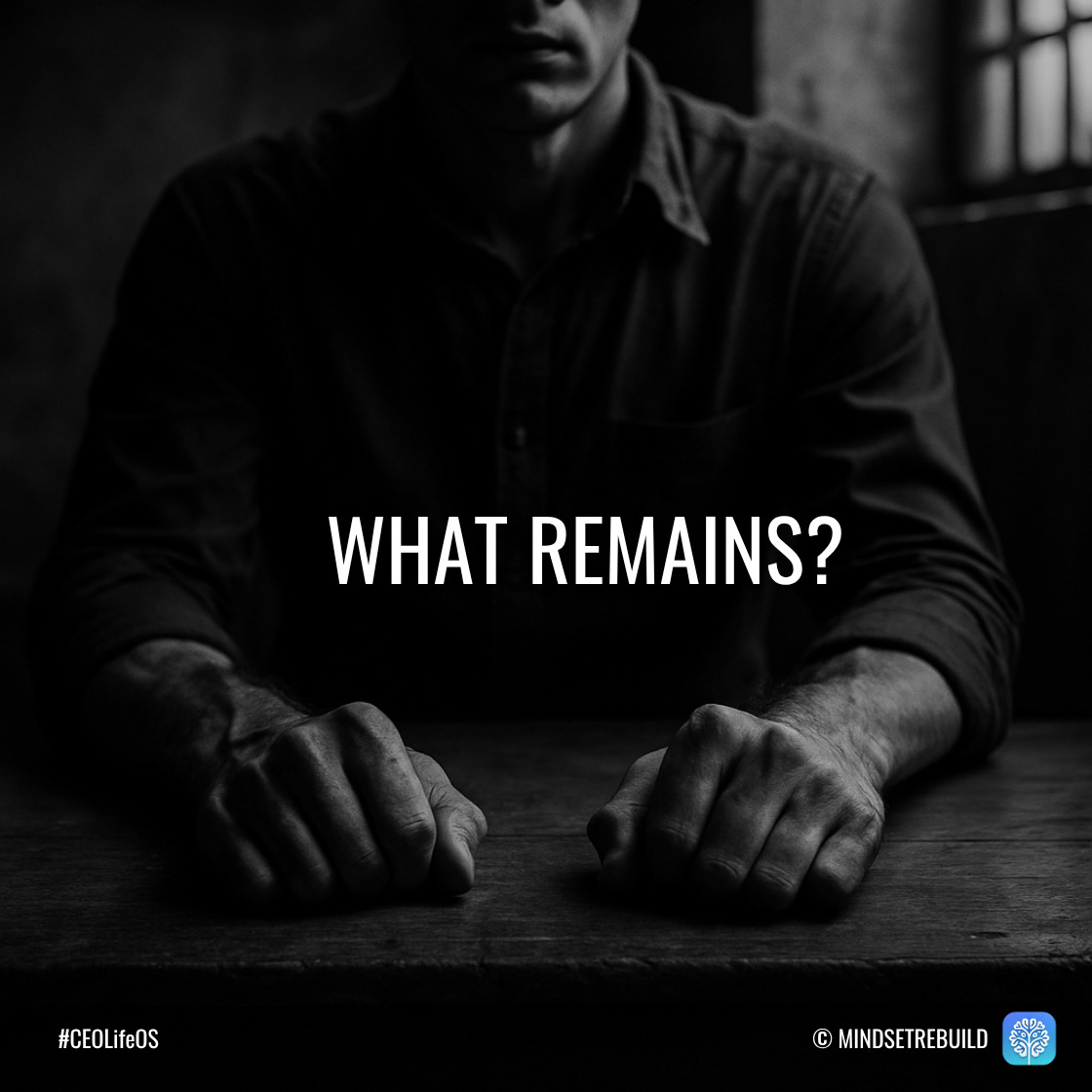
🔥 The Moment Everything Is Taken
When Viktor Frankl arrived at Auschwitz, he lost everything that told the world who he was.
His title: gone.
His profession: erased.
His name: replaced with a number—119104.
The coat on his back, the manuscript he’d sewn into its lining, the theory he’d spent years building—burned within hours.
But something strange happened.
He didn’t fall apart.
He got to work.
Not because he had a plan. But because he had a self—one not defined by credentials, but by conviction.
This wasn’t ego. It was his essence.
In a system designed to annihilate identity, Frankl discovered the one thing that couldn’t be confiscated:
The power to choose your response and rebuild meaning from the inside out.
It wasn’t motivational fluff. It was operational clarity, and it became the root code of a rebuilt self.
Read my full deep-dive article on Viktor Frankl here: 👉 The Quiet Resistance
💥 Section 1: When Control Dies, Ownership Begins
Let’s get something straight:
Frankl wasn’t an optimist.
He didn’t pretend things were fine.
He didn’t chant affirmations in a death camp.
He stared directly at reality—starvation, forced labor, family lost to gas chambers—and made a different decision:
“They’ve taken everything… so I’ll decide what remains.”
In modern terms, this is agency in a state of collapse.
It’s not about avoiding pain—it’s about not outsourcing your power when pain arrives.
You don’t have to control everything to be a leader.
You only have to own your stance toward it.
Frankl’s framework shattered two modern illusions:
That power depends on position.
That identity depends on validation.
Both are comforting lies until life strips them away.
🧭 Section 2: The Collapse Is the Test of the Code
Most entrepreneurs and creators operate under fragile scripts:
• “I am what I produce.”
• “I am how I’m perceived.”
• “I am what I control.”
But what happens when those break?
What if your product flops?
What if your audience ghosts you?
What if your plan gets blindsided by a life event no strategy could anticipate?
Frankl’s story offers this correction:
You are not what happens to you. You are what you choose to stand for in the middle of it.
This is not semantics.
This is the moment when the CEO Life OS begins to function for real.
Because systems aren’t tested in a comfortable environment.
They’re fully exposed in times of collapse.
The moment everything falls apart is the moment most people retreat.
But it’s also the moment where true identity gets forged.
🔧 Section 3: How Frankl Rewired Power Without Control
Frankl found three levers—each invisible, each unbreakable:
1. Responsibility > Reaction
“Between stimulus and response, there is a space. In that space is our power to choose our response.”
Frankl saw men give up and die the moment they lost that space.
He also saw others—sick, starving, hopeless—who still chose to bury another man with dignity.
It wasn’t about strength.
It was about reclaiming authorship over the next act.
Modern OS Upgrade:
→ Create buffer space. Don’t react. Decide.
2. Values > Validation
Frankl’s manuscript was burned. His work was erased. But he rebuilt it—in his mind, on scraps, in hiding.
Why?
Because the work didn’t depend on applause.
It depended on his commitment to it.
If you only build when others are watching, you’ll collapse when they leave.
Modern OS Upgrade:
→ Recommit to your values when no one is clapping.
That’s where real credibility is built.
3. Meaning > Morale
Frankl watched morale collapse in men who predicted they’d be freed by a certain date—and weren’t.
He wrote that people didn’t just die from disease.
They died from disappointment when their timeline failed.
But those who lived for meaning—not schedules—held on longer.
Modern OS Upgrade:
→ Make your mission independent of the calendar.
Let timelines serve your purpose, not replace it.
