


Welcome to this week’s special complimentary edition of Mindset Rebuild’s CEO Life OS Premium newsletter—where bold history meets practical transformation.
Each week, we dive deep into the life of a misunderstood trailblazer to uncover the mindset, strategy, and resilience that rewired the world. So you can build yours.
Deep thinking. Real leadership. No fluff.
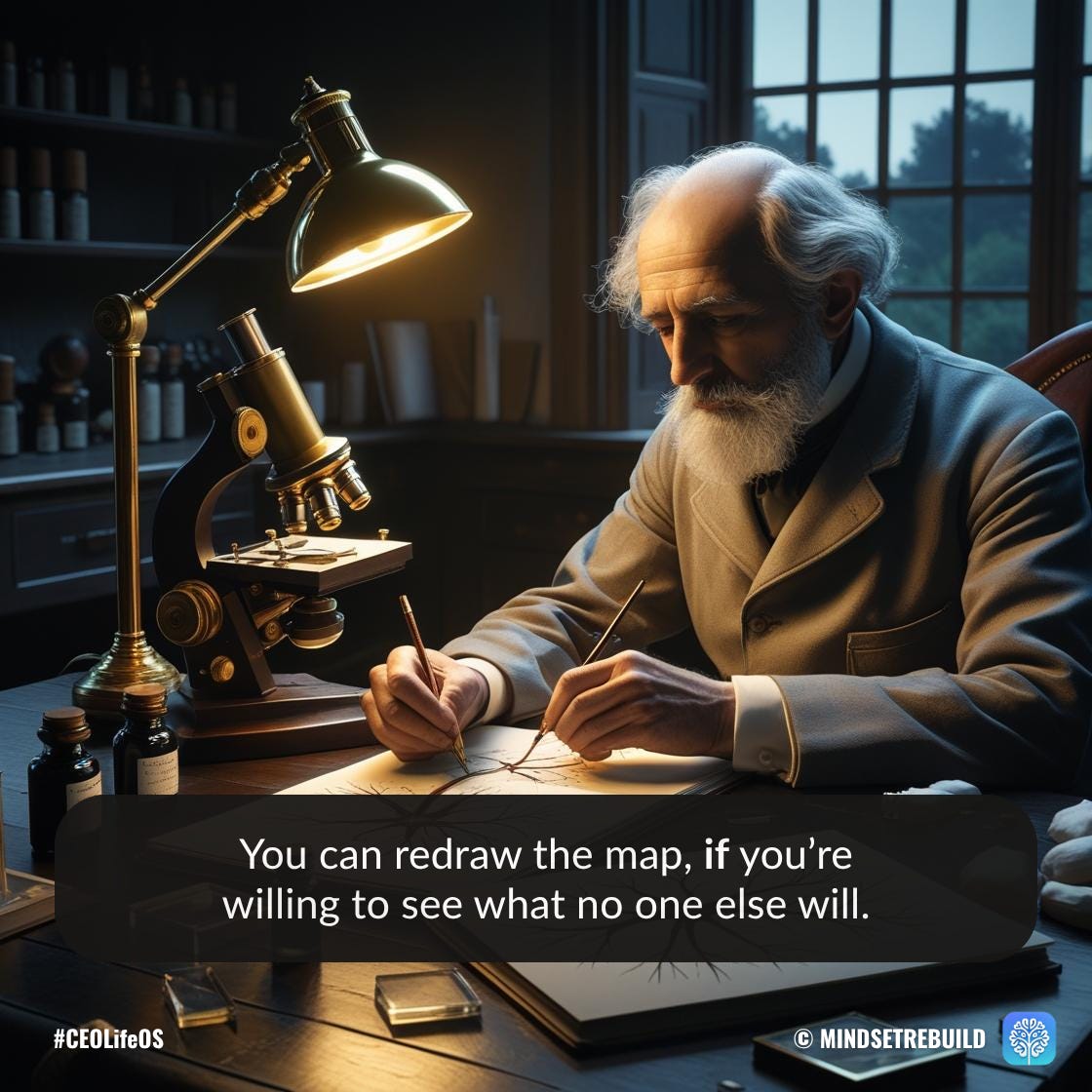
They told him the brain was one seamless web.
He saw forests of separate trees — and refused to look away.
A Brush, a Microscope, and a Rebellion Against the Obvious
In the autumn of 1888, in a cramped laboratory at the University of Zaragoza, Santiago Ramón y Cajal leaned over a brass microscope, his left hand adjusting the focus while his right sketched what he saw.
The faint scent of alcohol and carbolic acid hung in the air, the by-products of his daily battle to preserve tissue samples before they decayed. On the slide before him was a thin slice of bird brain, stained with silver nitrate, a tricky technique invented by the Italian scientist Camillo Golgi.
Under Cajal’s careful eye, the black-stained nerve cells revealed something extraordinary: instead of a continuous mesh, they appeared as distinct, individual units.
This was not what the textbooks said.
For decades, European neuroscience had been dominated by the reticular theory, the idea that the nervous system formed a single, unbroken network. Golgi himself was its most celebrated defender, his silver staining technique praised as a breakthrough that seemed to support the theory.
But here, in an underfunded Spanish lab far from the scientific capitals of Paris, Berlin, or London, Cajal saw something else — branching structures that ended cleanly, not blending into a continuous web.
Spain, at that moment, was not the place to launch a scientific revolution. The country was still reeling from political instability and lagged behind the rest of Europe in research infrastructure.
Cajal’s own career had been anything but smooth. As a child in the rural village of Petilla de Aragón, he’d been more interested in painting and mischief than schoolwork, once dismantling his father’s medical instruments to build makeshift toys.
His father, a provincial anatomy teacher, pushed him toward medicine, but Cajal’s artistic eye would become his greatest scientific asset. Where others saw indistinct shadows under the microscope, he saw shapes, boundaries, and patterns, and he could render them with exacting clarity.
The silver stain was notoriously temperamental, producing uneven results that many researchers dismissed as unreliable. Cajal, however, refined the method to bring out unprecedented detail. In his drawings, neurons emerged like living trees, with delicate dendritic branches and long axons stretching toward other cells.
It was in these images that his central claim took shape: the nervous system was not one continuous structure, but a collection of individual cells communicating across small gaps — what we now call synapses.
Challenging the reticular theory was more than an academic disagreement. It meant confronting a hierarchy of eminent European scientists who controlled the journals, conferences, and reputations of the field.
At first, Cajal’s work was ignored, his findings dismissed as artifacts of staining error or provincial amateurism. Yet he persisted, driven not by institutional validation but by what his own eyes had seen.
In that small lab in Zaragoza, the tension between tradition and discovery was tangible. Men with international influence supported the prevailing theory, while Cajal was a young, relatively unknown Spaniard without the advantage of Parisian salons or Berlin lecture halls.
Still, he sketched, refined, and documented. Each page of his notebook was both evidence and declaration — a refusal to accept the accepted map of reality.
History would later recognize these sketches as the foundation of the neuron doctrine, one of the cornerstones of modern neuroscience.
But in 1888, they were simply the work of a man willing to stake his reputation on what he saw, even if the rest of the world refused to look.
Context – Spain’s Outsider in a Europe of Giants
When Santiago Ramón y Cajal began his career in the late 19th century, Spain was not a scientific superpower.
Decades of political instability, economic stagnation, and the lingering shadow of imperial decline had left the country isolated from the modern research networks flourishing in France, Germany, and Britain.
While European capitals invested in well-equipped laboratories and nurtured scientific academies, Spain’s research infrastructure was thin, its universities underfunded, and its scholars often disconnected from international debate.
Cajal was born in 1852 in Petilla de Aragón, a small, rugged village in northern Spain’s Navarre region — so remote that his birth was not even registered in a timely fashion.
His father, Justo Ramón, was a provincial surgeon who rose to become a professor of anatomy, and he believed fiercely in the transformative power of education. But Santiago was not the model pupil.
Restless and prone to mischief, he spent more time drawing and daydreaming than following instructions, a habit that earned him frequent punishment.
Later, he would admit that his rebellious streak was less a rejection of learning than a refusal to learn passively.
The Spain of Cajal’s youth was still mired in the aftermath of the Carlist Wars, with deep political rifts between conservatives and liberals shaping public life.
These divisions extended into academia, where outdated curricula clung stubbornly to tradition. In medicine and biology, Spanish institutions leaned heavily on French influences but lacked the resources and laboratory culture that characterized Paris, Berlin, or Turin.
For an ambitious scientist, the typical path to recognition involved leaving Spain altogether.
Cajal’s choice to stay was both pragmatic and principled. After training in medicine at the University of Zaragoza, he served as a military doctor in Cuba during Spain’s colonial conflicts.
Contracting malaria nearly killed him, but it also ended his military career and returned him to civilian life with a sharpened sense of urgency. By the early 1880s, he was a professor of anatomy, working in modest conditions, often building his laboratory equipment from scrap materials.
In Europe’s leading neuroscience circles, one theory reigned supreme: the reticular theory, championed by figures such as Joseph von Gerlach and later refined by Camillo Golgi. It held that the nervous system was a single, continuous network — a syncytium — through which signals flowed without interruption.
The theory fit neatly with the limitations of the microscopes and staining methods of the time, which rendered nerve tissue as an indistinct tangle of fibers. Golgi’s silver nitrate stain, developed in 1873, was hailed as a breakthrough, but even its creator interpreted its images through the lens of continuity, not individuality.
This intellectual climate left little room for dissent. The leading journals and conferences were dominated by scientists in Germany, Italy, and France, and their consensus carried enormous weight.
For a Spanish anatomist working far from these hubs, proposing an alternative was not simply a matter of publishing a paper — it was a challenge to the authority of an entire network of gatekeepers.
Cajal’s advantage, ironically, came from his outsider status. His early artistic training had honed a visual sensitivity uncommon among his peers, allowing him to detect patterns and boundaries that others overlooked.
In a discipline where interpretation of visual data was everything, this skill gave him the confidence to trust his own eyes over prevailing dogma.
Still, the barriers were real.
Scientific meetings were expensive to attend, and travel from Zaragoza to Berlin or Paris required both funding and connections he did not initially have.
Early on, many of his Spanish colleagues were hesitant to champion his work abroad, wary of backing a view that Europe’s elite could dismiss. Even so, Cajal persisted, methodically refining Golgi’s staining technique to produce cleaner, more consistent images.
The neurons that emerged under his lens had clear borders and distinct shapes — not the continuous mesh the reticular theory predicted.
The political and cultural backdrop mattered here. Spain’s intellectual isolation mirrored Cajal’s personal one: both were on the margins of European modernity, yet both had a chance to redefine their place by refusing to conform.
In this way, Cajal’s scientific defiance became a microcosm of a broader truth — that transformative breakthroughs often come from those working just outside the center of power, where the pressure to conform is weaker but the cost of defiance is higher.
By the time he began sharing his neuron drawings in the late 1880s, Cajal had already learned an essential lesson — not just about science, but about life and leadership: credibility built inside the system can be fragile, but credibility built on truth observed firsthand is far harder to erase.
Drawing the Lines Others Couldn’t See
By the late 1880s, Cajal’s career was poised to shift from quiet provincial work to a direct challenge against Europe’s most entrenched scientific belief.
This shift would unfold through a series of decisive breakthroughs, confrontations, and relentless advocacy.
1. Early Struggles and a Turning Point
By this point, Santiago Ramón y Cajal was teaching anatomy at the University of Barcelona, moving between lecture halls and a small, improvised laboratory where his equipment was often self-built.
His early career had been marked by hardship.
The years as a military doctor in Cuba had left him physically weakened — malaria nearly claimed his life — but also fiercely determined to make his mark in science.
The Spain he returned to was scientifically insular, with few opportunities for an ambitious researcher to gain access to the cutting-edge techniques circulating in Paris, Berlin, or Turin.
The turning point came in 1887 when Luis Simarro, a well-connected Spanish neurologist and one of the few in Spain who corresponded regularly with European laboratories, introduced Cajal to Camillo Golgi’s “black reaction” — a silver nitrate staining method that revealed nerve tissue in stark contrast against a yellowish background.
The technique was notoriously temperamental: it sometimes stained only a few cells in a sample, other times none at all. Most scientists saw it as unreliable.
Cajal saw the possibility.
Drawing on his background as an artist, he approached the stain like a painter learning the properties of a new pigment. He experimented with variables — tissue age, immersion times, solution strengths — until he could consistently produce images of extraordinary clarity.
Under his microscope, neurons appeared not as a seamless network but as distinct, bounded entities with branching dendrites and axons stretching outward.
2. The Breakthrough
Cajal’s observations directly contradicted the dominant reticular theory, the idea — championed by Golgi and deeply entrenched in European neuroscience — that the nervous system formed a single, continuous web. In the brains of developing birds, he saw neurons terminating cleanly, not blending into other cells.
This was more than a technical distinction; it suggested that the brain was made of discrete units — neurons — that communicated across small spaces, later known as synapses.
To capture what he saw, Cajal relied on the precision of his hand-drawn illustrations. Photography of the time could not achieve the necessary resolution, so his drawings became scientific evidence in themselves.
Far from artistic embellishment, they were meticulous records of branching patterns, cell bodies, and directional flows — the architecture of thought made visible.
In 1889, Cajal brought his slides and drawings to the Congress of the German Anatomical Society in Berlin. Speaking in careful, imperfect German, he presented to a room of anatomists steeped in the reticular model.
The skepticism was palpable — but as his slides were passed from hand to hand, silence replaced resistance. Wilhelm Waldeyer, a respected German anatomist, would soon champion Cajal’s findings, coining the term neuron in 1891 and giving the new theory a name: the neuron doctrine.
Waldeyer’s endorsement helped move Cajal from the margins into serious scientific debate.
If this story has shown you the power of shaping your own inner architecture, imagine what a steady stream of insights like this could do for the way you lead — from the inside out.
3. The Relentless Campaign
The years that followed were a sustained effort to prove, refine, and defend the neuron doctrine.
Cajal published extensively, with his landmark work Textura del sistema nervioso del hombre y de los vertebrados (1899) compiling years of observations across species and developmental stages.
He demonstrated that neuron structures were consistent across mammals, birds, and other vertebrates, reinforcing the idea that this was a universal principle of nervous system organization.
Travelling to scientific meetings across Europe, Cajal often carried his own slides, knowing that seeing was believing. He won converts not just through argument but by offering colleagues a direct look through his microscope.
In 1906, his recognition was cemented when he and Golgi were jointly awarded the Nobel Prize in Physiology or Medicine. The award was historic — and awkward.
In his Nobel lecture, Golgi reiterated his belief in the reticular theory; Cajal, speaking after him, firmly defended the neuron doctrine, each man embodying a different vision of the nervous system’s architecture.
By this time, advances in microscopy and the work of younger researchers had revealed synaptic junctions, vindicating Cajal’s position. His later research explored neural plasticity — the brain’s ability to change its connections — decades before it became a central topic in neuroscience.
Cajal’s rise from a provincial Spanish lab to the Nobel stage was more than a personal triumph. It was a demonstration of what happens when patient, disciplined observation collides with entrenched orthodoxy — and wins.
He had redrawn the map of the nervous system, cell by cell, line by line, until the rest of the scientific world could no longer deny what he had seen from the very beginning.
The CEO Life OS Lesson from a Microscope Rebel
In the final decades of his life, Santiago Ramón y Cajal became not just a scientist, but a mentor and a philosopher of learning.
His laboratory in Madrid was modest compared to the grand institutions of Berlin or Paris, yet it produced a generation of Spanish neuroscientists who would carry his methods forward.
By the time he died in 1934, the neuron doctrine he had fought to establish was no longer controversial — it was the bedrock of modern neuroscience.
Cajal’s guiding belief, stated often in his later writings, was disarmingly radical for its time:
“Every man can, if he so desires, become the sculptor of his own brain.”
This was not a metaphor in his mind. He meant it in the literal, anatomical sense — that the brain’s physical structure could be altered through effort, learning, and discipline.
At a time when most scientists believed the nervous system was fixed in adulthood, he was already describing what we now call neuroplasticity.
That conviction had grown directly from his own experience. He had reshaped his life from an undisciplined boy in rural Aragón into a Nobel Prize–winning scientist, teaching himself the techniques, languages, and methods he needed along the way.
The neuron doctrine itself was born of that same principle — the willingness to ignore the “continuous web” everyone else insisted was there, and instead map reality as he observed it, piece by piece.
His career also revealed something about the anatomy of progress. The entrenched reticular theory was not wrong because its advocates were foolish; it was bad because their framework limited what they could see.
Cajal’s advantage was not superior intelligence alone, but the humility and patience to let the evidence redraw his mental map, no matter how many times it contradicted established truth.
This is where his story aligns with the more profound lesson for modern leadership and personal growth.
Your mindset — your personal operating system — is built like a neural network. Each connection you form, each association you strengthen, is a choice.
Over time, those choices become your internal architecture. And like Cajal’s neurons, they are not fused into an unchangeable whole; they can be pruned, rewired, and expanded.
Cajal’s life stands as a reminder that genuine breakthroughs, whether in science or self-leadership, come from the courage to perceive clearly and the discipline to refine what you’ve perceived.
It is easy to inherit the mental maps handed down by authority; it is harder to test them against lived experience, to redraw them when they fail.
By rejecting the “continuous web” everyone else accepted, Cajal transformed the world’s understanding of the mind. By challenging the outdated patterns in your thinking, you can do the same for your life.
The frontier, then as now, isn’t just out there in the world — it’s part of the architecture of your own brain, waiting for you to see it clearly enough to change it.

Final Reflection – Redrawing the Maps That Run Your Life
Cajal’s greatest gift to science was not just the neuron doctrine, but the mindset behind it — the willingness to trust direct observation over inherited certainty.
That same mindset is just as critical outside the laboratory, in leadership, creativity, and personal growth.
Every one of us lives with a mental “reticular theory” of sorts — a model of how things work that we’ve absorbed from authority, culture, and habit. These models can feel as immutable as natural law, especially when reinforced by those around us.
But as Cajal’s work shows, the most entrenched maps can be wrong, not because their creators were malicious, but because they couldn’t yet see the gaps in their vision.
The parallel to modern life is direct. Your mental operating system — what the CEO Life OS calls your “internal architecture” — is built through repeated thoughts, choices, and actions. It is a network, but it’s not fixed. You can rewire it.
The neurons Cajal drew were separate, dynamic units, capable of forming new connections and pruning old ones. So are your patterns of thinking, your reflexes in decision-making, your assumptions about what is possible.
Rewiring isn’t easy. It demands what Cajal himself demonstrated for decades: disciplined observation, iteration, and a refusal to abandon what you’ve seen simply because it’s unpopular.
The world rewards conformity in the short term; it rewards clarity and courage over the long term.
If you’re ready to put that into practice with guidance tailored to your highest-stakes decisions, I work alongside a small number of creators and leaders each quarter through my Strategic Co-Pilot Retainer. It’s where we dismantle the maps that hold you back, build new ones that fit your vision, and act with the kind of clarity that changes everything.
If you want to lead with clarity, you must learn to test the maps you’ve been given. Ask where the evidence ends and where assumptions begin.
Recognize the “continuous webs” in your thinking — those unquestioned frameworks that blend everything into something neat but misleading. Then, with the same precision Cajal used at his microscope, start tracing the boundaries yourself.
In this way, Cajal’s legacy is not only a scientific truth but a personal challenge: to be the sculptor of your mind.
To treat your internal network not as a finished cathedral, but as an evolving structure — one you can strengthen, redesign, and expand with intent.
The transformation isn’t instant, but neither is it hypothetical. Each time you choose to redraw a line rather than accept the one already sketched for you, you build a brain — and a life — that is truly your own.
Stay curious, keep rewiring, and lead your life like you’re mapping new territory.
Warren