


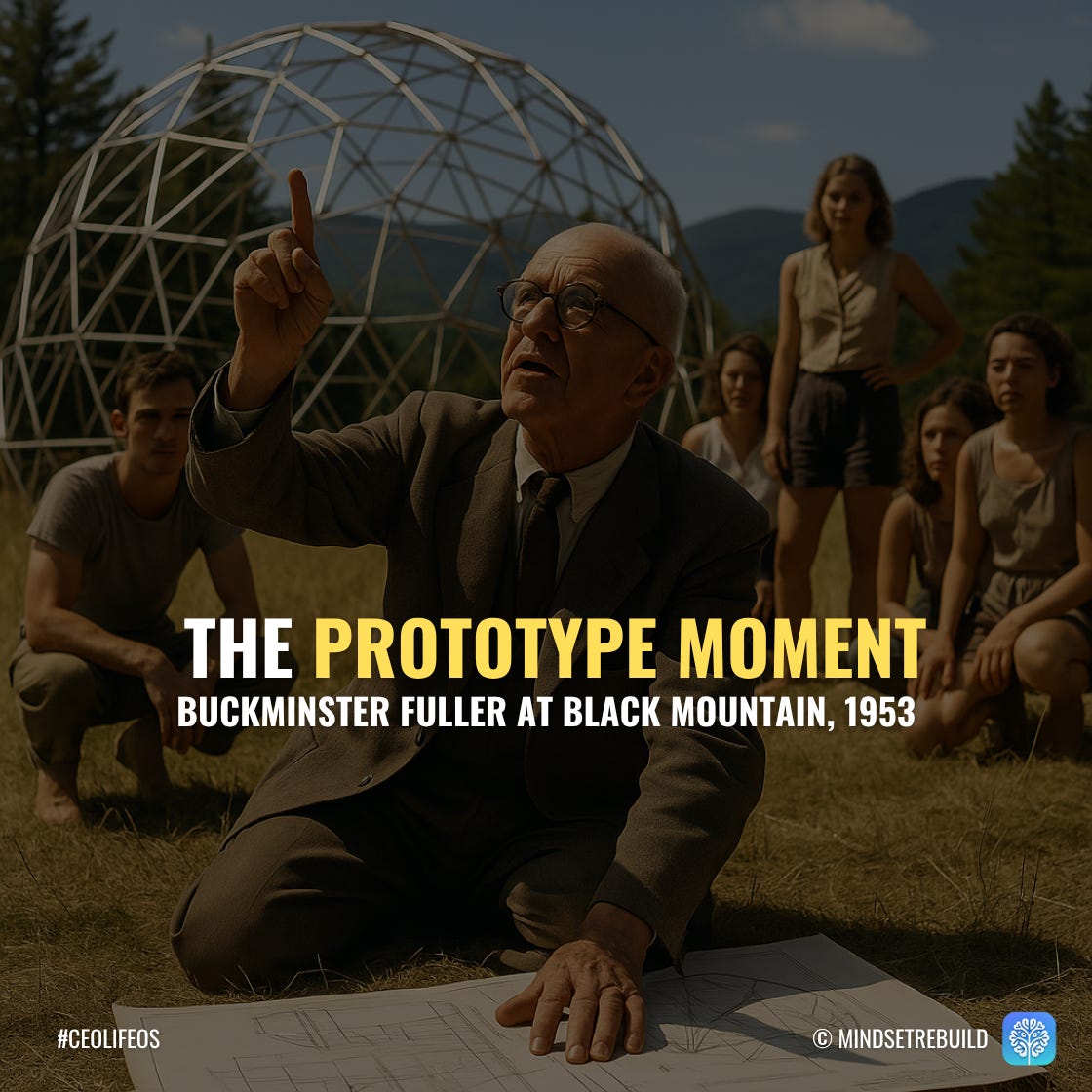
Buckminster Fuller was dismissed as a dreamer, mocked as a crank, and ignored by every major institution.
But today, Silicon Valley studies his blueprints. NASA builds on its math. And his design philosophy may be the last roadmap we have for a livable future.
Introduction
In the summer of 1948, a strange gathering took place in a North Carolina field.
Artists, dancers, and disillusioned architects stood barefoot in the grass, assembling rods and cables under the sharp sun. At the center knelt an aging man in a worn suit, sketching geometric equations in the dirt like some exiled prophet from a future that hadn’t arrived yet.
His name was Buckminster Fuller. The structure they built — a shimmering half-sphere of triangles — appeared absurd to most. Light, hollow, and impractical.
And yet, it stood.
That moment at Black Mountain College didn’t make headlines. But it changed the course of design history.
Fuller wasn’t just building a dome; he was constructing a thesis: that the systems we live by—our homes, our tools, our economies—could be redesigned for resilience rather than profit—clarity, not conformity.
He didn’t fit his time. But he may have built for ours.
I. The Dome at the End of the World
Black Mountain College, North Carolina – Summer 1948
The field was uneven, more brush than grass, and the sun pressed down hard on the ridges of the Blue Ridge Mountains.
Buckminster Fuller stood at the edge of the clearing, scribbling furiously in chalk across a long blackboard propped against the side of a makeshift studio.
A small group of barefoot students and avant-garde faculty—painters, composers, dancers—surrounded him, watching in puzzled silence as he mapped out strange geometric arcs and force diagrams like some rogue physicist who had wandered into the wrong campus.
They were at Black Mountain College, an experimental school known more for nurturing abstract expressionists and poets than for engineering marvels. But this summer workshop had been Fuller’s idea, and he had come with a plan. Not a lesson plan, a life plan. He wasn’t here to teach theory. He was here to build a prototype for human survival.
That prototype would become the first large-scale test of his geodesic dome.
The dome had no precedent in architecture. It wasn’t classical. It wasn’t modernist.
It was mathematical, based on the icosahedron and the principles of tensegrity, a word Fuller would later help popularize to describe how structures could maintain integrity by balancing tension and compression.
No heavy columns. No wasted materials. Just pure geometry, distributing stress evenly across a lattice of triangles.
The materials were basic: thin steel rods, wire, and canvas.
The math was not.
The first few attempts collapsed under their weight or tilted at awkward angles. One model fell apart mid-construction, sending pieces skittering across the field while students stifled laughter.
But Fuller didn’t flinch. He had already been called a failure too many times to care. Instead, he sketched a new diagram and started over.
Eventually, with rods cut to precise lengths and joined at angular hubs, the frame clicked into place. Then, something startling happened: the structure stood.
Light, airy, and impossibly stable, it had no internal support beams, no foundation, and yet it held.
As one observer recalled, it looked like it was floating, "as if it had been plucked from the future and dropped into the Carolina woods."
This wasn’t just a stunt.
It marked the first full-scale, walk-in demonstration of Fuller’s theory that the correct geometry could replace brute force. He had shown, before artists and skeptics alike, that one could construct something strong, sheltering, and materially efficient by aligning with nature’s logic.
That same year, Fuller returned to Chicago and filed for U.S. patent No. 2,682,235, awarded in 1954: "Building Construction," describing the geodesic dome. It was the only U.S. patent ever issued for a structural system—not a design or a method, but a fundamental way of organizing space. In time, the dome would become one of the most recognized shapes in the world.
But in 1948, the architectural world dismissed it. Too strange. Too simple. Too idealistic.
Modernist titans like Mies van der Rohe favoured rectangles and concrete. Developers had no use for a building that didn’t require mass labour and endless materials. Even among Fuller's peers, many chalked it up as eccentric folly.
The critics overlooked what the artists at Black Mountain had sensed: that this wasn’t merely a structure—it was a philosophy rendered in steel. Fuller wasn’t trying to impress architects; he was trying to solve a global coordination problem.
By the mid-20th century, the American dream was being poured into suburban grids. Tracts of single-family homes stretched across farmland, requiring energy-intensive infrastructure and relentless consumption.
Military budgets soared. The Cold War accelerated technological development without asking whether the outcomes were humane, let alone sustainable.
In this context, Fuller’s dome wasn’t decorative. It was reactive. It was his answer to a system that seemed designed to collapse under its weight.
Privately, Fuller referred to his approach as "comprehensive anticipatory design science."
It meant thinking about solutions before the crisis. He believed humanity’s survival depended not on politics or protest, but on design: designing structures, tools, and systems that could scale without harm, and that required fewer resources while serving more people.
The dome was proof of concept.
Years later, the U.S. military would test geodesic domes in Antarctica. NASA would use them for lunar habitat research. Environmentalists would turn them into sustainable greenhouses and refugee shelters.
But none of that had happened yet. In the summer of 1948, Fuller was just a failed businessman, a Harvard dropout, a grieving father (he had lost his first daughter to polio in 1922), and a man who had once considered walking into Lake Michigan to end his life.
What stopped him, he said, was a moment of clarity: a "voice" that told him his life belonged not to himself but to humanity.
From that moment on, he refused to work for personal wealth. He rejected corporate offers. He lived frugally and devoted himself to answering one question:
What can one individual do to meaningfully improve the future of all humanity, without killing anyone or destroying anything?
The dome was his first public answer. Built not for applause, but for scale. A quiet rebellion made of rods and triangles, in a college field where no one expected history to change shape.
And while most people forgot the day, a handful of students didn’t.
One of them, Kenneth Snelson, would later collaborate with Fuller on tensegrity sculptures that merged art and physics. Others would carry his ideas into architecture, design, and environmental activism.
They didn’t just remember the dome, they remembered the mindset: design for everyone, waste nothing, and don’t wait for permission.
The world wasn’t ready. But Fuller was already designing what came next.
II. A Man Misaligned with His Century
When Buckminster Fuller stepped into adulthood, the 20th century was already roaring forward on the fumes of industrial expansion.
Born in 1895 in Milton, Massachusetts, into a patrician New England family, Fuller was expected to follow a respectable path: Harvard, business, marriage, civic success.
He flunked out of Harvard. Twice. First for partying too hard, then for “irresponsibility and lack of interest.” The system had no patience for misfits.
By the early 1920s, Fuller had bounced through Navy service in World War I, a stint at meatpacking, and a failed construction company co-founded with his father-in-law. The company had aimed to produce lightweight, low-cost housing using new materials—already a glimpse of Fuller’s later obsessions. But the venture collapsed.
In 1927, jobless and nearly bankrupt, he stood on the shores of Lake Michigan in Chicago, seriously contemplating suicide. His first daughter, Alexandra, had died five years earlier. His second child had just been born. He felt, by his own words, “a complete failure.”
But then came the moment that would define him. He later described it as a kind of cosmic interruption: a flash of internal revelation where he realized that his life didn’t belong to him anymore.
He would treat himself as “Guinea Pig B,” the subject of a lifelong experiment to see what a single human, unaffiliated with any institution, could do to benefit all humanity. He would devote the rest of his life not to personal ambition, but to service through design.
The decision was both radical and strategic.
Fuller understood that the world didn’t need another critic; it needed models. If he could prototype a viable future, others might follow.
But that also meant he would spend decades dismissed as a fringe figure, traveling relentlessly, giving unpaid lectures, crashing on friends’ couches, and scribbling notes that wouldn’t be understood for another generation.
This was the context in which Fuller began to formulate what he later called comprehensive anticipatory design science. The term sounded clunky, but the goal was clear: to solve large-scale human problems using systems thinking, resource efficiency, and nature-inspired design.
He saw that the 20th century’s greatest failure wasn’t technological; it was conceptual. We were still trying to solve global problems with 19th-century thinking.
Politically, the world was digging in its heels. Fascism had fallen, but Stalinism had calcified. The U.S. and USSR were racing for nuclear supremacy, with the first hydrogen bomb tested in 1952.
Domestically, the U.S. was riding a postwar economic boom built on mass production, militarization, and the rapid sprawl of suburbia. The Federal-Aid Highway Act of 1956 would soon slice through cities and natural landscapes alike, paving over both community and ecology.
This was the system Fuller saw coming, and which he rejected.
While planners focused on traffic, and corporations focused on quarterly growth, Fuller zoomed out. He envisioned “Spaceship Earth,” a fragile, finite, integrated system.
He asked why the world’s wealthiest nations couldn’t ensure every human had shelter, energy, education, and access to opportunity, without resorting to war or endless extraction.
This wasn’t hippie idealism.
Fuller kept receipts. He obsessively tracked statistics, created global resource maps, collected technological patents, and published models for how much energy, metal, and manpower it would take to lift the entire human population out of scarcity.
He was an early practitioner of what we now call life-cycle thinking, decades before climate models or sustainability indices existed.
But in his time, his methods were opaque, his language confounding. He invented terms—tensegrity, dymaxion, ephemeralization—that baffled his peers. He spoke in long, winding monologues, delivered in staccato bursts and punctuated with diagrams.
To the mainstream press, he was a curiosity. To corporate leaders, he was a liability. To the military-industrial complex, he was irrelevant—too utopian, too unbiddable.
And yet, he kept moving. He traveled around the world—nearly always by bus or car, rarely by plane—lecturing at universities, sketching on napkins, refining his domes. He refused to take a salary from any employer and lived frugally, at times supported by his wife, Anne Hewlett Fuller, who believed deeply in his mission even as she quietly kept the household afloat. They stayed married for 66 years.
At a time when the prevailing wisdom said “every man for himself,” Fuller insisted that we were all crew members aboard a shared vessel. When America worshipped scale and consumption, he countered with minimalism and restraint. When others asked, “How do we win?” he asked, “How do we make the whole world work for 100% of humanity?”
And when the system ignored him, he just kept building. Not just physical structures, but a worldview—a new operating system for thinking about human potential, one that bypassed gatekeepers and vested interests. It wasn’t just that he misfit his era. It’s that he was working for a different one entirely.
By the end of the 1950s, a few signs of vindication had started to appear. Military engineers adopted geodesic domes for radar installations in the Arctic. The dome at the 1967 Montreal Expo would become a global icon. Younger thinkers in architecture, design, and counterculture began reading Operating Manual for Spaceship Earth, published in 1969, as gospel.
But those moments of recognition were rare. Most of Fuller’s life was spent in the margins—teaching, testing, tweaking his theories in obscurity. He was misaligned not because he was wrong, but because he was early. The system he was designing for hadn’t arrived yet.
That’s the thing about systems thinkers. They don’t fight the now. They prototype the next.
III. Blueprints for a Future That Wasn’t Ready
By the early 1930s, Buckminster Fuller had already committed himself to a lifelong design experiment in service to all of humanity.
But the world still expected its inventors to make money or make war. Fuller did neither. What he offered instead were prototypes—radical artifacts meant to upend the logic of industrial capitalism by proving that efficiency, not excess, was the real key to abundance.
The first of these was the Dymaxion Car. Designed in 1933, it looked like it had been dropped in from the future—long, teardrop-shaped, and impossibly aerodynamic. It seated 11 people, could reach speeds of up to 90 miles per hour, and achieved fuel efficiency of over 30 miles per gallon at a time when the average American car barely managed half that.
Unlike any vehicle before it, the Dymaxion had three wheels and a rear-wheel steering system, allowing it to turn in place within its own length. The name, like much of Fuller’s language, fused function and philosophy: Dynamic maximum tension—his shorthand for doing the most with the least.
It was a dazzling feat of engineering. But it didn’t last. During a demonstration at the 1933 Chicago World’s Fair, one of the prototypes was involved in a fatal crash. A Chicago politician was killed.
While the accident was widely attributed to another car veering into the Dymaxion’s path, public interest collapsed overnight. Fuller’s backers pulled out. The press labeled it a deathtrap. No further units were produced.
The real cause of the Dymaxion’s demise, however, wasn’t mechanical; it was structural. Detroit didn’t want a car that didn’t need Detroit.
Fuller’s design wasn’t just innovative; it threatened the entire supply chain of oil, steel, and standardized production.
It asked a dangerous question: What if better didn’t mean more, but less?
He posed that question again in the 1940s with the Dymaxion House—a lightweight, prefab aluminum structure intended to be mass-produced using aircraft manufacturing methods developed during WWII.
The house, supported by a central mast and tension cables, could be shipped flat, assembled quickly, and function off-grid with its own ventilation and water-recycling systems. It required minimal materials and little labor.
The idea was simple: solve housing scarcity with scalable design, not sprawling construction.
Fuller envisioned it as a solution for returning GIs and postwar housing shortages. The prototype was refined at Beech Aircraft Corporation in Wichita, Kansas, which had spare manufacturing capacity after the war.
Yet despite the excitement, the project stalled. Local governments were unprepared to approve it. The construction industry lobbied against it. Banks wouldn’t finance it. People were intrigued—but uncomfortable. It didn’t look like a house. It didn’t conform.
Only one full-scale Dymaxion House survives today, restored and displayed at the Henry Ford Museum in Michigan. It never reached mass production, not because it failed to function, but because the economic ecosystem around housing refused to shift.
Still, Fuller didn’t relent. If the house and car had proven too alien for mainstream adoption, he would design something no one could ignore: the geodesic dome.
In 1949, he constructed his first successful large-scale dome at Black Mountain College, as chronicled earlier. But in 1954, he received U.S. Patent No. 2,682,235, formally recognizing the geodesic dome as a novel structural system.
That same year, he demonstrated a 49-foot dome at the Milan Triennale exhibition. Its minimal weight, rapid assembly, and remarkable strength drew global attention.
By the late 1950s, the U.S. military took notice. The Marine Corps began using domes as radar enclosures—"radomes"—in harsh climates. The Strategic Air Command deployed them in the Arctic under Operation Dew Line.
The appeal was obvious: domes could be built fast, transported easily, and withstand high wind loads. By 1967, Fuller’s design reached iconic status with the U.S. Pavilion at Expo 67 in Montreal—a massive, 250-foot-diameter dome that stunned visitors and remains one of the most recognizable structures of the 20th century.
But even with this acclaim, the construction industry largely ignored domes for civilian use. Developers saw them as hard to commodify. Builders didn’t understand the math.
And despite their elegance, domes didn’t lend themselves to conventional floor plans or mortgage evaluations. They were more efficient, but efficiency wasn’t the market driver.
Profit was.
Perhaps his most radical and least understood contribution came not in physical form, but as a systems simulation: The World Game.
First proposed in the early 1960s, the World Game was Fuller’s attempt to map global resource flows, human needs, and technological capacities—long before the emergence of digital computing or satellite data.
He believed that with the right data and the right models, humanity could achieve what he called “ephemeralization”: the ability to do more and more with less and less, until we could support all of humanity at a higher standard of living using fewer materials and less destruction.
The idea was inspired partly by his experience working with the U.S. Navy in World War II. He had seen firsthand how vast, global logistics operations could coordinate resources efficiently under a single unified command. What if, he wondered, that same level of coordination could be applied not to war, but to peace?
Fuller proposed that universities become centers for simulation, collaboration, and policy innovation—not just research. He envisioned students not just studying the world, but designing its future in real time, using global data sets to solve for housing, food, energy, and education.
The game had no losers. Only viable or unviable strategies.
Few institutions were ready to implement such an idea. The World Game persisted mostly on the margins—hosted occasionally by progressive universities, toyed with by peace activists and technocrats, but never integrated into real-world policymaking. And yet, today, we use versions of it constantly: climate models, economic simulations, GIS tools, and digital twins that help cities optimize for sustainability. They all trace intellectual ancestry to Fuller’s work.
Each of Fuller’s creations shared the same DNA. They weren’t gadgets or gimmicks. They were designed as systems interventions—pointed responses to inefficient paradigms. His goal was never to build one-off marvels, but to render obsolete the outdated models they sought to replace.
But in a world not yet ready to upgrade its operating system, Fuller’s designs often functioned more as warnings than blueprints.
He was showing us what was possible. We were still asking, Is it profitable?
