


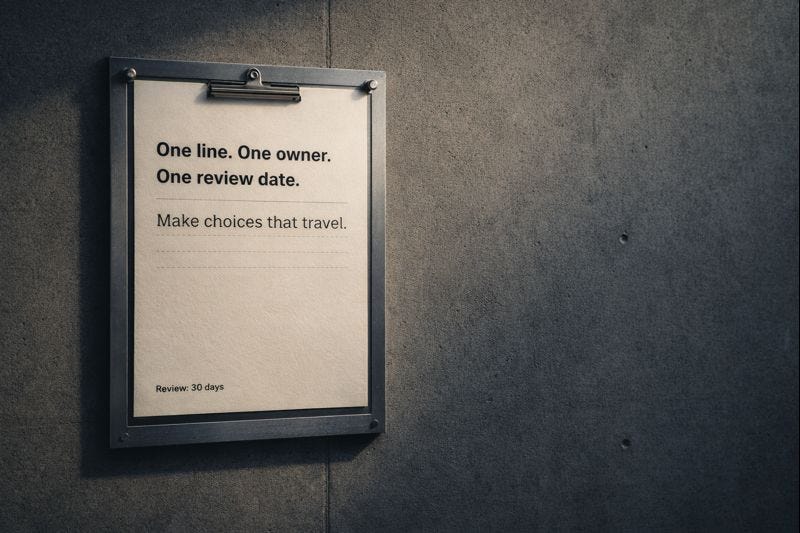
📐 Welcome to this week’s issue of Leadership Architecture from Mindset Rebuild, providing you with design choices that travel without you.
🔒 Premium edition: one operating pattern, a copy-ready Decision Page, and a real example.
🙌 Build one Decision Page you can use this week.
🫶 On the free plan? Upgrade for Wednesday’s build notes + templates.
Some decisions feel solid in the room and vague in the hallway.
No one’s being difficult. The choice doesn’t have a shape people can hold once you’re gone.
I’ve been quietly tracking where this happens in my own work.
The pattern is simple: when a decision lives as an impression, it begs to be re-explained. When it lives as a sentence in a place people trust, it starts to carry itself.
Today, let’s walk around that difference, not as a framework, but more like shining a flashlight on the edges.
A scene with W. Edwards Deming
W. Edwards Deming (1900–1993) spent his life helping teams make work visible.
He was famous for statistical quality control and the Plan-Do-Study-Act (PDSA) cycle, but the quiet move I return to is his insistence on an operational definition; words that tell you exactly what to look for so two people won’t argue about a ghost.
If you say “on time,” Deming would ask, “Which clock?” If you say “done,” he’d ask you to point at what exists when it’s done.
He used this not to police people but to reduce friction.
When a term gets a shared meaning, the team stops debating air and starts looking at the same thing.
That’s the posture I want for our decisions: give them enough definition that they travel.
Walking the edges of a decision
Here’s a short tour I use when a choice keeps slipping through my fingers. Not a template, just questions that help the shape emerge.
Where does this choice live when I’m not around?
If the answer is “in our memory of last Thursday,” that’s the first fix.What would a stranger see if this were ‘done’?
One sentence. No poetry. Something someone can point at.What words are fuzzy?
“Ready,” “on time,” “urgent,” “MVP.” Pick one and give it a Deming-style meaning everyone can agree to in thirty seconds.When will we look again?
A review date lowers the cost of committing now and keeps the choice from calcifying.
The noticing takes less time than a “quick sync” to clear up misunderstandings—and it leaves you with something that can move without you.
A body for the choice (softly spoken)
When a decision needs to travel through a team, I reach for this shape:
Decision: For the next 30 days, we’ll do A (not B) to achieve X.
Owner: one name
‘Ready’ means: three checks someone can see
First look: what will exist in ~7 days
Review: a real date
That “‘ready’ means” line is pure Deming. It’s the operational definition that stops arguments later.
Put this where the work lives—issue, doc, board, wall—so questions can point at something other than your memory.
What I notice: once the page is created, the temperature drops by 1 degree.
People stop lobbying for air and start editing the line.
You adjust a word or the plan. Either way, the conversation is with the choice, not with you.
Deming, lightly applied
A few places this helps fast:
Handoffs: “Ready” often means different things to different people. Write three checks once: e.g., tests pass, change log posted, owner named.
Release notes: “On time” becomes published by 2 p.m. CT on the release day with a link in #announcements.
Inbound requests: “Small” becomes < 2 hours and no schema changes. If it exceeds the definition, it goes in the backlog by default.
Not to be pedantic, but to keep the day from slipping on the same words over and over.
A lighter question for the week
The question I’m carrying:
What single word in this project keeps making us argue with shadows, and how would we define it so it can’t be misunderstood?
When I can’t define it, it tells me I’m early, or I’m foggy, or I’m still carrying two ideas and calling them one. Useful either way.
Sometimes the honest move is to delay the decision and write the question that needs a day.
Other times, the sentence is ready; I’m just avoiding putting someone’s name on it.
Both are signals worth hearing.
