


Welcome to this issue of Clarity Letters from Mindset Rebuild.
If “let’s circle back next week” has shown up more than once lately, you’re not short on meetings; you’re short on decision ownership. This is a quick look at the polite phrases teams use to dodge the call, what that costs in drag and rework, and the simple structure that makes decisions stick.
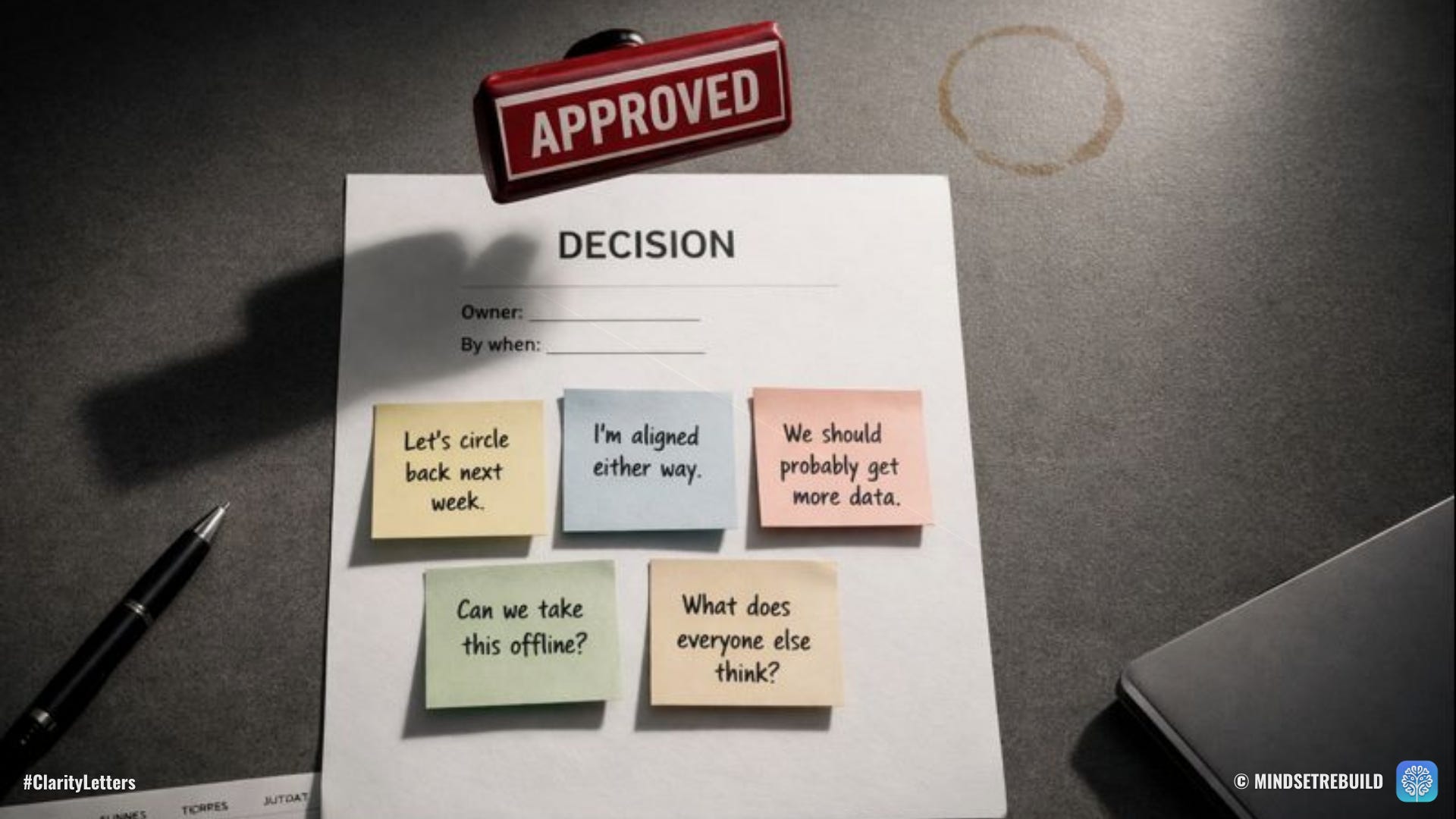
You’ve heard these phrases a thousand times.
Sometimes you’ve even said them.
Not because you’re lazy. Not because you’re clueless. Not because you’re trying to dodge work.
Because in many teams, the meeting isn’t where decisions get made.
It’s where decisions go to hide.
Let’s talk about the little “professional” sentences that show up right when a decision needs oxygen and accountability.
And let’s talk about what they’re really doing to your week.
The meeting where everyone “agreed” and nothing moved
A while back, I sat in on a leadership meeting that felt … normal.
Smart people. Good intentions. Solid prep. No chaos. No yelling. Nobody is being weird.
We were discussing something that should’ve been a simple call: which option to ship, and what to stop doing so the team could actually ship it.
Thirty minutes in, the room sounded like a corporate lullaby:
“Let’s circle back next week.”
“I’m aligned either way.”
“We should probably get more data.”
“Can we take this offline?”
“What does everyone else think?”
Here’s the part that still makes me laugh (in that tired way): everyone was acting like they were being careful.
As if postponing was responsible.
As if neutrality were maturity.
As if one more spreadsheet would finally make the decision painless.
But the truth was sitting right in the middle of the table:
Nobody knew who actually owned the call.
And because nobody owned the call, everyone started speaking in a kind of polite code.
Not malicious code.
Protective code.
If you’ve been in those meetings, you know the feeling. It’s like watching a group of intelligent adults play hot potato with a decision.
Nobody wants to be the person who says, “Here’s what we’re doing.”
Because if they say it out loud, the room might turn and look at them and ask the scariest follow-up question in business:
“Ok. And if it goes wrong, is that on you?”
So instead of deciding, the team performs.
They demonstrate thoughtfulness.
They perform collaboration.
They perform “process.”
And then they walk out with the same reality they walked in with: a live decision still floating around the organization, quietly taxing everyone’s time.
When authority isn’t clear, language becomes a shield
Those phrases aren’t the problem.
They’re the symptom.
They’re what people reach for when the structure is missing.
Because when decision authority isn’t clear, a meeting becomes a social risk environment.
People start optimizing for safety, not speed.
They start choosing words that give them maximum wiggle room later.
That’s what those phrases really are: wiggle room.
Let’s translate them into plain language.
“Let’s circle back next week.”
Translation: I’m hoping time solves this for me. Or I’m hoping someone else makes it messy enough that I can react instead of choosing.
“I’m aligned either way.”
Translation: I have a preference, but I don’t want to be attached to the consequences.
“We should probably get more data.”
Translation: I already know what the data will say, and I don’t like the trade-off it forces.
“Can we take this offline?”
Translation: I disagree, but I don’t want to be the person who creates tension in front of the group.
“What does everyone else think?”
Translation: Somebody please step in front of this train. I’ll support you as long as it works.
Again, this isn’t about bad people.
It’s about a predictable human response to ambiguity.
If a team doesn’t know who decides what, they'll do the next best thing: talk until the discomfort passes.
And if nobody feels empowered to close the loop, the loop stays open.
Open loops create:
rework
second-guessing
shadow decisions
“temporary” workarounds that become permanent
quiet resentment
meeting inflation
If you’re wondering why your calendar keeps filling up, it’s often not because the team loves meetings.
It’s because the org has unowned decisions.
Meetings become the default storage unit for indecision.
How to break the spell and make decisions stick
You don’t fix this with “better meetings.”
You fix it by putting a simple decision structure in place so people don’t need code words.
Here are five practical moves that change everything fast.
1) Name the decision, not the topic
Most teams talk about topics. Topics never end.
Try this instead:
Not: “Let’s talk about hiring.”
Yes: “Decision: do we hire a senior engineer in Q1, yes or no?”
If you can’t put the decision in one sentence, you’re not ready to discuss it yet.
That one sentence is what the meeting is for. Everything else is supporting material.
2) Assign a decider before the meeting starts
Not a facilitator.
Not a note-taker.
A decider.
One person accountable for closing the loop and recording the decision in plain language.
If it’s truly a shared decision, fine. But be honest about the trade-off: shared decisions are slower and require more explicit closure, not less.
A simple line that helps:
“For this decision, who owns the call?”
If the answer is “we all do,” you’ve just found the reason you keep circling back.
3) Put a cost on “not deciding”
Indecision feels cheap because it’s invisible.
Make it visible.
Ask:
What work is blocked until this is closed?
What work will be wasted if we choose wrong later?
Who will build a workaround if we do nothing?
What’s the calendar cost if we keep revisiting this?
You don’t need perfect math. You need a number that wakes people up.
Even a rough estimate changes the tone of the room.
Because now you’re not debating preferences.
You’re staring at a real price tag.
4) Force the trade-off into the open
Most “we need more data” moments aren’t about data.
They’re about trade-offs nobody wants to own publicly.
So ask the adult question:
“What trade-off are we trying not to make?”
Examples:
speed vs. polish
cost vs. control
simplicity vs. flexibility
short-term relief vs. long-term maintainability
Once the trade-off is named, the meeting stops being theatrical and starts being useful.
5) Close the loop in writing before everyone leaves
This is the smallest habit that saves the most time.
Before the meeting ends, write three lines:
Decision: what we decided
Owner: who owns the outcome
Next step: what happens next, by when
If you can’t write those three lines, the decision isn’t made.
It’s just been discussed with confidence.
And confidence does not ship product.
If you’re enjoying this and finding value, pass it along to your friends and encourage them to subscribe.
Which phrase is your team’s tell?
Here’s the fun part. Every team has a “tell”.
A phrase that shows up like clockwork right when accountability approaches.
So I’m curious:
Which one shows up most in your meetings right now?
“Let’s circle back next week.”
“I’m aligned either way.”
“We should probably get more data.”
“Can we take this offline?”
“What does everyone else think?”
If you’re hearing these phrases a lot, don’t read it as a character flaw in your team.
Read it as a signal.
The system is lacking a clear Decider, a visible trade-off, and a written close.
Fix those three things, and the language changes fast.
Meetings get shorter. Rework drops. People stop hedging and start moving.
P.S.
If you want a quick, practical way to spot where you’re bleeding time on unmade decisions, comment or DM me “AUDIT” and I’ll send you the Decision Drag Audit.
It’ll show you where decisions are getting stuck, what it’s costing you, and the simplest next step to get momentum back without adding another recurring meeting.