


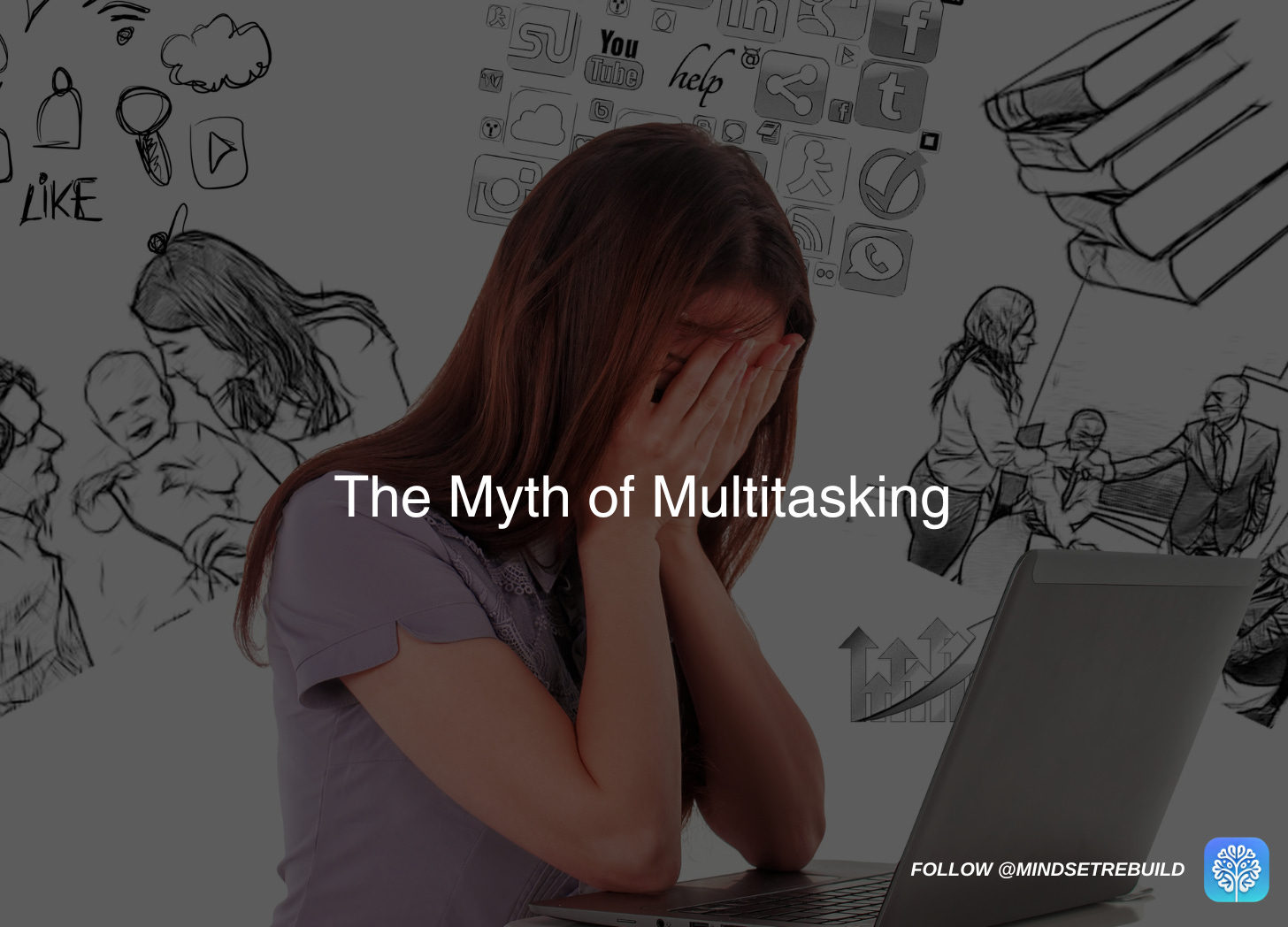
🎯 The Myth of Multitasking and the Power of One
Picture this: You’ve just wrapped up a 12-hour workday. Your to-do list is a sea of checkmarks—emails answered, meetings attended, social posts scheduled.
But as you shut your laptop, a sinking feeling hits: Did any of this actually matter?
You’re not alone.
Meet Alex, a freelance graphic designer who spent months “perfecting” client logos while avoiding the one task that terrified him: pitching his dream client, a Fortune 500 company.
Sound familiar?
Alex’s story isn’t unique—it’s the silent crisis of modern productivity.
A 2024 Asana study revealed that 78% of entrepreneurs spend less than 2 hours daily on high-impact work, trapped in what psychologists call “productivity theatre”: performing busyness that looks impressive but lacks meaningful progress.
Here’s the uncomfortable truth: In a world glorifying hustle culture and 5 AM routines, we’ve confused motion with momentum.
We chase inbox zero, react to every notification, and multitask ourselves into mediocrity—all while our most important goals gather dust.
But what if you could reclaim 80% of your results with just 20% of the effort?
This article isn’t about cramming more into your day.
It’s about a counterintuitive, science-backed strategy used by Olympic athletes, Nobel laureates, and top CEOs: the MIT (Most Important Task) method.
By focusing on one priority daily, you’ll sidestep decision fatigue, bypass burnout, and finally start achieving what truly moves the needle.
Why does this matter now?
For creators and entrepreneurs, the cost of misaligned productivity isn’t just stress—it’s lost revenue, stifled creativity, and missed opportunities.
A startup founder recently told me,
“I spent six months ‘too busy’ to fix a broken payment system—it cost me $220K.”
Ready to turn your busyness into breakthroughs? Let’s dive in.
🛑 Pardon the interruption.
This post is an experiment on my part. I’d like to know if this type of long-form article is something you’re interested in seeing more of. Please leave a comment and let me know. I appreciate your feedback.
And now, back to the article …
🧠 Why Creators and Entrepreneurs Keep Chasing the Wrong Priorities (And How to Stop)
You’ve likely heard the advice: “Work smarter, not harder.”
Yet, for creators and entrepreneurs, this feels like telling someone drowning to “just swim smarter.”
The real issue isn’t effort—it’s biology, culture, and a world designed to hijack your focus.
1. The Brain Science of Scattered Focus
Your prefrontal cortex—the brain’s CEO—is a finite resource.
Every decision, from choosing a Zoom background to prioritizing tasks, depletes its energy.
By mid-morning, studies show decision fatigue reduces willpower by up to 40%, leaving you vulnerable to:
Default Mode: Opting for easy, low-impact tasks (e.g., clearing emails) over strategic work.
Reactive Work: Letting others’ agendas (Slack pings, client requests) dictate your day.
Dr. Roy Baumeister, author of Willpower: Rediscovering the Greatest Human Strength, explains:
“Your brain is like a muscle. Use it relentlessly on trivial choices, and it has nothing left for what matters.”
Real-World Impact:
A 2023 study in the Journal of Applied Psychology found that knowledge workers switch tasks on average every 3 minutes, which is a recipe for cognitive overload.
2. The Tyranny of “Urgent” Over “Important”
The Eisenhower Matrix divides tasks into four quadrants:
Urgent + Important (crises)
Not Urgent + Important (strategy, creativity)
Urgent + Not Important (most emails)
Not Urgent + Not Important (social media)
Yet a 2024 RescueTime report revealed that 68% of entrepreneurs spend their days in Quadrants 1 and 3, while neglecting Quadrant 2—the realm of breakthroughs.
Why?
Cultural Pressure:
Hustle culture glorifies “busy” as a status symbol. Posting “Grind, don’t stop” stories feels productive, even if you’re avoiding real work.Fear of Missing Out (FOMO):
Saying “no” to non-essential tasks triggers anxiety (“What if I lose this client?”).
Case Study:
A SaaS founder delayed fixing a broken payment system for 6 months—“too busy” handling daily support tickets.
The result? $220K in lost revenue and a 30% customer churn rate.
3. The Hidden Cost of Digital Distraction
Your phone isn’t just a tool—it’s a slot machine.
Notifications trigger dopamine hits, keeping you hooked on shallow work.
Consider:
The average person checks their phone 144 times daily (Asurion, 2023).
It takes 23 minutes to refocus after an interruption (University of California, Irvine).
For creators, this fragmentation is lethal.
A novelist I coached spent years rewriting Chapter 1 “to make it perfect” while avoiding the harder work of finishing the manuscript.
Why?
Editing felt safer than facing the vulnerability of completion.
4. The Psychological Trap of “Productivity Guilt”
Entrepreneurs often tie self-worth to output.
This breeds:
Perfectionism Paralysis:
“If I can’t do it flawlessly, why start?”Shiny Object Syndrome:
Jumping to new projects when the current one feels hard.
Brené Brown’s research on vulnerability nails it:
“We’d rather stay busy than risk being seen failing at what matters most.”
🧰 The MIT Method: Your Antidote to Modern Chaos
The MIT (Most Important Task) strategy isn’t just a productivity hack—it’s a rebellion against systems designed to fragment your focus. By identifying one lever task daily, you:
Preserve Decision Energy:
Start your day with clarity, not reactivity.Outsmart Fear:
Progress on your MIT builds momentum, shrinking anxiety.Reclaim Agency:
Choose your priority before the world chooses it for you.
Next, let’s dismantle the myth of multitasking and dive into actionable strategies to make your MIT non-negotiable.
From Overwhelmed to Overflowing: 3 Science-Backed Strategies to Master Your MIT
Are you ready to break free from busyness and start building something that lasts?
Let’s transform your daily routine.
The MIT (Most Important Task) method involves more than picking a priority—it also involves designing a system to protect it from the chaos of modern work.
Below, I’ll explain how to implement this habit with military precision, using neuroscience and real-world case studies.
Strategy 1: Identify Your MIT Using the “Regret Filter”
Why It Works:
The Pareto Principle (80/20 Rule) shows that 20% of efforts drive 80% of results.
But how do you pinpoint that 20%?
The “Regret Filter” forces you to confront long-term consequences, bypassing short-term urgency.
Here’s how to implement this:
Evening Ritual:
Spend 5 minutes the night before answering:“What one task, if done tomorrow, would make me feel unstoppable?”
“Which item would I regret NOT doing in 6 months?”
The “Hell Yes or No” Rule:
If a task doesn’t excite you and align with quarterly goals, it’s not your MIT.
Example:
Freelancer A chose “Outline the ebook” over “Reply to 50 emails”—launching a $15K passive income stream in 3 months.
Startup CEO B prioritized “Negotiate the partnership deal” over “Attend team standup”—securing a 6-figure contract.
Mindset Hack:
Fear Audit:
If your MIT scares you, you’re on the right track. Fear signals importance.
Tool: Create an MIT Prioritization Worksheet to rank your tasks by impact vs. effort.
Pitfall to Avoid:
Don’t confuse “urgent” with “important.”
Use the Eisenhower Matrix to test: “Is this deadline real or self-imposed?”
Strategy 2: Protect Your MIT Like Fort Knox
Why It Works:
Stanford research found that it takes 23 minutes to refocus after an interruption. Guarding your MIT requires ruthless boundaries.
How to Implement:
Time Blocking:
Schedule your MIT in a 90-minute “focus fortress”:Pre-Game: 5 minutes of deep breathing (activates prefrontal cortex).
Weapons: Noise-canceling headphones + a physical “Do Not Disturb” sign.
Post-Game: 10-minute walk (consolidates memory and creativity).
Digital Defense:
Use Freedom or Cold Turkey to block distracting sites during MIT time.
Set an auto-responder: “I’m in deep work until 12 PM. For emergencies, text [Number].”
Case Study:
A YouTuber grew her channel to 500K subscribers by treating her MIT (“Film 1 video weekly”) as non-negotiable. She:
Filmed every Tuesday 8–10 AM, ignoring all notifications.
Outsourced editing and thumbnails to protect creative energy.
Mindset Hack:
The “One Thing” Mantra:
Repeat “If I accomplish nothing else today, I’ve won” during your MIT block.
Pitfall to Avoid:
Avoid “productive procrastination” (e.g., organizing files instead of writing).
Ask: “Is this moving my MIT forward?”
Strategy 3: Optimize with the “MIT Loop”
Why It Works:
MITs evolve as goals shift.
The “MIT Loop” ensures continuous alignment through reflection and iteration.
How to Implement:
Weekly Review:
Every Friday, ask:“Did my MITs this week advance my 90-day goals?”
“What patterns derailed me?” (e.g., meetings before noon).
Adjust Ruthlessly:
If a project stalls, pivot your MIT (e.g., “Research competitors” → “Prototype the feature”).
Use the “5 Whys” to diagnose failures: “Why didn’t I finish the MIT?” → “I got distracted by Slack” → “Why?” → “I didn’t block notifications.”
Iterate the “why” 5 times to get to the root of the problem
Example:
A consultant struggling to launch a course discovered his MITs were too vague (“Work on course”). He refined them to:
Day 1: Script Module 1.
Day 2: Film Module 1.
Result: Launched in 30 days vs. 6 months.
Mindset Hack:
Celebrate “MIT Wins”:
End each day writing “Today, I ______” (e.g., “Today, I drafted the proposal”).
Tool:
Use Notion or Trello to create a visual MIT tracker. Colour-code your completed tasks green—a dopamine boost for progress.
Pitfall to Avoid:
Don’t let sunk cost bias trap you in ineffective MITs.
Kill tasks that no longer serve your goals.
🎬 Real World Stories
Now, let’s look at some real-world stories to illustrate the power of the MIT Method.
To start, here’s how these strategies transformed a burnt-out founder’s life—and how you can replicate her success.
From Burnout to Breakthrough: How a Burnt-Out Founder 10X’d Her Output (And How You Can Too)
Let me introduce you to Mia, a solopreneur running a boutique marketing agency.
Two years ago, she was the poster child for “busy”: 80-hour weeks, 200+ unread emails, and a client roster filled with $1K/month gigs that drained her creativity.
“I felt like a hamster on a wheel,” she told me. “I was exhausted, but my business was stuck.”
The Breaking Point:
On one Tuesday, Mia missed her best friend’s wedding—a commitment she’d sworn to keep—because she was “too busy” fixing a client’s last-minute website edit.
That night, she sobbed in her home office, realizing her hustle had cost her relationships, health, and ambition.
“I wasn’t building a business—I was babysitting one.”
The Turning Point: Embracing the MIT Method
Mia’s wake-up call led her to the MIT strategy. Here’s how she applied it:
Step 1: Identify the Leverage Point
Using the “Regret Filter,” Mia asked:
“What task would transform my business if I did it daily?”
Answer: Pitching enterprise clients instead of nickel-and-diming small projects.
Step 2: Protect the MIT Like a Lioness
She blocked 9–11 AM daily as “Pitch Time”:
Turned off phone notifications.
Used Focus Keeper for 25-minute Pomodoro sprints.
Posted a sign: “In the zone until 11. Emergencies only.”
Step 3: Iterate Relentlessly
After a week, Mia noticed a pattern: She procrastinated by “researching” prospects (aka scrolling LinkedIn). Her fix?
Pre-commitment: Pre-writing pitch templates the night before.
Accountability: Texting her MIT to her sister daily (“Today: Pitch 3 enterprise leads”).
The Results:
From 5K to 30K in 2 months":
Week 1:
Pitched 12 leads → 1 call → 0 sales. “I almost quit,” Mia admitted.Week 3:
Landed a $10K/month contract with a fintech startup.Month 2:
Closed 3 enterprise clients, tripling her revenue.
“The MIT method forced me to stop hiding behind busywork,” she said. “Those two hours daily changed everything.”
The Ripple Effect: How a Content Creator Escaped the “More is Better” Trap
Josh, a fitness YouTuber, had 100K subscribers but made $0 from his channel.
Why?
“I chased views, not value,” he said. His MIT became “Script one monetizable video weekly” (e.g., product reviews vs. viral challenges).
The Shift:
Old MIT:
“Post 5 shorts daily.”
→ Burnout, no income.New MIT:
“Create one affiliate-focused long-form video.”
→ Generated $3K/month in 60 days.
Key Insight: “Views don’t pay bills—strategic content does.”
The Pitfall: When MITs Go Wrong (And How to Recover)
Not all MITs succeed—and that’s okay.
Take Lena, a coach who set “Launch a $2K group program” as her MIT.
After 3 weeks of silence, she panicked.
Diagnosis via the MIT Loop:
Why?
Her audience needed a lower-price entry point.Pivot:
Changed MIT to “Survey 20 ideal clients about pricing.”Result:
Launched a $497 course and sold out in 48 hours.
“Failure isn’t the end—it’s feedback,” Lena said.
Your Story Starts Now
Mia, Josh, and Lena aren’t special—they’re proof that clarity + consistency > chaos.
As James Clear writes in Atomic Habits:
“You do not rise to the level of your goals. You fall to the level of your systems.”
Your Challenge:
Today: Identify your MIT using the Regret Filter.
This Week: Protect it with one boundary (e.g., a “focus fortress” block).
Share: Post your MIT win with #MITRevolution—I’ll reshare the most inspiring stories.
These stories prove that small, focused actions create seismic shifts. Now, let’s cement your game plan.
🔥 The Quiet Power of One: How a Single Daily Habit Can Redefine Your Success
Let’s cut through the noise for a moment.
You’ve just absorbed a mountain of strategies, stories, and science—but here’s the only truth that matters:
Your greatest work will never come from doing more. It will come from doing better.
Mia, the burnt-out founder, didn’t scale her revenue by working longer hours.
The YouTuber Josh didn’t monetize his channel by posting more videos.
They thrived by doing one thing—relentlessly, unapologetically, daily.
The MIT method isn’t a productivity hack. It’s a rebellion against a world that profits from your distraction.
It’s a declaration that your time, energy, and genius are too valuable to waste on tasks that don’t move the needle.
Your Game Plan, Simplified
Choose Your MIT Like Your Life Depends on It (Because Your Business Does)
Use the Regret Filter: “Will this matter in 6 months?”
If it doesn’t scare you a little, dig deeper.
Guard It Like a Sacred Ritual
Time-block it. Silence notifications. Say “no” to everything else until it’s done.
Remember: Every “yes” to a distraction is a “no” to your legacy.
Iterate or Terminate
Weekly, ask: “Did my MITs get me closer to my Everest?”
If not, pivot fast. Success favours the flexible.
The Ripple Effect of One
When you master the MIT method, something unexpected happens:
Stress shrinks: You’ll stop drowning in “what-ifs” because you’re too busy winning the day.
Confidence grows: Each completed MIT is proof you can trust yourself.
Momentum builds: Small daily wins compound into breakthroughs.
As author Darren Hardy writes:
“Small, smart choices + consistency + time = radical difference.”
Your Invitation to the 1% Club
The top 1% of creators and entrepreneurs aren’t smarter or luckier. They’re just ruthlessly focused.
As author Cal Newport says:
“Clarity trumps brute force every time.”
The MIT method isn’t about doing less—it’s about achieving more by channelling your energy into what truly moves the needle.
🏁 Final Thought: The Antidote to “Someday”
You’ve read this far because part of you knows that you’re capable of more.
But “Someday” isn’t a strategy.
The MIT method is your bridge from “maybe” to “hell yes.”
As you shut this tab and return to the chaos, ask yourself:
“What’s the one thing I’ll do today to make tomorrow proud?”
Then go do it.
🚨 Hey, Overwhelmed Creator!
You just learned how to conquer chaos with one task—imagine what you could do with ongoing mindset upgrades.
Upgrade your subscription for more:
✨ 5-Minute Wins: Bite-sized challenges (like today’s MIT method) to rebuild focus fast.
✨ Zero Fluff: Tactics that work > trends that fade.
✨ First Access: Free tools before they go public.
👇 Hit “Subscribe” below. Your future self—calmer, sharper, and 10X more productive—is waiting.
P.S.
Your boldest work isn’t waiting for ‘more time.’ It’s waiting for you to choose it.
So much information and really good. I think it would be better to break down into much smaller chunks. It’s too much even though it’s great information, it’s hard to absorb it all and I’m only mentioning this since you asked. Great article