


Welcome to this week’s edition of Mindset Rebuild’s CEO Life OS Premium newsletter—where bold history meets practical transformation.
Each week, we dive deep into the life of a misunderstood trailblazer to uncover the mindset, strategy, and resilience that rewired the world. So you can build yours.
Deep thinking. Real leadership. No fluff.
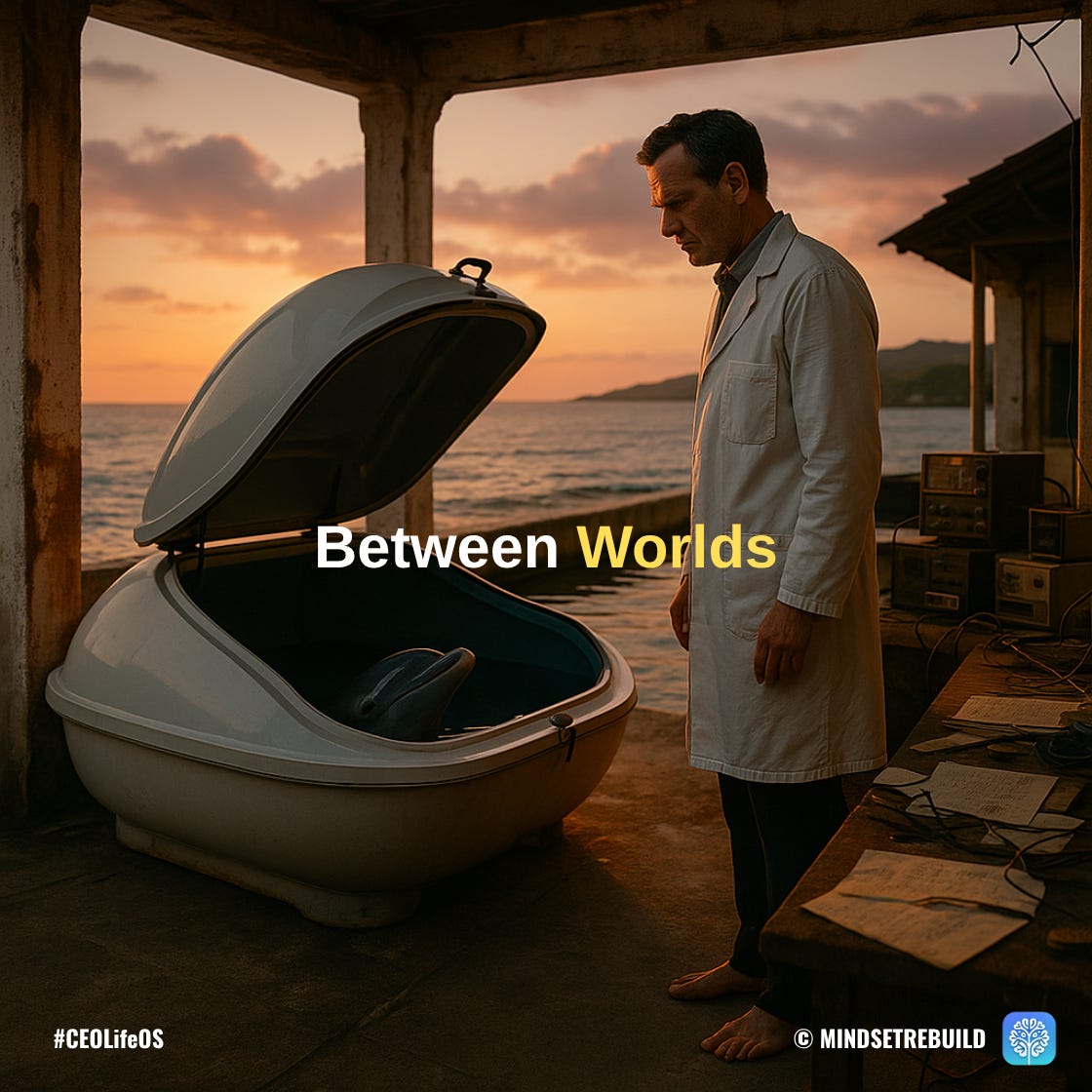
Before Silicon Valley preached “reprogram your mindset”,
before Navy SEALs floated in silence to sharpen their edge,
a rogue neuroscientist sealed himself in a dark tank and asked:
What if the mind isn’t fixed? What if you could rewrite it?
He was called a lunatic.
Now, the world runs on his blueprint.
Introduction: The Dive Begins
In 1954, inside a soundproof room at the National Institute of Mental Health in Bethesda, Maryland, a man sealed himself into a lightless tank filled with body-temperature water.
He wore no clothes. No mask. No earplugs. Just a custom-built breathing apparatus and the quiet intention to disappear from the world outside—physically, sensorily, mentally.
That man was Dr. John Cunningham Lilly, a neuroscientist trained at Caltech and Dartmouth, and already known in elite circles for his research into electrostimulation of the brain.
But what he did in that tank would set him on a collision course with the scientific establishment that had once welcomed him. He wasn’t testing cognition or writing grant proposals.
He was chasing a question no lab had been built to answer: What happens when a human mind is completely cut off from all external input?
He would later call it “the province of the mind.” And for much of the next three decades, he would live there, exploring its landscapes not only through rigorous neurological experimentation, but through deep dives into isolation, altered states, psychedelic journeys, and open conflict with the norms of mid-century science.
At the time of that first float, American psychology was still under the heavy influence of behaviourism and Freudian orthodoxy. Skinner’s stimulus-response model dominated academia.
To many, the mind was simply the byproduct of environmental conditioning. The soul, if acknowledged at all, was a metaphor. LSD was unknown to the public. Computers filled entire rooms and ran on punched cards. The term “consciousness hacking” did not yet exist.
But Lilly wasn’t content with theoretical models. He wanted experience. He wanted to feel the limits of consciousness from the inside—and he was willing to build the tools to do it.
After extensive animal research, including implanting electrodes in primate brains to study pleasure and pain pathways, he turned toward what he saw as the more urgent question: not how brains work in rats or monkeys, but how human consciousness might be mapped, programmed, and possibly evolved.
That first float in the isolation tank changed something.
In the absence of light, sound, gravity, or movement, Lilly reported a state of vivid awareness—his thoughts becoming “more luminous,” his inner voice sharper, his identity somehow unshackled from the body.
The early skeptics claimed he was hallucinating. But Lilly wasn’t just meditating in a dark room. He was laying the groundwork for what would eventually become float therapy, a now-mainstream practice used by athletes, trauma survivors, executives, and creatives to access deep states of calm and clarity.
To those around him, it was hard to say what he was anymore. A scientist? A mystic? A provocateur?
He had the credentials—M.D. from the University of Pennsylvania, fellowship with the National Academy of Sciences—but he also had the defiance. He walked away from government-funded brain research to pursue dolphin communication and psychic exploration.
He clashed with supervisors, ignored protocol, and eventually left the NIH entirely. When he resurfaced in the 1960s, he was tripping on acid and trying to build interspecies empathy with dolphins—an image that would both define and distort his legacy.
But back in that government facility, before the press mockery, before Timothy Leary and the acid era, before exile from the scientific mainstream, John Lilly was something simpler and harder to categorize: a man who built his own portal inward.
He wanted to understand consciousness not by dissecting it, but by experiencing its raw form, stripped of input and noise. He wasn’t looking for God. He wasn’t looking for fame.
He was looking for a reproducible, measurable process through which a human being might reprogram their mind from within. And for that heresy—suggesting the self was a system and could be rewritten—he would pay a steep price.
Yet over half a century later, neuroscientists, therapists, and personal development leaders alike are picking up the tools he left behind: float tanks, mind hacking, biocomputer metaphors, and the conviction that radical inner transformation is not only possible—it’s repeatable.
The true story of John Lilly doesn’t start with dolphins or drugs. It begins here, in the dark, in the silence, in the stillness of a tank filled with nothing, and the echo of a question no one else dared to ask.
What if the mind wasn’t something we had… but something we could build?
A Man Out of Time
John Lilly was never built for the boxes his era tried to place him in.
Born in 1915 to a wealthy family in Saint Paul, Minnesota, he was educated at some of the finest institutions in America—Caltech, Dartmouth, and the University of Pennsylvania School of Medicine.
From an early age, he was drawn not just to science, but to questions of systems: how things worked, and how the underlying architecture of life could be mapped, tested, and, eventually, transformed.
Yet Lilly was entering the world of science during a time of extraordinary constraint. By the 1940s and ’50s, American research was heavily shaped by wartime pragmatism, Cold War politics, and the rise of institutional gatekeeping.
The Manhattan Project had defined a new standard for “useful” science: research that fed defence, computation, or industrial growth.
Psychology, as practiced in universities, was focused on observable behaviour, data sets, and statistical controls. The inner world of the individual—the terrain Lilly most wanted to explore—was seen as murky at best, mystical at worst.
Still, Lilly played the game, at least for a while. His early work in neurophysiology was meticulous and respected. At the National Institute of Mental Health, he pioneered the use of fine-wire electrodes to stimulate specific regions of the brain in animals, mapping how pain, pleasure, and basic motor responses were triggered.
He conducted complex neurosurgeries on rhesus monkeys and cats. By the early 1950s, he was publishing in prestigious journals and was seen as a rising star in the world of brain research.
But something in him resisted reductionism.
Where his peers sought to isolate variables and quantify behaviour, Lilly began asking questions that didn’t fit neatly on a spreadsheet:
What is subjective experience? Can consciousness be studied directly? Is it possible to observe the mind without the interference of the senses?
It was around this time that Lilly came up with the idea of the isolation tank—a sealed, dark, soundproof chamber filled with saltwater heated to skin temperature. It wasn’t just a scientific device; it was a philosophical approach.
For Lilly, the tank wasn’t built to block out input—it was meant to reveal the self.
This was profoundly subversive. In an era that still celebrated behaviourist psychologists like B.F. Skinner, who famously described the mind as a “black box” unworthy of serious scientific investigation, Lilly was turning inward.
He was rejecting the idea that consciousness was irrelevant simply because it couldn’t be examined physically. He believed that if we wanted to understand the mind’s structure, we had to experience it directly.
In that sense, he was more aligned with William James than with his contemporary peers—someone who viewed the science of the self as both empirical and experiential.
Lilly’s divergence drew attention. By the mid-1950s, he gained a reputation within government circles as brilliant but volatile. His work with the U.S. Public Health Service, and later with the Office of Naval Research, introduced him to both military and intelligence communities.
During the time when the CIA was secretly conducting MK-Ultra, an illicit program experimenting with mind control and LSD, Lilly was exploring similar areas—but with a fundamentally different purpose. While others aimed for control, he aimed for liberation. He sought to understand how consciousness could evolve instead of being manipulated.
That philosophical rift would become irreconcilable.
Lilly refused to allow his sensory deprivation research to be used for coercive purposes. In a documented case, he declined a proposal from military officials who wanted to adapt the tank for interrogation or training.
He saw early on what others didn’t, or wouldn’t. That any technology used to reveal the self could also be used to erase it.
This tension—between discovery and domination—would ultimately drive him out of the establishment. By the late 1950s, he left government service entirely and began charting his own course.
He founded the Communication Research Institute in the U.S. Virgin Islands, free from federal oversight, where he would later conduct his controversial dolphin communication experiments. But even before that, the die had been cast.
Lilly was not just a man ahead of his time. He was a man at odds with his time.
While America built interstate highways, suburban subdivisions, and nuclear arsenals, he was building a sensory chamber to meet the unfiltered mind.
While psychologists trained rats and catalogued phobias, he was meditating in saltwater silence.
While Cold War scientists engineered weapons of mass destruction, Lilly quietly asked whether the human brain could rewire itself for peace, connection, and expanded awareness.
In a society obsessed with conformity, productivity, and control, his work represented a radical counter-thesis:
That the inner world was not a byproduct of biology, but a frontier of freedom.
That the self was not fixed, but programmable.
And that transformation begins not with data or doctrine—but with deliberate attention.
His colleagues called it irresponsible. Later, some would call it madness. But for Lilly, it was simply necessary.
Because the future he saw coming, the one we now live in, would demand more than intelligence. It would demand inner agency. And he wasn’t going to wait for permission to find it.
Tanks, Dolphins, and LSD
By the early 1960s, John Lilly had become a cautionary tale in some circles and a cult figure in others.
He had left the secure corridors of NIH and academia and was now moving through the fringes of science with an urgency that bordered on obsession. If the first part of his journey was about building the laboratory of the self, this next part was about what he chose to do with it—and how the world reacted when he did.
After developing the first commercial sensory isolation tanks, Lilly started using them not only for research but also for personal growth. The tanks enabled him to enter prolonged states of introspection, which he described as nonlinear, associative, and sometimes euphoric.
He wasn’t just observing his mind—he was engaging with it as if it were a programmable interface. This idea, partly inspired by cybernetics and early computer theory, led to one of his most controversial claims: that the human brain was a biocomputer, and that consciousness was the software we could rewrite.
At the time, this seemed like science fiction. The field of neuroscience lacked a framework for self-programming, let alone deliberate rewiring of the brain. But Lilly wasn’t just theorizing from his armchair. He was practicing it—using tanks, meditative states, and increasingly, chemical assistance.
In 1964, he published "Programming and Metaprogramming in the Human Biocomputer," a book that quietly influenced not only psychonauts and spiritual seekers but also future thinkers in artificial intelligence, virtual reality, and consciousness studies.
The book was based on notes he had originally compiled as a manual for NASA, which had consulted him about the psychological effects of isolation on astronauts. However, it became something much more ambitious: a framework for reprogramming belief systems through conscious intent.
And yet, what pushed Lilly from maverick to pariah wasn’t just his theories. It was his willingness to pursue them outside the boundaries of institutional decorum. By the mid-1960s, he began using LSD-25—legally at first, under sanctioned medical research conditions—to explore the deep structure of consciousness while inside the tank.
He called the experience “an encounter with the center of the cyclone.”
Others called it dangerous. At the time, LSD was still legal in the U.S., but it was rapidly becoming associated with cultural rebellion and psychological instability. Lilly was already ahead of the curve—and already losing institutional allies.
Then came the dolphins.
In the early 1960s, Lilly moved to the island of St. Thomas in the U.S. Virgin Islands to establish the Communication Research Institute, a facility built to study interspecies communication—specifically, with bottlenose dolphins.
He had long believed that language was not solely human and that dolphins, with their complex vocalizations and high brain-to-body ratio, might hold the key to unlocking new forms of consciousness.
With NIH funding and initial military interest, he constructed a series of dolphin tanks and began daily interaction protocols with trained researchers. One of the most notable figures was Margaret Howe Lovatt, a young naturalist who lived with a dolphin named Peter in a partially flooded laboratory for 10 weeks.
The experiment was controversial even in its time, but it reached mythic (and misunderstood) status when a 2014 BBC documentary resurfaced it with tabloid flair. The truth was stranger—and more instructive—than the headlines.
Lovatt’s mission was to teach Peter English, not by rewards or punishments, but by immersion and empathy. He learned to mimic human-like sounds, imitate words like “hello” and “ball,” and showed signs of emotional bonding.
But progress was slow and, to many observers, absurd. When funding dried up—due in part to Lilly’s increasing use of psychedelics and his public association with Timothy Leary—the experiment was shut down.
The most tragic consequence came after: when the dolphins were relocated to an inferior facility in Miami, Peter died by suicide—a phenomenon documented by veterinary staff who concluded that the dolphin, isolated and distressed, voluntarily stopped breathing.
For Lilly, this wasn’t just a failure. It was a turning point. It confirmed his belief that consciousness was not confined to humans, and that emotional depth extended far beyond the scientific models of the day.
But it also marked the beginning of his full break with mainstream science. By the 1970s, he had become a public symbol of the counterculture: appearing on talk shows with George Carlin, publishing books on psychedelic exploration, and giving lectures where neuroscience met mysticism.
He developed a belief system involving “ECCO” (the Earth Coincidence Control Office) and “Solid State Entities”—terms that veered from metaphor into metaphysics. Some of his later work was undeniably speculative, and his critics used it to discredit his earlier breakthroughs.
Still, history remembers longer than scandal.
Floatation tanks, once merely a curiosity, are now employed in clinics, recovery centres, and high-end training programmes. The U.S. Navy, which previously funded Lilly’s dolphin research with strategic interest, now recognises the intelligence and communication abilities of cetaceans. LSD, once demonised, is experiencing a global resurgence as a treatment for PTSD, depression, and trauma.
And perhaps most tellingly, the concept of self-programming—which in the 1960s sounded like science fiction—is now central to modern cognitive-behavioural therapy, neuroplasticity research, and the broader field of personal development. What Lilly began in a dark tank with a scientist’s mind and a seeker’s heart is now fundamental to how we discuss mindset.
Yes, he was wild. Yes, he pushed too far.
But the territory he charted—the blurred edges between machine and soul, self and system—wasn’t madness.
It was a map.
And like all true explorers, John Lilly never got to live in the world he helped reveal.
Misunderstood, Then Vindicated
By the late 1970s, John Lilly was no longer welcome in the halls of mainstream science.
What had begun as a promising career in neuroscience had fallen apart into a story the establishment was eager to forget—one of LSD-fueled dolphin experiments, isolation tanks mistaken for pseudoscientific toys, and cryptic writings about cosmic control agencies and non-human intelligences.
In academic journals, his name was no longer cited with respect. It was mentioned with a cautious tone, often followed by an ellipsis.
But Lilly had never aimed to be accepted. He aimed to understand the architecture of the self. And while his methods became increasingly unconventional, his main thesis—that consciousness could be studied, altered, and directed from within—wasn’t just provocative. It was prescient.
During his public marginalization, cognitive science was still in its early stages. The dominant models focused on computational theories of mind, based on external inputs and observable behaviour.
The brain was viewed as a passive processor, and the idea of internal rewiring through intention or belief was dismissed as mystical nonsense. Lilly’s notion that a person could “metaprogram” their own consciousness—intervening in the recursive loops of thought and perception—had no formal framework.
But cultural memory is porous. Even as institutions distanced themselves from Lilly’s name, his influence seeped into the edges and, over time, into the mainstream. One of the earliest adoptions came not from medicine but from the countercultural intelligentsia.
In the 1980s and ’90s, floatation tanks—still based on Lilly’s original blueprints—began to appear in underground wellness centres, martial arts dojos, and private studios used by elite performers. Those who experienced them often described the same themes Lilly had: heightened awareness, clarity of thought, reduced anxiety, and a profound reconnection with self.
Eventually, athletes took notice. By the 2000s, elite teams like the Seattle Seahawks were incorporating sensory deprivation into recovery and performance routines. Tech entrepreneurs and Navy SEALs followed suit.
Joe Rogan, one of Lilly’s most vocal modern followers, popularized float tanks on his podcast, describing them as “a tool for solving problems, decompressing, and exploring consciousness.” Suddenly, what was once dismissed as stoner science was now supported by performance data.
At the same time, the scientific landscape was evolving. In the decades since Lilly’s exile, neuroplasticity—the brain’s ability to change its structure and function in response to experience—emerged as one of the most significant discoveries in modern neuroscience.
Research from institutions like Harvard, MIT, and the University of California confirmed that thought patterns, emotional regulation, and even memory can be reshaped through deliberate practice.
What Lilly had intuitively understood through personal experimentation is now supported by fMRI studies: the mind is not fixed. It can be rewired.
Even his most controversial idea—that internal belief systems could be consciously rewritten—has gained recognition in cognitive-behavioural therapy (CBT), mindfulness-based stress reduction (MBSR), and trauma-informed coaching.
Techniques such as reframing, affirmations, and exposure therapy are now scientifically validated methods for altering neural pathways. Lilly’s use of “programming” may have been too extreme for his era, but the core insight has become a fundamental part of contemporary mental health.
Then came the psychedelic renaissance.
After decades of prohibition, the 2010s experienced a resurgence in clinical research on substances like psilocybin, MDMA, and LSD—many of which Lilly had investigated in sterile, controlled settings decades earlier. Studies from Johns Hopkins, Imperial College London, and MAPS (Multidisciplinary Association for Psychedelic Studies) now demonstrate that these compounds can induce lasting changes in neural connectivity, emotional resilience, and sense of purpose.
Far from being dismissed as dangerous curiosities, psychedelics are now being fast-tracked by the FDA as potential treatments for depression, PTSD, and end-of-life anxiety.
None of this exonerates Lilly’s excesses. He made mistakes—personal, scientific, and ethical. His later writings veered into speculative cosmology. His lack of boundaries in the dolphin experiments remains a stain, despite his original intentions. And yet, reducing him to a fringe eccentric would be intellectually dishonest.
What Lilly offered—before the branding, the backlash, and the psychedelic spiral—was a working model of inner transformation. Not as a metaphor, but as a technical process.
He asked whether the human being could become the operator of their own system—not merely a passive subject of upbringing, trauma, and cultural inertia, but an active agent in reshaping how the mind sees, reacts, and behaves.
In a world now saturated with apps for habit tracking, courses on mindset, retreats for trauma healing, and wearables for cognitive optimization, Lilly’s early work doesn’t seem mad. It seems foundational.
He wasn’t a mystic. He wasn’t a guru. He was a systems thinker who turned his attention inward—at a time when doing so cost him everything.
His vindication didn’t come with awards. It came through the slow absorption of his ideas into fields he no longer had access to.
Through the practices of those who never knew his name, but follow his path. Through the millions who now enter isolation tanks not to escape the world, but to meet themselves in it.
In the end, the world came around.
Not with applause.
But with adoption.
And that may be the most enduring kind of legacy there is.
CEO Life OS Takeaways
John Lilly never built a business. He didn’t scale a company, raise venture capital, or sit on a corporate board.
