


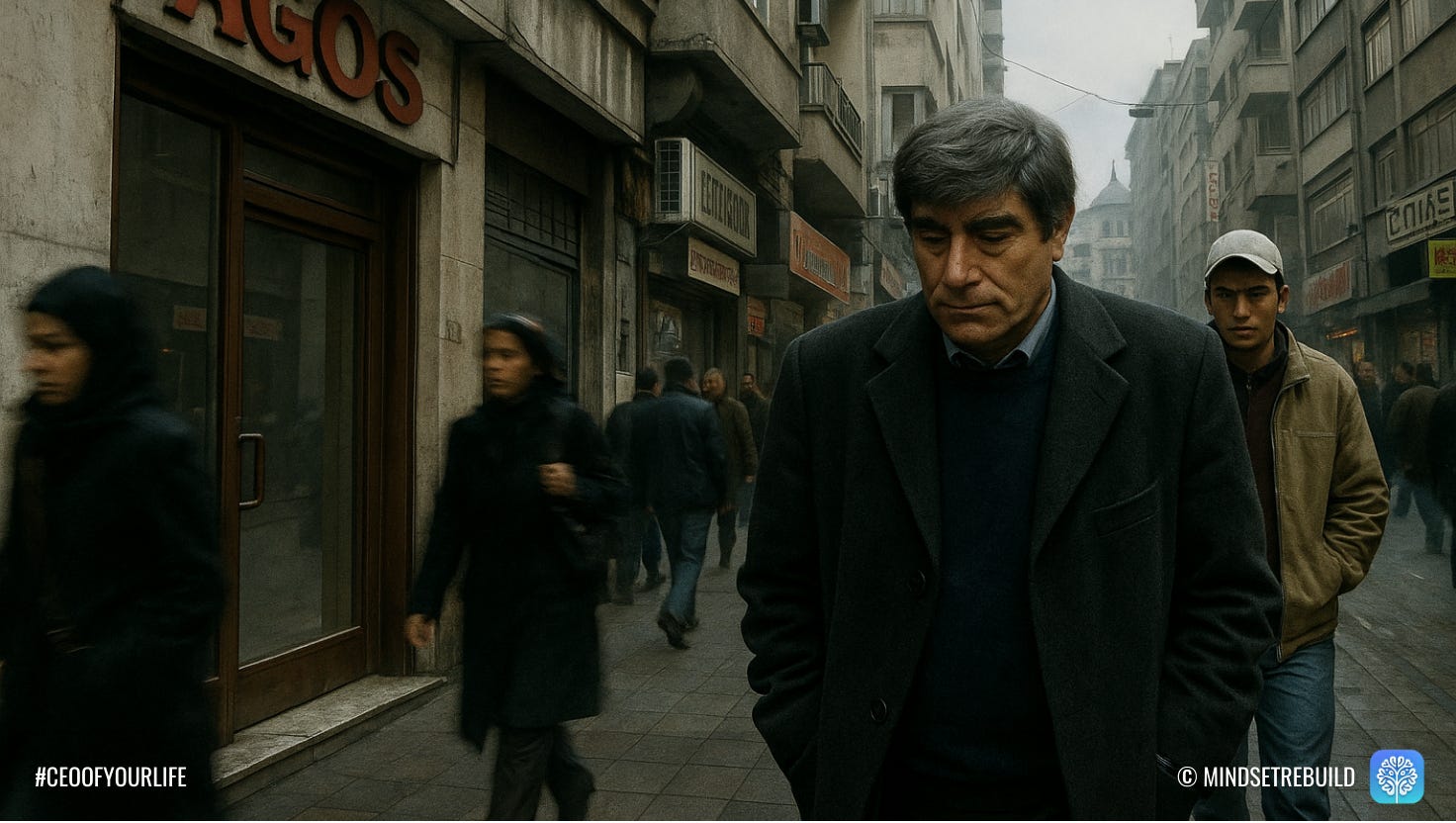
A Bullet on a Busy Street
The afternoon of January 19, 2007, was unusually cold in Istanbul. Outside the modest office of Agos, a bilingual Armenian-Turkish newspaper housed in a narrow building on Halaskargazi Street, the city moved as it always had—crowded, hurried, alive.
Inside, 52-year-old Hrant Dink, the newspaper’s founding editor, was preparing to leave for a routine errand: he planned to pick up his daughter from school. He stepped onto the sidewalk just after 3 p.m., unaware that his final steps were being watched.
A young man approached from behind, drew a pistol, and shot Dink three times—twice in the back of the head, once in the neck. The journalist collapsed instantly. Blood pooled beneath his head. Passersby screamed. And in a matter of minutes, a city long accustomed to silence around its taboos was shaken awake by a brutal act of political violence.
The killer was quickly identified: 17-year-old Ogün Samast, a high school dropout from Trabzon, a conservative Black Sea town known for its ultranationalist leanings. Samast would later admit to the killing with a chilling lack of remorse. He claimed Dink had "insulted Turkishness"—a phrase that echoed the language of Article 301 of the Turkish Penal Code, under which Dink had recently been prosecuted. Samast had travelled to Istanbul with a single goal: to eliminate someone he and others viewed as a traitor to the nation.
But Dink was no traitor. He was a bridge-builder. A Turkish citizen of Armenian descent, he had spent years walking an impossible line—challenging Turkey’s official narrative of history while insisting that reconciliation, not revenge, was the path forward. He openly used the word “genocide” to describe the Ottoman-era massacre and deportation of Armenians in 1915, a term the Turkish state has long rejected. For that, he was harassed, threatened, and finally condemned in a courtroom—not for falsehoods, but for truths that made the state uncomfortable.
His assassination was not the act of a lone madman. It was the predictable outcome of a climate that treated dissent as betrayal, history as malleable, and identity as a zero-sum game.
Samast had not acted alone. His radicalization was nurtured by far-right groups and media outlets that routinely labelled Dink an enemy of the nation.
In a photo released after his arrest, Samast was flanked by smiling police officers, posing proudly under the Turkish flag. For many, the image was more disturbing than the crime itself.
Dink’s death reverberated far beyond Turkey. It exposed a deep fracture in the country’s democratic aspirations between its veneer of modernization and its authoritarian reflexes. It also spotlighted the unresolved trauma of the Armenian Genocide, a wound that continues to shape both Turkish and Armenian identities, a century later.
The following days brought an extraordinary display of grief. Over 100,000 mourners flooded the streets of Istanbul for Dink’s funeral. Many had never read Agos, nor agreed with his politics, but they came anyway—some carrying black-and-white signs that read, *“We are all Hrant Dink. We are all Armenian.”* It was a striking act of defiance in a country where even acknowledging Armenian identity had long been a risk.
Yet behind the solidarity lay a hard truth: the state had failed to protect a citizen it had already condemned. Intelligence reports later revealed that authorities were warned about a plot to kill Dink months in advance. Local police and the gendarmerie in Trabzon had tracked Samast’s movements and knew he posed a threat. Nothing was done.
To understand why Hrant Dink was killed is to confront the contradictions at the heart of modern Turkey—between secular nationalism and ethnic plurality, between memory and denial, between democracy and deep-state inertia. His life was shaped by those forces. So was his death.
And in the end, the bullet that silenced him did not stop the conversation. It ignited it.
Born Between Two Fires
Hrant Dink was born in 1954 in Malatya, a city in eastern Turkey that once had a vibrant Armenian population. Before the genocide of 1915, Armenians made up a significant portion of Malatya’s residents. Afterward, they were nearly erased. Dink's birth into this historical vacuum was not unusual for Armenians who remained in Turkey after the fall of the Ottoman Empire—they lived in the shadows of a past the state refused to name.
As a child, Dink moved to Istanbul with his family. After his parents divorced, he and his brothers were placed in the Tuzla Armenian Children's Camp—an orphanage and summer camp established by the Armenian Patriarchate and managed by the Turkish-Armenian intellectual and educator Hrant Guzelyan. It was a place of both hardship and cultural preservation. The Turkish state would later confiscate the camp during a period of intensified nationalist policy, part of a broader pattern of dispossessing non-Muslim minorities through bureaucratic and legal pressure.
The seizure, which was never legally justified, left an indelible mark on Dink’s understanding of power, injustice, and memory.
He grew up acutely aware of his identity as a *gavur*—a pejorative term used for non-Muslims in Turkey. The official secularism of the Republic, established by Mustafa Kemal Atatürk in the 1920s, promised equality in theory but maintained a de facto hierarchy in practice. Armenians, Greeks, and Jews—though legally citizens—were often treated as outsiders. Their schools were tightly controlled, their property rights frequently violated, and their loyalty to the state perpetually questioned. In this climate, silence became a survival strategy.
But Dink would not be silent.
In 1996, he founded Agos, a modest newspaper published in both Turkish and Western Armenian. His goal was simple yet radical: to create a space for open dialogue between Turkey’s Armenian minority and the broader public. Dink believed the future of Armenian identity in Turkey did not lie in separation or exile—but in integration without erasure. He wanted Armenians to feel like full citizens, able to speak their language, remember their dead, and contribute to a country that had long pushed them to the margins.
This vision clashed head-on with the dominant narrative of Turkish nationalism, which remained haunted by the collapse of the Ottoman Empire and defined itself against perceived internal enemies. In the Republic’s founding ideology, the Armenian Genocide was not just denied—it was unspeakable. Even the word “genocide” (*soykırım* in Turkish) was effectively taboo. Acknowledging this meant challenging the myth of a heroic national resistance against Western imperialism; many Turks, across the political spectrum, viewed it as a threat to national unity.
The state’s position was fortified by laws, most infamously Article 301 of the Turkish Penal Code. Initially enacted in 2005 (as a revision of earlier, even stricter speech laws), it criminalized “insulting Turkishness.” Vague and easily weaponized, it was used to prosecute writers, intellectuals, and journalists—including Nobel laureate Orhan Pamuk—for merely discussing the Armenian Genocide or other sensitive issues like Kurdish identity or the role of the military in politics.
For many, Dink’s mere presence in this landscape was subversive. He was Turkish, yet Armenian; critical of the state, yet devoted to its future. He openly criticized the Armenian diaspora for focusing too much on retribution and too little on dialogue. He challenged Turkey’s rigid nationalism while also opposing the idea that Armenians could only be safe outside its borders.
This insistence on dual belonging made him a target from all sides. Turkish nationalists accused him of disloyalty; some Armenians accused him of compromise. In 2003, Dink published an article urging Armenians to “shed the poison of the Turk from their blood”—a metaphorical call for healing that was willfully misinterpreted as an ethnic insult against Turks. That misreading would later become the centrepiece of the state’s case against him under Article 301.
Dink’s legal troubles began in earnest in 2004, and his conviction in 2005 sent a chilling message. The court ruled that his remarks had insulted Turkish identity, even though they had been taken out of context, mistranslated, and distorted by nationalist media. The conviction was suspended but not overturned. Dink appealed to the European Court of Human Rights, arguing that Turkey had violated his right to free expression and failed to protect him from incitement. The Court would eventually agree, with a decision that came too late.
By the time of his death, Dink was under constant surveillance—not just by the state, but by its fringes: ultra-nationalist groups, vigilante networks, and right-wing media figures who painted him as a traitor. He wrote that he felt like a dove—always on edge, always alert—but committed to staying. “They see me as a foreigner,” he reflected in one of his final essays, “but I am no foreigner in this land. I am its true son.”
Hrant Dink was a man of paradoxes: Armenian and Turkish; nationalist and pluralist; journalist and activist. He understood that Turkey’s future depended not just on economic growth or democratic institutions, but on its willingness to confront its foundational amnesia. And that meant, above all, telling the truth.
That truth—not ideology, aggression, or activism—would put a target on his back.
When Words Became a Crime
