


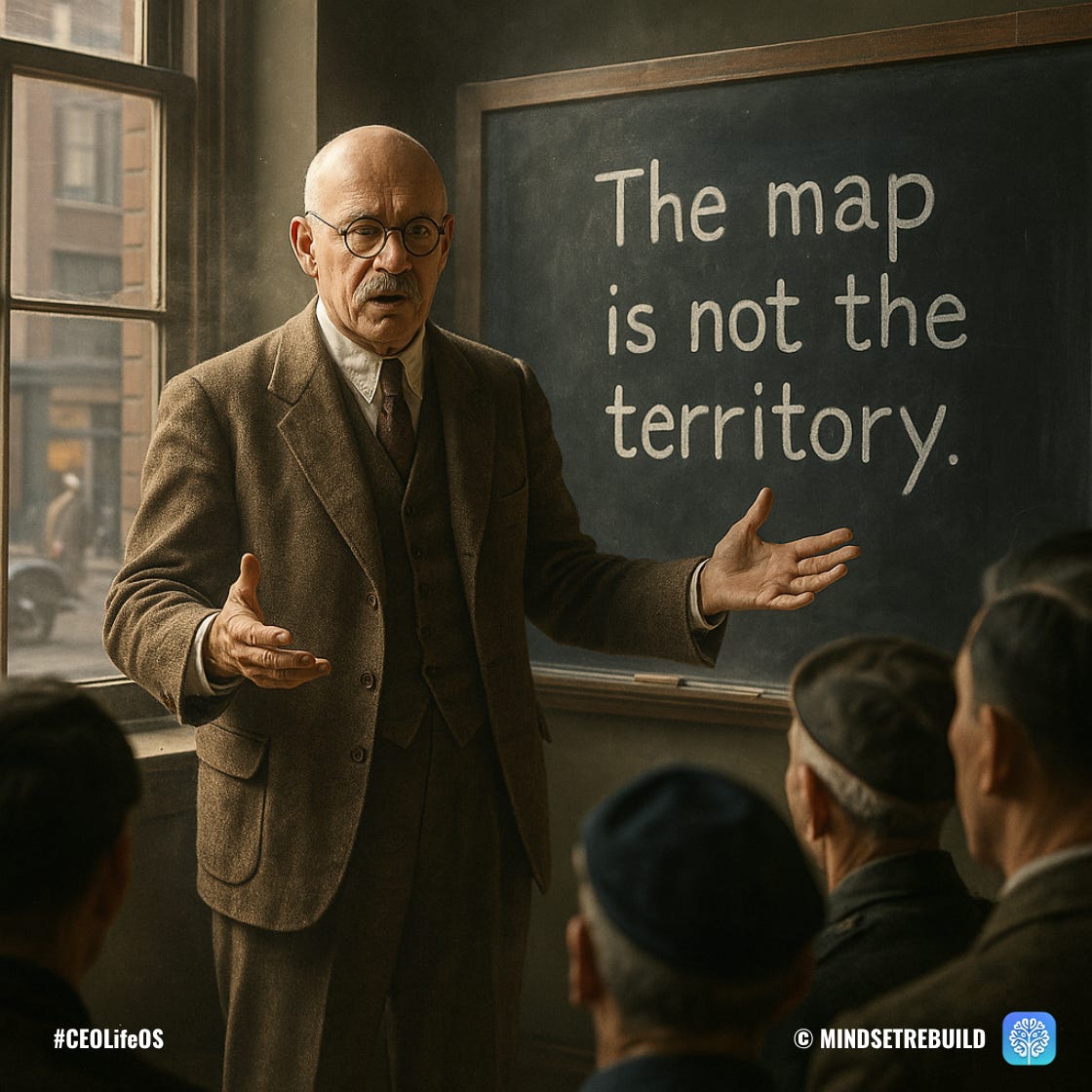
Most people live their entire lives mistaking their beliefs for reality. One man made it his mission to expose the difference—and was ridiculed for it.
Before "mindset" became a buzzword, before systems thinking entered boardrooms, and before therapists and AI researchers warned us about linguistic traps, Alfred Korzybski was already sounding the alarm.
A war-injured engineer turned philosopher, Korzybski argued that our greatest danger wasn’t external—it was internal. We were navigating a world of accelerating complexity using outdated mental maps, confusing the names of things with the things themselves.
And unless we learned to update how we perceive and describe reality, he warned, we’d destroy ourselves not with malice, but with misunderstanding.
This is the forgotten origin story of a man who tried to teach humanity how to stay sane in a world built on symbols.
The General Who Lost His Leg but Found a New World
Alfred Korzybski’s turning point didn’t begin in a classroom or a lab; it began in the mud-soaked trenches of World War I.
Born in 1879 to Polish nobility under the Russian Empire, Korzybski was immersed in the culture of the landowning intelligentsia: multilingual, classically educated, and trained in engineering.
He had studied at Warsaw’s Polytechnic Institute, specializing in chemistry and mechanical engineering, but war would alter his path. When World War I broke out in 1914, he volunteered for service in the Russian army, serving as both an intelligence officer and an artillery engineer.
His role placed him at the intersection of technology and destruction, converting geographic coordinates into calculated firepower—turning maps into commands, commands into death.
It was during this time that the seed of his later insight—the map is not the territory—was planted, although it was not yet named.
Korzybski was not merely an armchair theorist. He witnessed firsthand how miscommunication—between generals and field officers, between plans and terrain—could lead to disaster.
But even more troubling, he observed that people often acted as if their descriptions of the world were the actual world. They believed the slogans, obeyed the abstractions, and ignored the contradictions they encountered on the ground.
In 1915, Korzybski was reassigned to a diplomatic position in North America to assist in coordinating Russian war logistics with the Allied powers. He traveled extensively across Canada and the United States, engaging with industrialists and military leaders about war materials coordination.
During this period, his observations extended beyond the battlefield. He began noticing how the same distortions he had seen in war also appeared in civilian life—how language, when interpreted as literal or absolute, distorted perception, impaired decision-making, and subtly conditioned behaviour.
Then came a personal rupture. In 1917, while travelling by train in Canada, he suffered a serious injury; accounts differ slightly, but he fractured his leg badly in a fall.
Confined to a hospital bed for weeks, Korzybski used the time not to rest, but to think. His mind turned obsessively toward a single question that had haunted him since the trenches:
Why do humans, supposedly the rational animal, behave so irrationally under stress, especially in groups?
He believed the answer wasn’t just psychological—it was structural.
While others focused on content—what people believed—Korzybski began to probe the form that those beliefs took. What if the problem wasn’t what people thought, but how they thought—specifically, how language shaped, constrained, and sometimes corrupted thought altogether?
By 1920, now a naturalized American citizen, Korzybski settled in New York and published Manhood of Humanity, a lesser-known but influential text. In it, he introduced the idea that human beings are “time-binding” creatures—capable of accumulating and transmitting knowledge across generations through language and symbols.
Animals live in the moment. Humans, he argued, think in abstractions—memories, predictions, systems. But that same gift, if not examined, could become a trap.
What began as a soldier’s reflection evolved into a mission: to develop a comprehensive theory of human sanity, grounded in the ways language, symbols, and structure shape consciousness.
It was not a purely philosophical project; it was existential in nature. The same forces that allowed society to progress also allowed it to rationalize mass violence, to organize genocide, to sanctify lies as doctrine.
Korzybski was convinced: until human beings learned how to think about their thinking, they would remain vulnerable, not just to external manipulation, but also to the internal blindness of their own minds.
In the roaring 1920s, as industrial capitalism boomed and scientific optimism dominated, few paid attention to such ideas. He wasn’t affiliated with any major university. He lacked institutional support.
His writing was dense, and his speech was heavily accented. To many, he appeared to be a crank—a fringe figure clinging to an abstract theory about language and sanity.
But behind the eccentricity was something prophetic. Korzybski wasn’t warning about semantics for the sake of wordplay. He was warning about structural delusion: how the labels we inherit, the generalizations we adopt, and the timelines we ignore contribute to systemic errors.
By the early 1930s, he had relocated to Chicago, where he would soon found the Institute of General Semantics. But the road to that point—through war, injury, and isolation—had clarified his conviction:
If humanity were to survive the technological age with its mind intact, it would have to learn a new discipline—a new kind of literacy, not just in what we say, but in how we symbolize the world.
And so the wounded soldier, once trained to fire on coordinates, is now prepared to teach people how to question the maps they live by.
Not to reject them, but to remember that no map, no matter how precise, is the territory it describes.
War, Science, and the Crumbling Certainties of the 20th Century
By the time Alfred Korzybski began writing Science and Sanity, the Western world was coming apart at the seams of its own confidence.
The 19th century ended with a surge of faith in rationalism, progress, and the inevitable victory of science. The Enlightenment dream was in full flourish—electric lights brightened cities once lit only by candles; steamships closed distances; telegraphs shrank time. If humans could control nature, they could surely control themselves.
But World War I shattered that illusion.
The same science that cured diseases also developed poison gas. The same logic behind building railroads also planned death camp logistics.
By the 1920s and 30s, a whole generation had returned from the trenches feeling numb, while the next was growing up amid financial collapse, political extremism, and rapid social upheaval.
For Korzybski, this was not merely an economic or ideological crisis; it was a crisis of abstraction.
He watched with alarm as modern life increasingly became dominated by symbols: headlines, slogans, ideologies, technical jargon.
Mass communication, once the domain of orators and print, had expanded dramatically. The invention of the radio meant that millions could now hear the same voice simultaneously. Cinema became a new collective dream machine. Public opinion could be swayed not by argument, but through repetition.
And yet, few people questioned the structure of the language shaping these messages.
Korzybski’s critique was radical not because it dismissed science; it revered it. But he insisted science alone was insufficient without a discipline to govern how we use symbols to model reality. And he believed that no one was teaching that skill — not in schools, not in politics, not even in science itself.
This is where he diverged from most of his contemporaries.
Where Freudian psychoanalysis focused on the unconscious and behavioural psychology emphasized stimulus and response, Korzybski centred on structure: how human nervous systems process language and how language creates fixed mental maps that can override actual experience.
His framework wasn’t psychological in the traditional sense—it was epistemological. He aimed to redesign how humans absorb and interpret reality.
He believed that the consequences of not doing so were fatal.
As the 1930s progressed, his fears gained new validation. In Germany, a former corporal named Adolf Hitler was gaining power amid a flood of nationalistic slogans and legendary storytelling.
The Nazi regime, similar to Stalin’s purges in the Soviet Union, showed how entire populations could be linguistically conditioned to see metaphor as fact and metaphorical enemies as real threats. Words became tools—Volk, Blut, Feind—and actions followed suit.
In the United States, propaganda was subtler but equally widespread. Edward Bernays, Freud's nephew and often called the father of public relations, had started using psychoanalytic techniques in marketing and mass persuasion. His 1928 book Propaganda argued that manipulation was not only unavoidable but also essential for managing modern democracy.
Korzybski saw it differently.
To him, these were not signs of progress but symptoms of symbolic decay. And the solution wasn’t better messaging—it was semantic hygiene. A population trained in abstracting consciously could not be as easily seduced by slogans or manipulated by fear. But such training required a fundamental shift: from reacting to questioning, from certainty to awareness, from words to structure.
Meanwhile, the scientific world was undergoing its own crisis of meaning.
Einstein’s theory of relativity (1905–1915) had already shaken up Newtonian physics, showing that time and space were not fixed. In the 1920s, quantum mechanics introduced a deeper level of uncertainty—one in which even observation could influence reality. The very concept of objective truth was becoming more nuanced, more fragile.
Korzybski was paying attention.
He believed that if physics had moved beyond classical assumptions, human reasoning needed to follow suit. We required a non-Aristotelian logic—a system that didn’t depend on binary categories or fixed identities but instead accepted gradation, context, time, and process. In other words, we needed a new kind of thinking for a new kind of world.
But the institutions of the time weren’t prepared. Korzybski wasn’t affiliated with a major university. His writing was challenging, often intentionally so. He believed that clarity required effort, not slogans.
His lectures attracted curious minds but rarely gained institutional backing. To many, his ideas seemed obscure, even pedantic. The term general semantics didn’t help; it sounded like grammar theory, not a revolution in perception.
Yet beneath the awkward phrasing lay a profound shift in how humans might approach understanding. He called it “consciousness of abstracting”: a mental discipline to constantly notice that what we see, say, or think is always a filtered version of the world, not the world itself.
And this was not simply theory.
Korzybski designed practical tools: index numbers to differentiate similar terms (e.g., “justice₁” ≠ “justice₂”), date-stamping to track changing ideas (“freedom⁽¹⁹³⁹⁾” ≠ “freedom⁽¹⁹⁶⁹⁾”), and the use of “etc.” to remind the speaker that no description is ever complete.
These were minor gestures, but they compelled the user to stay alert, question their assumptions, and create mental space between the label and the object.
It was a new kind of literacy. A linguistic mindfulness.
And in the midst of a world descending into ideological mania, that kind of literacy was rare.
Even within intellectual circles, few understood the urgency of Korzybski’s mission. He wasn’t aiming to win debates; he was trying to prevent epistemological suicide. He believed the most dangerous force in the modern world wasn’t malice. It was confusion; the silent, unseen drift between the words we use and the reality we live in.
And so, in an era defined by propaganda, acceleration, and abstraction, Korzybski stood alone, an injured engineer with no academic post, building an operating system not for machines, but for minds.
He would spend the rest of his life trying to install it.
“The Map Is Not the Territory”
In 1933, Alfred Korzybski self-published the book that would define, and marginalize, his intellectual legacy: Science and Sanity: An Introduction to Non-Aristotelian Systems and General Semantics.
Sprawling and dense at over 800 pages, the book was an unlikely candidate for broad influence. It opened not with a catchy thesis or neat metaphor but with a direct challenge to how Western civilization had learned to think.
Korzybski’s main argument was as bold as it was unsettling: most human suffering, conflict, and confusion come not from reality itself, but from our symbolic misrepresentations of it.
To most readers, this sounded like semantics. To Korzybski, it was about survival.
He argued that humans do not react directly to the world, but rather to their internal representations of the world—maps shaped by language, memory, and cultural filters.
When we forget that the map is merely a map, not the actual territory, it becomes dangerously easy to treat beliefs as facts, metaphors as truth, and assumptions as absolute. Entire systems of governance, religion, economics, and identity could be founded on such errors—and often are.
This wasn’t just philosophy. It was epistemological engineering.
Korzybski advocated for a “non-Aristotelian” approach to reality—a mindset that moved beyond the rigid, binary logic of categories and permanence. While classical logic operates on laws like identity (A = A) and rules out contradiction (A cannot be non-A), Korzybski encouraged people to view meaning as fluid, contextual, and constantly changing. In his perspective, “John Smith in 1933” was not the same as “John Smith in 1943”—yet language often treats them as identical.
This insight, deceptively simple, had profound implications. To operationalize it, Korzybski developed a set of tools: mental disciplines to rewire how people processed their experiences.
He encouraged the use of indexing (e.g., labelling events as war₁, war₂ to highlight contextual difference), date-stamping (noting when a judgment was formed), and the habitual use of “etc.” to acknowledge that no description is ever complete.
He also introduced the term “consciousness of abstracting”, the practice of maintaining awareness that all words, thoughts, and feelings are abstractions built upon previous abstractions, never the whole picture.
This was not a trivial mental detail. He believed such techniques could promote sanity—a clarity of thought vital in an era of mass manipulation, scientific uncertainty, and technological acceleration.
But his work arrived at an inconvenient time.
By the mid-1930s, totalitarian ideologies were spreading across Europe. The Great Depression had destabilized economies and minds. In the United States, faith in institutions was waning, and a culture of positivism—trust in data, metrics, and surface rationality—was quickly becoming the norm.
Korzybski’s critique of language and linear thought appeared arcane, even subversive.
He pressed on.
In 1938, he founded the Institute of General Semantics in Chicago to train others in his methods. The early years were modest—he held workshops, conducted “semantic hygiene” exercises, and personally mentored students, many of whom came from the margins of academia, including engineers, artists, psychologists, and even journalists.
Though often dismissed by the mainstream, the Institute attracted thinkers who sensed that something deeper was breaking down, not just institutions, but the very structure of human meaning-making.
Over time, Korzybski’s influence spread, not by acclaim but by osmosis.
One of his earliest and most notable students was S.I. Hayakawa, a Canadian-born scholar and semanticist who helped make general semantics more accessible. Hayakawa’s 1941 book *Language in Thought and Action* became a minor classic and laid the foundation for incorporating Korzybski’s ideas into education and communication studies.
But the larger culture remained ambivalent. University departments of psychology, philosophy, and linguistics mostly ignored Korzybski. His writing was too technical for popular audiences and too unorthodox for scholars.
His insistence on creating new terminology—like “time-binding” or “semantic reaction”—alienated readers more than it enlightened them. Reviewers often caricatured his work as intellectual gibberish. Many never read past the first few chapters.
And yet, beneath the surface, his ideas were taking root in more fertile soil.
Gregory Bateson, a British anthropologist and systems theorist, would later draw on Korzybski’s work in developing second-order cybernetics, a way of modelling feedback loops not just in machines, but in human perception and communication. Bateson’s emphasis on the difference that makes a difference echoed Korzybski’s view that distinctions in meaning shape our experience more than objective inputs do.
Buckminster Fuller, the visionary designer and futurist, credited Korzybski with sharpening his understanding of how language constrains thought and innovation. Fuller often spoke of the need to develop a “comprehensive anticipatory design science”—a vision that aligned with Korzybski’s call for an evolved form of symbolic reasoning to match humanity’s technological power.
Even the founders of neuro-linguistic programming (NLP), Richard Bandler and John Grinder, acknowledged Korzybski’s influence, particularly in their emphasis on reframing and the idea that the structure of experience matters more than its content.
Ironically, the phrase that outlived Korzybski, the one now printed on T-shirts, quoted in TED talks, and inscribed in countless cognitive science books, was not originally his own.
“The map is not the territory.”
He borrowed it from a 1931 article by Polish-American semanticist Alfred Habdank Skarbek Korzybski, who adapted the metaphor from earlier philosophical traditions. But it was Alfred who made it foundational—a compass to navigate an increasingly abstract world. He used it to challenge every field that mistook its models for reality: economists who believed their graphs, psychologists who over-relied on diagnostic labels, and politicians who traded in empty rhetoric.
For Korzybski, this wasn’t just an intellectual problem. It was a moral one.
To live unconsciously in symbols was to live unethically, as it meant acting on illusions rather than reality.
In his final years, teaching at the Institute with waning energy, he continued to sound the alarm: modern humans are symbol users who have forgotten they are doing so. Until they remember, they will remain at the mercy of their own abstractions.
He died in 1950, largely unknown outside his circle, but deeply respected by those who saw the world he had mapped, not as a final answer, but as a tool for asking better questions.
And in the decades that followed, as communication became digitized, data became dominant, and identity became algorithmic, one truth only grew louder:
The map is not the territory.
Vindication in the Age of Systems and Silicon
Alfred Korzybski died in 1950, just as the world he had warned about began to fully emerge.
In the decades following his death, the very structure of human life became increasingly defined by abstraction: by algorithms, simulations, and signs detached from their origins.
If the 20th century was the century of war, industry, and ideology, the 21st would be the century of symbols: data as identity, language as leverage, perception as product.
Korzybski never lived to see television become widespread globally, let alone the internet, but his core insight—that we relate not directly to reality, but to our representations of it—has only become more urgent.
The world today is flooded with symbolic systems so complex that even their creators often cannot fully explain them. Yet, they influence how we bank, vote, search, love, and learn.
For decades after his death, Korzybski’s work remained obscure. Academic philosophy continued to favour analytic precision or postmodern critique. Psychology shifted towards behaviourism, then cognitive science, often ignoring his contributions.
However, in parallel, a different kind of legacy was emerging —one less about citation and more about guidance.
By the 1960s and 70s, systems thinkers and futurists were rediscovering Korzybski’s model as a foundational lens for understanding feedback, perception, and meaning-making.
Gregory Bateson, whose work bridged anthropology, cybernetics, and ecology, built on Korzybski’s insistence that the structure of communication mattered more than the content. Bateson’s famous definition of information—“a difference that makes a difference”—echoed Korzybski’s theory of abstraction almost word for word.
In parallel, Marshall McLuhan, though not directly affiliated with General Semantics, advanced the idea that the medium is the message—another structural insight. While Korzybski warned that language distorts our perception of time, McLuhan showed how technology distorts our perception of space, speed, and social behaviour.
Both men were pointing to the same blind spot: we mistake the tools we use to perceive the world for the world itself.
In the realm of therapy and coaching, Korzybski’s influence took a more practical form. Neuro-Linguistic Programming (NLP), developed in the 1970s by Richard Bandler and John Grinder, drew heavily from Korzybski’s framework, even if it rarely credited him directly.
NLP’s emphasis on reframing, linguistic pattern recognition, and non-verbal feedback loops embodies his principle of consciousness, which involves abstracting. It treated meaning as contextual and language as malleable; ideas that had been central to General Semantics decades earlier.
Meanwhile, computer science and artificial intelligence, fields Korzybski couldn’t have predicted in their modern form, began facing the very dilemma he tried to address: how do you represent reality symbolically without losing track of reality itself?
Early AI developers, like Norbert Wiener in the 1940s and later Marvin Minsky, understood that any intelligent system must deal with abstraction layers: representations of representations.
Wiener’s cybernetics made feedback loops central to machine behaviour, just as Korzybski had emphasized feedback in human meaning-making. Minsky’s “Society of Mind” theory would later echo the concepts of time-binding and self-referential abstraction.
Today, AI systems increasingly rely on layers of symbolic interpretation. Language models produce coherent sentences without understanding their meaning. Facial recognition software analyses features without considering context.
Even human users, overwhelmed by data, delegate judgment to dashboards, trend lines, and scores. In a world driven by signs, numbers, and predictions, Korzybski’s warning has become a guiding principle: when we forget the difference between the symbol and the substance, we risk building castles in fog.
In education, too, his ideas found new life, not through formal curricula, but in methodologies that emphasized critical thinking, media literacy, and systems awareness.
His protégé, Wendell Johnson, a speech pathologist, carried General Semantics into the realm of communication studies, where it remains a quiet foundation for courses in media, rhetoric, and interpersonal dialogue.
But the true validation wasn't from institutions — it came from necessity.
In coaching, therapy, and leadership, the challenges people face today are not merely practical—they are semantic. They are overwhelmed not by what they see, but by what those things signify. Identity, productivity, clarity, purpose—these are not objective facts. They are maps. And most people have never questioned who created theirs.
That’s where Korzybski becomes more than a historical figure. He becomes a guidepost.
For leaders navigating complexity, his tools aren’t quaint; they’re urgent.
In a meeting where everyone is using the same word (such as “success,” “alignment,” or “ownership”) but with different meanings, semantic drift derails strategy.
In a world of personal branding, online personas, and algorithmic targeting, the danger isn’t just misinformation—it’s confusing performance with the person.
Even in wellness culture, the misuse of language—such as “manifest,” “energy,” and “trauma”—without clear definitions can lead to distortion rather than healing.
Korzybski never claimed to provide final answers. His goal was to raise awareness—a structural mindfulness. To encourage people to pause before acting, question before judging, and update their internal maps before blaming the territory.
That ethos aligns exactly with the soul-level inquiry required by today’s creator, entrepreneur, or conscious leader. The challenge isn’t just to act clearly—it’s to perceive accurately. And that means facing the invisible scaffolding of language, meaning, and inherited assumptions that shape thought long before action begins.
Korzybski may have died in obscurity, but his ideas now inspire fields he never saw in his lifetime: AI ethics, trauma recovery, narrative therapy, systems coaching, design thinking, and strategic decision-making. His discipline — the consciousness of abstracting — is now more than a philosophical stance. It’s a vital survival skill.
And in a world where people scroll past reality in favour of representation, where leadership is increasingly about controlling the narrative, and where language itself is being automated, one forgotten voice still whispers amidst the noise.
Check the map.
Then check again.
You may have mistaken it for the world.
CEO Life OS Takeaways
Alfred Korzybski didn’t build companies. He didn’t lead armies. He never held public office, never ran a government agency, never managed a single P&L.
And yet, he understood something that modern founders and CEOs still routinely miss:
