


Welcome to this issue of Clarity Letters from Mindset Rebuild. If you’ve said “let’s revisit this next week” more than once lately, you’re paying interest. This is a short look at where that interest shows up and how to stop it.
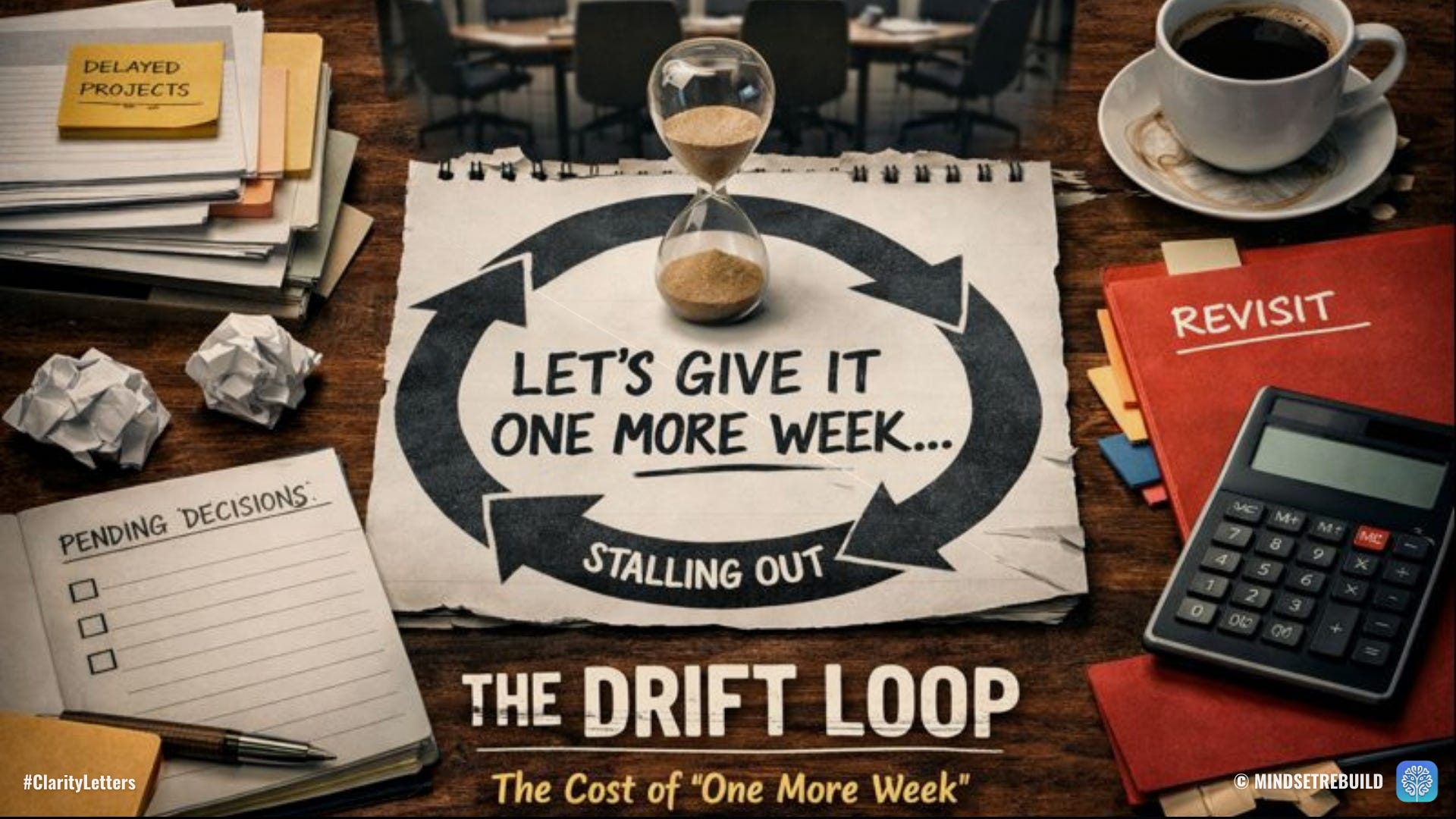
The most expensive sentence in a 25–200 person company is, “Let’s give it one more week.”
It sounds responsible. It sounds calm. It sounds like you’re avoiding a bad call.
Nothing is broken. But the business is paying a quiet tax
every day you do not decide.
But “one more week” rarely stays as one more week.
It turns into three repeat meetings, a half-built workaround, and a team that starts making their own calls just to keep work moving.
If you’ve been hearing that sentence lately, you’re not dealing with a motivation issue.
You’re usually dealing with a missing decision system.
And without one, a smart team can have a solid strategy on paper, while Monday morning feels heavy anyway.
I call that pattern the Drift Loop.
The Drift Loop (operational version)
The Drift Loop is sneaky because it doesn’t feel like drift while you’re in it. It feels like being careful.
It usually looks like this:
The business gets more complex.
Decisions show up faster than you can close them.
You compensate with more meetings and more input.
Ownership blurs.
“Temporary” becomes “this is how we do it now.”
That’s when the calendar starts running the company.
Not through malice. Through momentum.
What decision drag costs you
The obvious cost is time.
The quieter cost is what it does to focus and trust.
When decisions don’t close:
Your best operators build workarounds just to keep things moving.
“Quick questions” turn into meetings because nobody has the right to answer.
The loudest voice starts shaping reality, not the clearest one.
Priorities shift mid-week, and your team stops trusting the plan.
You keep multiple futures alive at once, and it burns budget and attention.
Nobody puts “weak decision system” on a slide.
They just say they’re slammed. They say execution is slipping. They say they can’t get ahead.
Why “more data” can make the drag worse
When you feel stuck, you gather more information.
Sometimes that’s the right move.
But I’ve noticed that a lot of “more data” is really code for one of these:
We haven’t named the trade-off yet.
We don’t know who owns the call.
So the team keeps collecting input because it’s safer than closing.
Not because anyone’s avoiding work. Because without a system, closing feels like stepping into traffic.
This is how smart teams end up with slow decisions.
Not from lack of intelligence.
From lack of a container that makes decisions close cleanly.
A simple test (60 seconds)
Try this quickly. No spreadsheet. No big exercise.
Think about the last two weeks.
How many meetings happened because a decision didn’t close the first time?
Can you name three open decisions right now, each with one owner and a due date?
Do you have a debate that sounds new every time, even though it’s the same topic?
If you’re getting “more than a couple,” “not really,” and “yes,” you’re probably looking at a system gap, not a people problem.
Four artifacts that break the loop
I’m going to give you four artifacts I use because they’re boring in the best way.
They don’t require a retreat. They don’t require a culture program. They just reduce the friction that keeps decisions open.
If you only try one, start with the first.
1) Decision Backlog Ledger
This is a single list of open decisions.
Not tasks. Decisions.
A line looks like:
Decision: “Choose pricing model for Pro tier”
Owner: ___
Due: ___
Blocked until closed: ___
That’s it.
Why it helps: it stops “we’re working on it” from becoming a hiding place.
Most teams already have a decision backlog. It’s just invisible, spread across meetings, Slack threads, and people’s heads.
Once it’s written down, you can see what’s stale, what’s urgent, and what’s quietly poisoning focus.
2) Trade-Off Map
This is one page that names the trade-off you’re actually choosing.
Not pros and cons. Costs.
I write it like this:
If we choose A, we pay: ___
If we choose B, we pay: ___
Examples:
If we keep pricing low, we pay in support load.
If we raise pricing, we pay in churn risk.
If we keep customization, we pay in delivery speed.
If we standardize, we pay in a few loud complaints.
Why it helps: teams stall when the trade-off stays polite and unspoken.
Once the cost is named, people stop arguing around the edges and start choosing.
3) Decision Rights Map
This one saves more time than it gets credit for.
It’s a simple map of who decides what.
Not who has an opinion. Who decides.
I keep it to four roles:
Decide
Recommend
Input
Approve (rare)
Why it helps: ambiguity creates politics, even when everyone’s well-intentioned.
When nobody’s sure who owns the call, meetings get crowded, decisions get delayed, and operators start doing quiet lobbying just to protect their work.
A Decision Rights Map reduces the invisible negotiating that eats your week.
4) Operating Cadence Blueprint
This is the “where does the decision go to close” artifact.
It answers questions like:
What types of decisions close weekly vs monthly?
What needs a meeting, and what can close async?
What does “ready for decision” mean here?
How do we communicate the call after it’s made?
Why it helps: without cadence, decisions bounce around.
They get raised in one meeting, deferred in the next, half-decided in Slack, and re-opened the following week.
With a cadence, decisions have a home. The team knows how to prepare. The organization knows when something is actually decided.
What to do next Monday
If this were my company, I wouldn’t try to install everything at once.
I’d run a small test.
Start a Decision Backlog Ledger with ten lines.
Ten open decisions. One owner each. One due date each. No essays.Pick one decision and write the Trade-Off Map in plain language.
“If we choose A, we pay…”
“If we choose B, we pay…”
Then ask, “Which cost are we choosing on purpose?”Name decision rights for one domain for two weeks.
Pricing, hiring, roadmap, customer exceptions, tooling. Pick one. Write it down. Run it.
If those three moves cut even one repeat meeting a week, you’ll feel the difference fast.
The point of the system
The goal isn’t speed for the sake of speed.
The goal is fewer reopened decisions and less leadership fatigue.
A decent decision system does something simple:
It makes ownership and trade-offs visible so decisions can close cleanly.
That’s how you stop paying “one more week” interest.
Next step
If you want, take the Decision Drag Audit.
It takes you 10 minutes, and I’ll reply with what I see and the best next step.