


Welcome to Mindset Rebuild’s CEO Life OS (Premium)—where bold history turns into operating instructions.
Each week, we unpack a “mad” idea that became modern best practice—then translate it into one small, enforceable ritual you can run tomorrow. This issue: the junior doctor who put a basin at a doorway and proved that disciplined behavior beats elegant theory.
Deep thinking. Field-tested habits. Zero fluff.
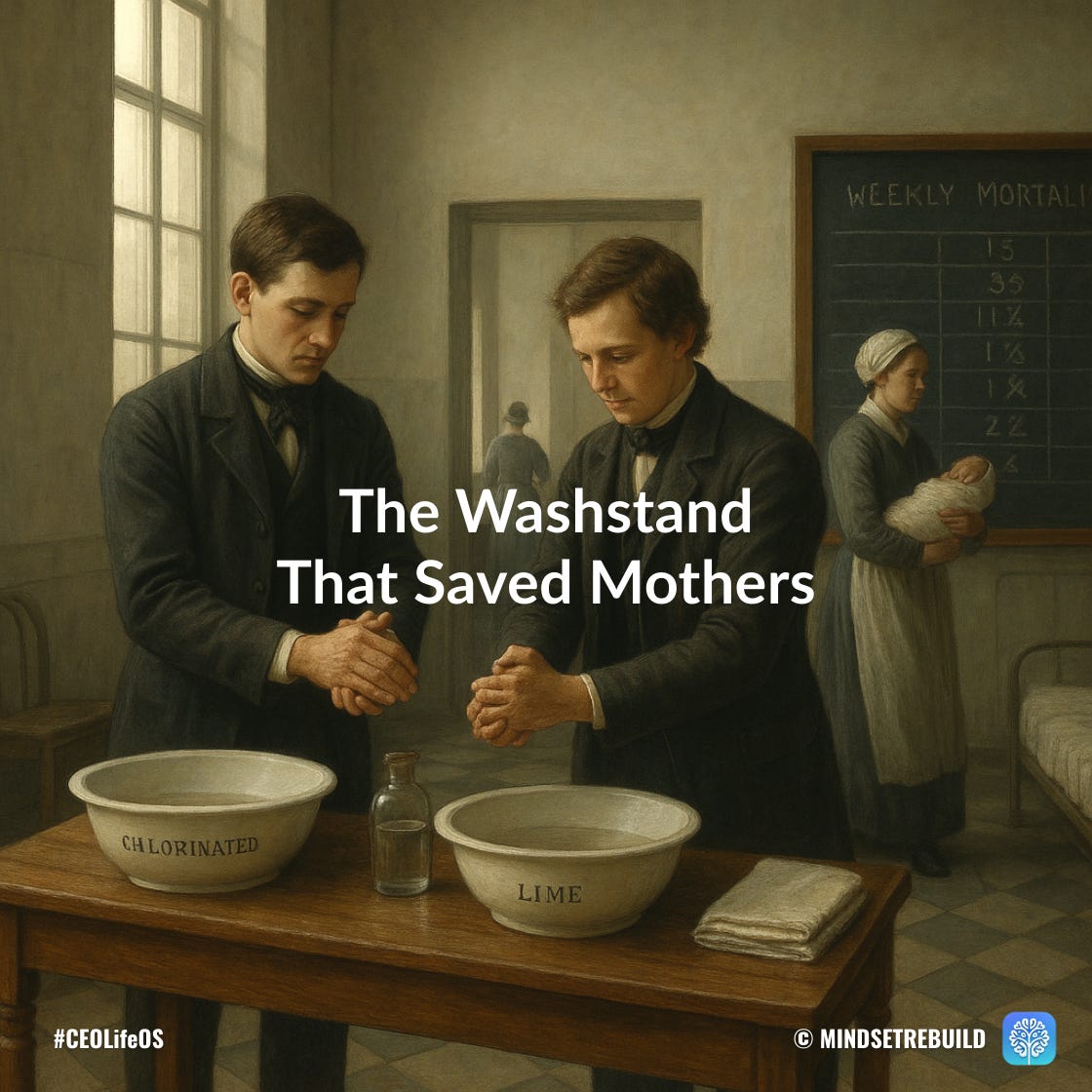
Ignaz Semmelweis didn’t publish a grand theory.
He put a basin at a doorway and told everyone to scrub—then watched death rates collapse.
A junior doctor makes a simple rule that saves mothers’ lives and insults an empire of ego. This is the moment where a system beats status, where one tiny, enforced habit outperforms every elegant explanation.
If you lead anything that matters, start here.
🏥 A Rule at the Threshold
Vienna, May 1847.
Inside the Allgemeines Krankenhaus—the vast General Hospital that anchored the Vienna Medical School—young physicians file from the dissecting theatre toward the First Maternity Clinic.
Until this month, many would have stepped straight from cadavers to mothers in labor. Now they’re halted by a 28-year-old assistant physician from Pest: Ignaz Semmelweis.
He has placed a long washstand at the threshold and filled its basins with a biting solution of chlorinated lime. No one touches a patient without scrubbing.
The order is simple, almost rude in its clarity. Within weeks, the toll of childbed fever in this clinic begins to fall.
To grasp why this mattered, you have to see the hospital as Semmelweis saw it. Two adjacent maternity clinics served the same city, in the same building, with the same bed counts and the same intake rhythms.
Yet one, the First Clinic, staffed by physicians and students who also performed autopsies, recorded maternal mortality rates that, some months, reached into the teens.
The Second Clinic, staffed by midwives who did not dissect, saw far fewer deaths.
Administrators tried to explain the gap with everything from overcrowding to the angle of the beds. Nothing held. The numbers kept accusing the hands that moved between rooms.
A death made the accusation impossible to ignore. In March 1847, Jakob Kolletschka, a respected professor of forensic medicine, died after a cut sustained during an autopsy.
His post-mortem findings—abscesses, systemic inflammation—mirrored what Semmelweis knew too well from the bodies of mothers lost to puerperal fever.
If the same lesions appeared in a man injured by cadaveric matter, then cadaveric particles carried by physicians could be the hidden courier of disease.
It was a leap of analogy grounded in the new pathological anatomy that Vienna prized. Still, it violated the era’s confidence in miasma and hygiene as matters of air and odour rather than contact and transfer.
Semmelweis acted before he had a complete theory. He didn’t write a manifesto; he changed a workflow.
The intervention was specific—scrub with chlorinated lime after the dissecting room and before patient contact—because ordinary soap and water had not moved the numbers.
The result did.
Mortality in the First Clinic, which had run at frightening levels, fell toward one or two percent when the washing was enforced. Midwives noticed. Students noticed. Some senior physicians bristled. The protocol implied a humiliation: that gentlemen of medicine were, in practice, vectors.
Hierarchy and timing worked against him.
The head of the First Clinic, Johann Klein, guarded custom and authority; Semmelweis was junior, Hungarian in an Austrian system, and not yet published.
Powerful allies existed—Ferdinand von Hebra would soon use his journal to publicize the results; Karl von Rokitansky presided over the pathology that made the analogy thinkable—but consensus did not arrive.
Vienna in the late 1840s was a place of precision and deference, about to be shaken by the revolutions of 1848; hospitals were disciplined machines. In that culture, a simple, disruptive rule that accused the machine itself met a hard surface.
This story opens at the washstand because that is where a theory-poor but data-rich decision became a system. The chlorine did not make Semmelweis right; the measured collapse of deaths did.
He installed a behaviour, and the behaviour produced a public fact. That is the hinge we recognize today: the moment a leader chooses results over reputation, process over posture.
What followed—resistance, exile to Pest, a late and combative book, and a tragic end—belongs to the rest of the narrative. But the introduction is this: a basin at a doorway, a young doctor willing to look at the numbers as they are, and a hospital forced, however briefly, to confront what its own hands had done.
🏛️ Where Prestige Became a Pathogen
The stage was the Allgemeines Krankenhaus in Vienna—the largest teaching hospital in the Habsburg Empire and a temple to the city’s “Second Vienna School of Medicine.”
Under Karl von Rokitansky’s pathology and Josef Škoda’s clinical method, students learned to correlate bedside signs with post-mortem findings. Autopsies were not rare; they were routine.
In obstetrics, this devotion to pathological anatomy created an unintended conveyor belt: medical students dissected in the morning, then crossed the courtyard to examine laboring women. Midwives, trained in a parallel track, did not.
Two maternity clinics sat side by side inside the hospital. The First Clinic, led by Professor Johann Klein, trained physicians and students; the Second Clinic trained midwives.
Both served poor women who came for free care and instruction. The records from the 1840s show a consistent and public embarrassment: the First Clinic’s maternal mortality from childbed (puerperal) fever often ran several times higher than the Second’s.
Some months in the First climbed into double digits, while the Second held near a few percent. The contrast was so notorious that women reportedly begged to be admitted to the midwives’ ward, and some delayed entry until after giving birth in the street to avoid the more lethal clinic—an act that kept them off the First Clinic’s rolls but not out of the city’s mortality statistics.
Obstetricians across Europe argued about causes. Most still trusted miasma theory—the idea that bad air or foul smells carried disease. Others emphasized constitution, climate, or crowding.
A few dissenters, including Oliver Wendell Holmes Sr. in Boston (1843), argued that physicians themselves could transmit puerperal fever from one patient to another. In Vienna, where authority flowed through rank and method, this view was a minority position and easily dismissed as moralizing.
The prevailing culture prized precision, hierarchy, and the visible lesion found at autopsy; invisible agents had no place to live.
Ignaz Semmelweis entered this world in 1846 as an assistant to the First Clinic. He was a Hungarian in an Austrian system, junior in rank in a unit governed by Klein, who controlled appointments and resented interference.
Semmelweis’s temperament pushed him toward the numbers. He walked the wards, studied the ledgers, and began stripping away explanations.
He tested the idea that the priest’s bell, used when bringing last rites, frightened women and worsened outcomes; he changed the route and timing. No effect.
He adjusted delivery positions to match the midwives’ practice. No effect. He scrutinized ventilation and bed spacing. Still, the First Clinic’s mortality dwarfed the Second’s.
The decisive clue came in March 1847, when Jakob Kolletschka, a professor of forensic medicine, died after a scalpel wound during an autopsy. The lesions described at his post-mortem looked painfully familiar to Semmelweis: the same abscesses and systemic inflammation he had seen in mothers dying of childbed fever.
The analogy was direct and indicting. If cadaveric material introduced into a small wound could kill a healthy man with the same pattern of disease, then hands moving from the dissecting room to the labor ward could seed the same catastrophe in women after delivery.
In a hospital built to perfect method, Semmelweis made the context itself the method. He ordered everyone entering the First Clinic to wash with chlorinated lime—a solution already known to strip the clinging stench of decomposition from skin—after leaving the autopsy room and before touching patients.
Ordinary soap had not changed the numbers; chlorine did. Within weeks, the death curve bent downward. The midwives noticed the difference; so did the students. But the rule carried a social penalty: it implied that learned gentlemen were the vectors of a lethal disease.
The larger city around the hospital was straining. Vienna in 1847–48 balanced on the edge of revolution; nationalism pressed against imperial order, and careers were made or unmade by loyalty as much as by data.
Semmelweis, not yet published and lacking a fully articulated theory—Pasteur’s microbes and Lister’s antisepsis still lay ahead—found himself colliding with the institution he served.
Klein guarded his prerogatives; allies such as Ferdinand von Hebra would later champion the results in print, but within the clinic the protocol’s success did not automatically translate into security or promotion.
This is the context that makes the washstand more than an anecdote. Vienna’s obsession with autopsy created the very pathway for contagion it could not yet name.
Two clinics, one culture, and a city about to break open formed the environment in which a young assistant’s narrow, procedural change proved what debates could not: the system was the problem—and it could be rewritten.
⏳ Five Turns That Changed the Ward—and Medicine
1) 🔬 An Autopsy That Drew the Map
On 2 March 1847, Semmelweis left Vienna for a short trip to Venice, trying to clear his head after months of watching mothers die. When he returned on 20 March, he learned that his colleague, the forensic professor Jakob Kolletschka, had died after a student nicked his finger with a cadaver knife.
The autopsy read like a mirror of the lesions in puerperal fever—lymphangitis, peritonitis, pleurisy, pericarditis, even metastatic abscesses. In his own words later, Semmelweis realized that Kolletschka had died of the same disease pattern that was killing parturient women.
The analogy was not romantic inference; it grew from Vienna’s own creed of pathological anatomy: identical lesions, identical cause. From that moment, “cadaveric” matter on physicians’ hands became the prime suspect.
2) 🫧 Chlorine in the Basin, Lives on the Line
Semmelweis responded with a rule, not a pamphlet.
On 15 May 1847 he ordered everyone moving from the dissecting room into the First Maternity Clinic to scrub their hands in chlorinated lime—a harsh solution that stripped the persistent smell of decomposition better than plain soap.
Within weeks the trends bent: the clinic’s maternal mortality, which had often run far above the midwives’ ward next door, fell to the low single digits and stayed there while compliance held.
By autumn, the requirement expanded from “after autopsy” to before each patient contact, translating insight into an operating rhythm. What made the case hard to ignore was not rhetoric but ledgers: when enforcement slipped, mortality rose; when he tightened the rule, it fell again.
The basin changed the numbers.
3) 📉 When Data Outran Doctrine
Vienna’s medical hierarchy prized visible lesions and orderly ranks.
Johann Klein, the First Clinic’s chief, controlled reappointments and disliked the insinuation that gentlemen’s hands carried death.
Semmelweis was Hungarian in an Austrian system, junior, and unpublished. He did the unglamorous work of falsification—rerouting the priest’s bell that signaled last rites (no effect), matching delivery positions to the midwives (no effect), adjusting ventilation and bed spacing (no effect). Only the chlorine wash moved the metric.
Yet many seniors still preferred miasma and constitution to an unseen agent.
Allies existed: Ferdinand von Hebra publicized the results; Josef Škoda pushed for an official inquiry—reports say it was quashed—but inside the clinic, politics outran data.
Then 1848 arrived, and with it a revolution that unsettled careers and hardened loyalties. The simplest reading is the human one: a rule that saved lives also humiliated status, and status pushed back.
4) 🚂 Exiled to Pest, Vindicated by Results
Denied reappointment in 1849, Semmelweis left for Hungary.
In 1851 he took charge of obstetrics at St. Rókus Hospital in Pest and, with institutional authority at last, installed the same chlorinated-lime regimen and admission discipline he had battled for in Vienna.
The replication was as clean as science gets: over 1851–1857, maternal mortality averaged about 0.85%—a second, independent demonstration in a different city, under different leadership, with different staff.
In 1855 he became professor of midwifery at the University of Pest, embedding the protocol in training rather than pleading for it at the margins.
Meanwhile, in laboratories across Europe, evidence was slowly accumulating that microorganisms could be causal—intellectual scaffolding that would soon make his numbers obvious rather than offensive.
5) 📖 A Book, Open Letters, and an Unforgiving End
Semmelweis finally published his full case in 1861: The Etiology, Concept, and Prophylaxis of Childbed Fever. Exhaustive and combative, it won attention but not quick conversion.
Stung by dismissive reviews, he wrote a series of Open Letters (1861–1862) to prominent obstetricians—including Späth in Vienna and Scanzoni in Würzburg—accusing them, sometimes in blistering terms, of tolerating preventable deaths.
History can misremember his vehemence as instability; in truth, it was also grief and urgency.
Within a few years, Louis Pasteur would frame microbes as causes, and in 1867 Joseph Lister would publish antiseptic surgical results that aligned with Semmelweis’s practical insight.
Vindication in print, however, arrived too late for the man. In 1865, after colleagues committed him to an asylum in Vienna, he died within weeks of sepsis from an infected wound. (Recent reviews of autopsy documents indicate he was beaten by attendants, likely contributing to the fatal infection; earlier accounts left the beating contested.)
The irony is unbearable and exact: the pioneer of hand hygiene died of the very bloodstream infection his rule could prevent.
Read together, these episodes show a leader using his institution’s own strengths—meticulous records, routine autopsies, disciplined training—to expose a lethal pathway hidden in the workflow.
He didn’t wait for perfect theory. He made a small rule, measured its effect, replicated it elsewhere, and argued until the science caught up.
That is the shape of durable change: evidence first, explanation soon enough.
🧱 Why the Obvious Looked Impossible
The obstacle wasn’t a lack of evidence; it was a world built to honour the wrong kind of evidence.
In the 1840s, Vienna’s Second Medical School took pride in turning symptoms into lesions and lesions into case histories. Pathological anatomy—under Rokitansky’s authority—made disease visible after death. What it could not yet make visible were agents that moved before death.
In that culture, Semmelweis’s claim sounded like a category mistake: a practical rule (“scrub with chlorinated lime”) presented as a causal explanation without a recognized mechanism.
Miasma theory still framed hospital debates; “bad air” and “epidemic constitutions” were respectable, teachable causes. A rule about hands felt like housekeeping, not science.
Hierarchy amplified the resistance.
The First Maternity Clinic was Johann Klein’s domain, and reappointment flowed through him. Semmelweis was a junior assistant, a Hungarian in an Austrian system, with no major publication to make his case portable.
He had numbers—month-by-month mortality collapsing when the wash was enforced, rising when it slipped—but the message embedded in those numbers was incendiary: that learned physicians were unwitting vectors.
Colleagues in other capitals reacted similarly. In Boston, Oliver Wendell Holmes had already argued contagion from physicians to mothers (1843) and met opposition from senior obstetricians who insisted a gentleman’s hands were, by definition, clean.
Vienna’s version of that recoil was subtler but no less real: adopting Semmelweis’s protocol meant admitting a moral injury within the profession itself.
Timing made it worse. In 1848, revolution shook Vienna; loyalty and rank mattered as much as logic.
Klein was replaced the next year by Carl Braun, whose 1850s textbook placed puerperal fever within a broad “epidemic” frame and resisted reducing it to contact transmission alone.
Even where Semmelweis’s data circulated—helped by allies like Ferdinand von Hebra—the reform sounded like discipline rather than discovery. There was no microscope-ready culprit to point at, no laboratory demonstration that mapped neatly onto the clinic.
Pasteur’s microbial work and Lister’s antiseptic program were still a decade away. In that gap, many seniors preferred to guard the prestige of established doctrine rather than concede that a junior’s basin had outperformed it.
Communication style added friction. Semmelweis delayed formal publication until 1861, long after his decisive results in Vienna (1847–48) and their replication in Pest (from 1851).
When the book arrived—Etiology, Concept, and Prophylaxis of Childbed Fever—it was exhaustive, fierce, and followed by open letters that named critics and accused them of tolerating preventable deaths.
While the urgency was humanly understandable; it was strategically disastrous. Figures such as Eduard von Scanzoni in Würzburg and Rudolf Virchow in Berlin—committed to their own theoretical frameworks—could dismiss his tone as zealotry and his regimen as a narrow fix lacking general theory.
The more Semmelweis demanded confession, the more the establishment dug in.
The institutional machine also diffused responsibility. Vienna’s training system pushed large cohorts of students from the autopsy room to the labor ward as a matter of routine.
No single actor “owned” the risk; the workflow did. When a system creates harm without a villain, leaders often defend the system itself. Hospital administrators tried every explanation that preserved the machine—ventilation, bed angles, priestly processions—because those fixes didn’t implicate the hands that ran it.
Semmelweis had tested many of those variables himself and found them wanting. That only sharpened the social cost of agreeing with him.
There were cultural undercurrents, too. The clinics primarily served poor women seeking free care. Their deaths were counted, even displayed in ledgers, but their voices carried little weight against professional pride.
The notorious practice of “street births”—women delaying admission to avoid the physicians’ ward—was an indictment from below that the institution could sidestep as anecdote while the data were still climbing.
Inside the faculty, nationality and patronage shaped careers. A Hungarian assistant challenging an Austrian chief during a politically charged decade did not begin with surplus capital.
Finally, the statistics themselves lived in an in-between era. Hospitals kept careful tallies, and Semmelweis used them relentlessly, but medicine had not yet embraced a culture of inference strong enough to overrule authority.
The logic of “evidence before explanation”—make the metric move, then ask why—felt backward to men trained to begin with theory. When his rule worked, it looked like technique; when miasma theory failed, it looked like mystery to be solved later.
Institutions tend to prefer elegant explanations that keep reputations intact over ugly facts that force behavioral change. Vienna chose elegance.
To call this collective failure “the Semmelweis reflex” is accurate but incomplete. Reflexes are automatic; this was also deliberate.
Senior figures protected status hierarchies; a discipline protected its paradigms; a city in turmoil protected its appointments. Meanwhile, a junior operator installed a single behavior that saved lives in real time and then proved it again across a border.
Misunderstanding dominated not because the facts were weak but because accepting them would have required a public reckoning—personal, professional, and procedural.
In that light, Semmelweis’s fiercest sin wasn’t merely being right too early. It was insisting that being right should change what people with power actually do.
🧾 What the Ledger Proved

By the summer of 1847, the ledger in Vienna’s First Maternity Clinic was telling a story the hierarchy did not want to hear: a basin of chlorinated lime at a doorway could collapse deaths from childbed fever within weeks.
That result didn’t come from a new doctrine or a laboratory breakthrough. It came from an operational change—a rule enforced at the point of work.
Ignaz Semmelweis reached his conclusion the way the Second Vienna School taught physicians to think: he followed the evidence from bed to autopsy and back again. The death of Jakob Kolletschka after a cadaver cut supplied the analogy; the ward registers supplied the verdict.
What followed exposes the fault lines of nineteenth-century medicine.
Professor Johann Klein protected custom and rank; Semmelweis, a junior Hungarian in an Austrian machine, lacked the political insulation publication might have given him. Even with allies like Ferdinand von Hebra amplifying the data, the institution resisted a rule that implied its gentlemen had been vectors.
The city’s politics—1848’s upheavals, the turnover that brought Carl Braun—made caution a safer choice than reform.
When Semmelweis left for Pest, he turned a contested Viennese result into a second, independent demonstration at St. Rókus Hospital, driving mortality below one percent across years.
That replication should have ended the argument. Instead, it waited for Pasteur’s microbial causation and Lister’s antisepsis to make the invisible visible and translate a practical victory into an accepted theory.
Semmelweis’s end, committed to an asylum in 1865 and dead of sepsis within weeks, adds a grim symmetry. Although accounts differ on whether injuries from beatings contributed to the fatal infection; what is not in dispute is the cause of death and the timing.
Vindication arrived shortly after, in other men’s journals and other men’s names.
The record, read straight, is plain: he identified a lethal pathway created by the very strengths of Vienna’s medical culture and rewrote it with a single, disciplined behaviour.
The consequence, measured in mothers who lived, was an order-of-magnitude improvement. The cost, measured in years lost to pride, theory lag, and institutional self-protection, is harder to tally but no less real.
🪞Find Your Basin at the Doorway
Leaders like to believe we change the world through big ideas.
