


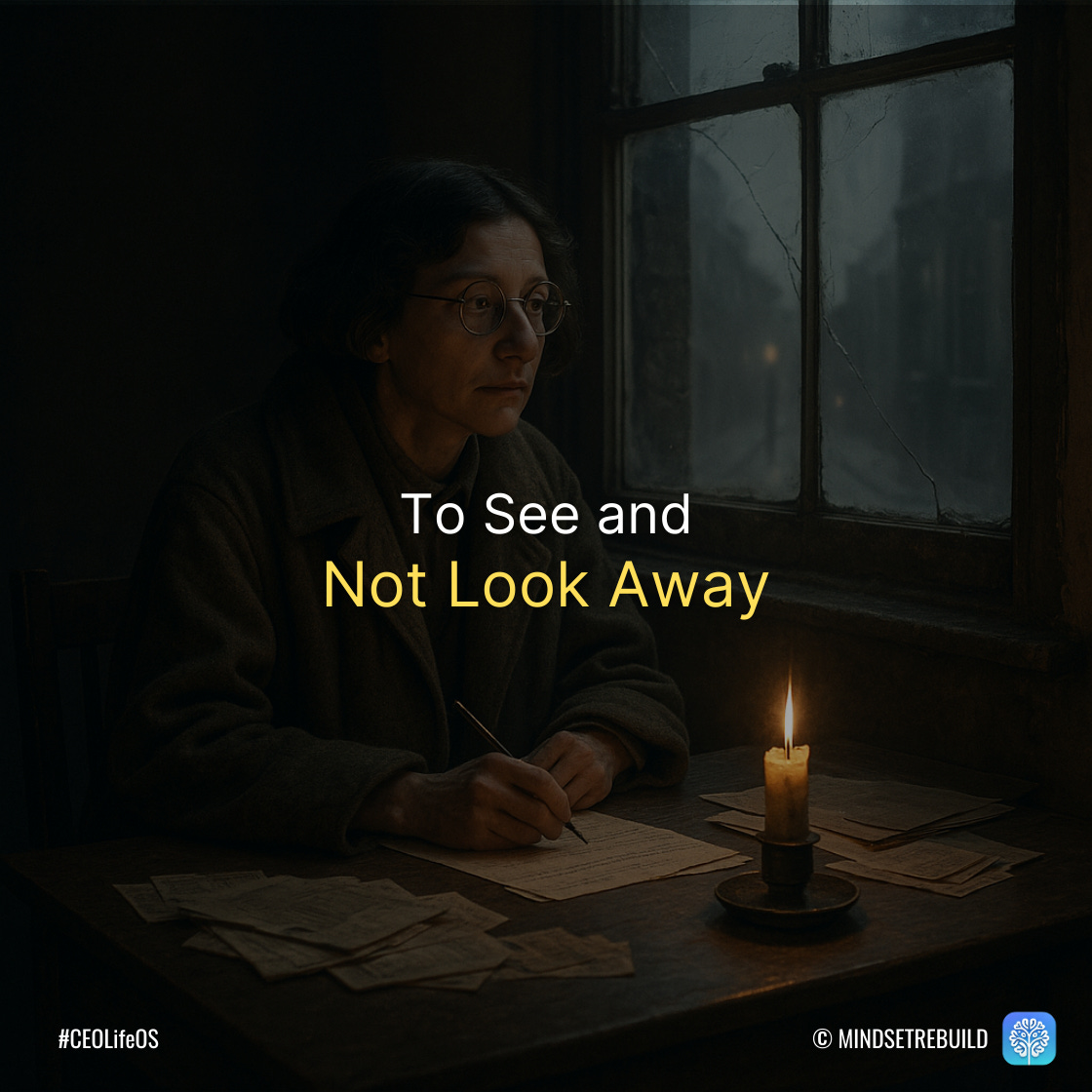
Most people scroll past suffering.
Simone Weil stopped and stared it in the face.
Not for drama. Not for status.
But because she believed attention—real, undivided attention—was the beginning of truth.
This isn’t a story about productivity.
It’s a story about moral courage.
And the cost of seeing clearly in a world that rewards looking away.
Introduction: A Letter Never Read
She died in a hospital bed in London.
Alone.
Thirty-four years old.
The doctors called it self-starvation.
Said she was depressed.
Said she refused food and treatment.
Case closed.
But that’s not the real story.
The real story starts with a woman who couldn’t turn away.
Her name was Simone Weil.
Brilliant. Strange. Unrelenting.
Born into comfort in Paris, raised on philosophy, fluent in ancient Greek by 12.
She had every reason to play it safe, rise through the system, and build a name for herself.
But she walked away from all of it.
Factory floors instead of lecture halls.
War zones instead of writing retreats.
Peasant rations instead of proper meals.
Why? Because she believed truth had to be earned—not imagined, not quoted—but lived through the body.
By the time she arrived in London in 1943, she was sick. Tuberculosis. Exhaustion. But still writing, still fighting to be useful. She begged the Free French government to let her parachute into Nazi-occupied France—not to fight with weapons, but to suffer alongside the people. To bear witness. To serve. They said no.
So she stopped eating.
Not as an act of self-destruction, but as an act of solidarity.
She refused to eat more than those starving under occupation.
The world saw a madwoman.
But if you read her notebooks—if you sit with her words—what you find isn’t madness.
It’s moral clarity.
Simone Weil didn’t want to escape reality.
She wanted to enter it fully.
With eyes wide open.
To her, attention wasn’t just focus.
It was love.
It was the most sacred offering you could give another person.
And she believed that if we could all learn to pay attention—deep, generous, ego-free attention—we could remake the world from the inside out.
That’s not depression.
That’s devotion.
And maybe the question she leaves us with is this:
What’s the cost of seeing clearly—and are you willing to pay it?
Context: The Woman Who Refused to Look Away
Most people spend their lives learning how not to feel too much.
Simone Weil was the opposite.
She felt everything—so deeply, it almost broke her.
And instead of running from that pain, she made a home in it.
Not for pity.
Not for points.
But because she believed this: If you want to think clearly, you have to stop looking away.
She was born in Paris in 1909, into a well-off, intellectual Jewish family.
Her father was a doctor. Her mother was protective. Her brother would go on to become one of the most famous mathematicians in the world.
And Simone? She was different from the start.
A genius. But weird about it.
She wouldn’t let anyone treat her like she was special.
She gave up sugar in elementary school when she heard soldiers at the front didn’t have any.
She wept over foreign wars like they were happening in her own backyard.
By the time she hit university, she was schooling the boys in philosophy—Simone de Beauvoir included.
She started teaching by 22.
And then she did something nobody expected.
She walked away.
Because the classroom felt too safe.
And safe, to her, felt like complicity.
So she took a job as a factory worker.
Twelve-hour shifts. Machine oil. Crushed fingers. Human beings turned into parts.
And she lived it—fully—so she could understand the suffering most people only study.
It wrecked her health.
But it changed her forever.
What she saw in those factories wasn’t just economic injustice.
It was spiritual erosion.
People stripped of meaning. Of agency. Of attention.
She came to believe that real oppression isn’t just material.
It’s what happens when you’re treated like you don’t matter.
When no one sees you.
When you’re invisible, even to yourself.
That’s what she set out to fight.
Not with rage.
Not with ideology.
But with the most radical thing she could muster:
Presence.
Weil didn’t think attention was just about being productive or mindful.
She believed it was the foundation of morality.
To pay attention—fully, humbly, without ego—was to love.
And love, in her eyes, wasn’t sentimental.
It was rigorous.
It was costly.
She didn’t just write that truth.
She lived it.
To the bone.
And in doing so, she made people uncomfortable.
Still does.
Main Events: Suffering, Service, and Sacred Attention
Simone Weil didn’t live a long life.
But she lived a full one.
Not full of comfort or ease, but full of friction.
She chose it that way.
Because to her, a life without truth wasn’t worth living.
The Factory Years
In 1934, at just 25, Simone signed up to work the line at a Renault plant outside Paris.
Twelve hours a day, six days a week, her hands on a machine that didn’t care who she was.
Her co-workers thought she was insane.
She had a university degree. She’d been teaching philosophy. What was she doing here?
She was learning.
Learning how pain dulls the mind.
How repetitive labour breaks the spirit.
How it feels to be unseen.
Her health collapsed under the strain. Migraines. Exhaustion.
She didn’t last long, but long enough to write one of her most important essays:
Factory Work.
It wasn’t just an economic critique.
It was a moral one.
She argued that modern industry didn’t just exploit workers—it erased them.
“The destruction of the soul is a real, everyday occurrence,” she wrote.
“It is a death far more terrifying than physical death.”
And she meant it.
The War and the Wound
In 1936, when civil war broke out in Spain, Simone rushed to join the anti-fascist fight.
But she wasn’t a soldier. She couldn’t even fire a rifle.
She just… showed up.
Wanted to serve. Help. Carry weight.
She accidentally burned herself on a cooking pan, and the injury got infected.
They sent her home before she ever saw the front lines.
But again—she turned failure into fuel.
She began to write about the nature of war, power, and obedience.
And what she saw was this:
Violence isn’t just about weapons.
It’s about the way power flattens the individual.
Turns people into objects.
Into numbers.
It haunted her.
And it shaped every word she wrote from that point forward.
The Final Years – The Need for Roots
By 1942, Simone had escaped Nazi-occupied France and made her way to London.
She was sick. Malnourished.
But still burning with purpose.
She tried to enlist with the Free French government.
Begged them to send her back into France, behind enemy lines.
She didn’t want to carry a gun.
She wanted to serve.
To be a witness.
To offer her life for something greater.
They refused.
Said she was too weak. Too fragile. Too strange.
So she wrote.
In the last year of her life, she produced The Need for Roots, a staggering work of political philosophy, moral insight, and spiritual clarity.
She argued that what people need isn’t just food and freedom.
They need meaning.
Belonging.
A place to stand.
A reason to care.
She called it “rootedness”—the deep connection to truth, community, and purpose that gives human life its shape.
And she believed modern society had ripped those roots out.
Left people drifting.
And empty.
That book was her offering.
Her final attempt to help rebuild a shattered world.
And shortly after finishing it…
Her body gave out.
Simone Weil didn’t seek fame.
She didn’t build a brand.
She didn’t try to be understood.
She just lived the truth as she saw it—no matter what it cost.
And in doing so, she left us something rare:
A blueprint for living with eyes open, heart exposed, and attention sharpened by love.
Why She Was Misunderstood, and Why She Matters Now
Let’s be honest:
A woman like Simone Weil doesn’t fit neatly into history.
Too mystical for the philosophers.
Too rebellious for the church.
Too ascetic for the activists.
Too honest for just about everyone.
So people did what they usually do with someone that raw:
They dismissed her.
Called her unstable. Unwell.
Said she was too intense. Too idealistic. Too… much.
But that was the point.
She wasn’t trying to fit.
She was trying to see.
And more importantly—to live according to what she saw.
That’s what made her dangerous.
She didn’t believe in theory without suffering.
Didn’t believe in spirituality that floated above the real world.
Didn’t believe you could know anything worth knowing if you weren’t willing to pay the price for it.
Her whole life was one long act of refusal:
Refusing to play the game.
Refusing to numb out.
Refusing to look away.
And underneath all that refusal was something deeper:
Attention.
To Simone, attention wasn’t just focus.
It was devotion.
It was an act of moral courage.
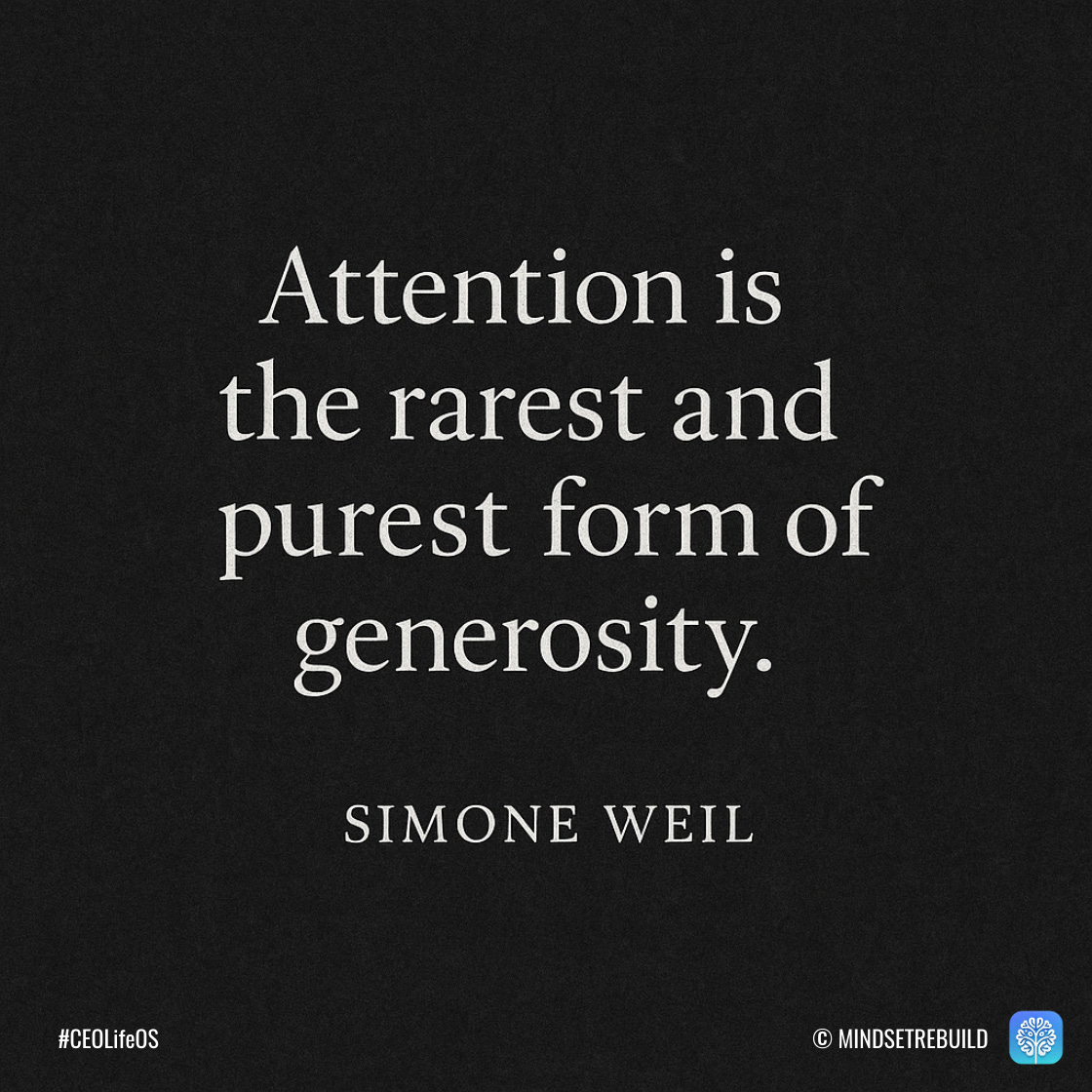
“Attention is the rarest and purest form of generosity,” she wrote.
Not scrolling. Not consuming. Not reacting.
But holding your gaze on something—or someone—without rushing to control, fix, or escape.
In a world built on noise, distraction, and dopamine…
That kind of attention?
It’s rebellion.
It’s also leadership.
Because what Simone Weil practiced, in her own quiet, radical way, is what every creator, entrepreneur, and soul-led leader eventually has to learn:
That truth doesn’t come to the comfortable.
That purpose isn’t a slogan—it’s a sacrifice.
And that if you want to rebuild your life on something solid, it starts by noticing what you’ve been trained to ignore.
She died young.
Most of her work was published after she was gone.
And yet here we are—quoting her, studying her, trying to keep up.
Because she saw something most people don’t:
That attention—real, apparent, focused attention—isn’t just a mindset.
It’s a calling.
Final Reflection: The Discipline to Stay With It
Most people want clarity.
Few are willing to sit in the silence long enough to find it.
Simone Weil did.
Not because it was trendy.
Not because she had a productivity system.
But because she knew the truth isn’t loud—it’s quiet.
And to hear it, you have to listen without flinching.
You have to pay attention long after it’s comfortable.
Long after the ego gets bored.
Long after the easy answers run out.
She called that discipline “decreation”: the slow undoing of everything false in you so that something true can emerge.
And that’s what most people miss.
We talk about mindset. But we forget:
Mindset isn’t just what you believe.
It’s what you practice when no one’s watching.
It’s how long you’re willing to stay with the hard thing—without numbing, without fleeing, without performing.
So here’s the question Simone leaves us with:
What might shift in your life… if you gave one thing your full, undivided attention today?
Not to finish it.
Not to fix it.
But to see it.
Fully. Quietly. Generously.
Because sometimes, the most radical rebuild starts with not turning away.
Three Ways to Start Rebuilding
You’re not here to chase hacks.
You’re here to build something solid.
If Simone Weil taught us anything, it’s that clarity comes after attention.
And attention starts with how you choose to show up today.
You don’t need a new app.
You need a new agreement with yourself.
Start here—simple, grounded, no fluff:
🔹 Pick one person today, and give them your full attention.
No multitasking. No checking your phone. Just listen. See them fully. That’s the muscle you’re rebuilding.
🔹 Choose one task, and do it slowly, on purpose.
Even if it’s making coffee, pay attention to every step. No rushing. Attention is trained through the ordinary.
🔹 Sit still for five minutes, and watch your mind.
No goal. No fixing, simply observe where your attention goes. Don’t fight it—just notice. Awareness is the doorway.
That’s how it begins.
Not with a big breakthrough.
But with the decision to stop looking away.
Warren