


When the world gets louder, the leaders who last aren’t the ones who shout.
They’re the ones who know how to listen beneath the words.
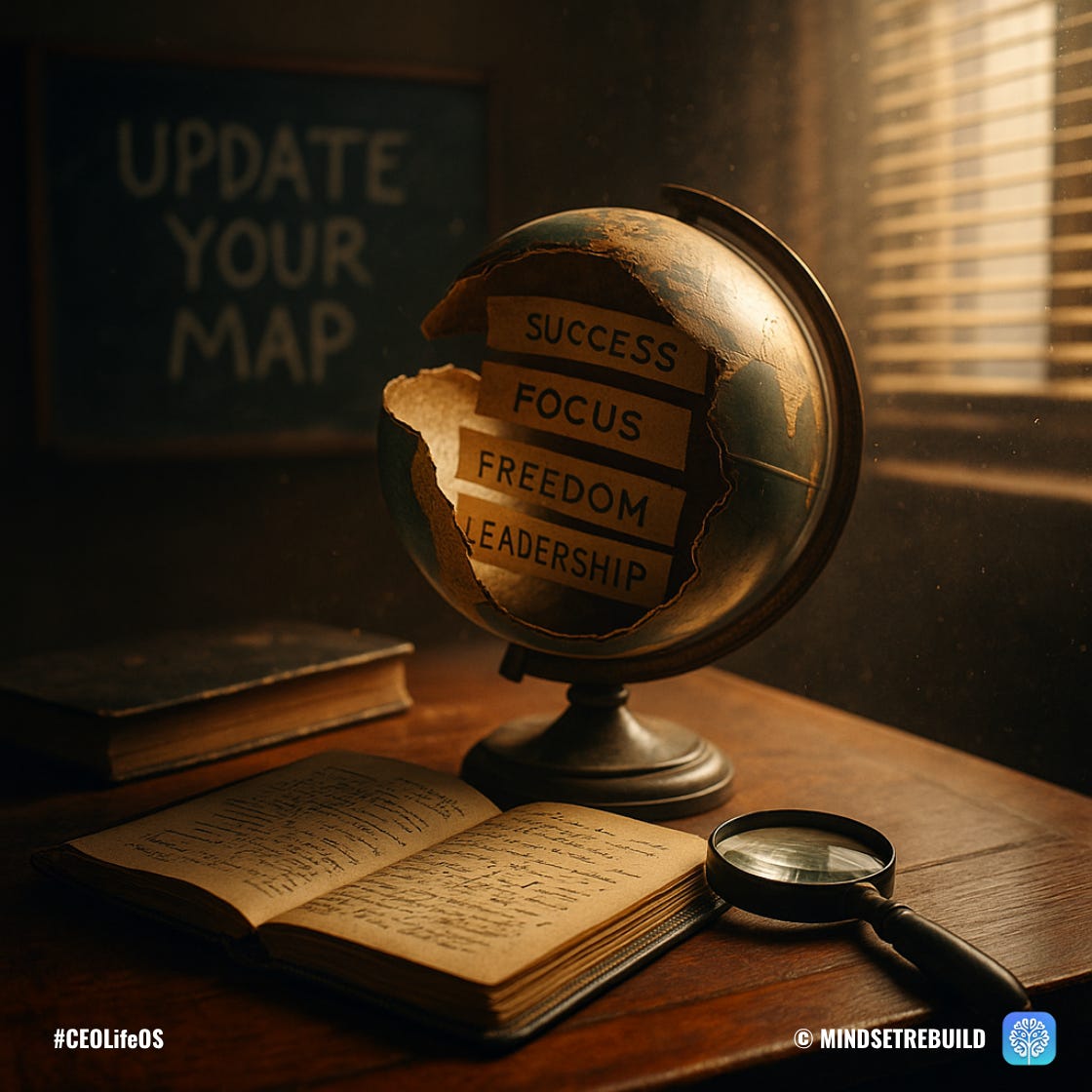
Most people don’t realize it, but they’re running their lives on someone else’s code.
They wake up within routines they didn’t create.
They pursue goals they didn’t select.
They argue over definitions they never took the time to define.
And when things go wrong—when the product stalls, when the team drifts, when the vision becomes unclear—they react.
They blame the mindset, motivation, or execution.
But Alfred Korzybski would ask something different:
“What map are you using?”
Because if you’re using outdated symbols, your speed or focus won’t matter. You’ll still be lost.
The Maps We Inherit
Let me ask you a hard question:
What does ‘success’ mean to you right now in this season of your life?
Pause and answer it.
Now ask yourself: Where did that definition come from?
Was it yours? Or did you absorb it?
From school, from culture, from someone you wanted to impress or someone you didn’t want to disappoint.
This is the core of Korzybski’s work, not just philosophy, but survival:
“The map is not the territory.”
Meaning: the labels, beliefs, and categories you live by are not the same as reality.
They are abstractions, useful but risky if you forget they’re temporary.
Because when a symbol becomes invisible, it becomes sacred. And sacred things aren’t questioned.
Consciousness of Abstracting: Seeing the Filter
Korzybski’s phrase “consciousness of abstracting” sounds academic.
But it’s wildly practical.
Here’s the truth it holds:
You’re never directly responding to reality itself. Instead, you’re reacting to a version of it that’s filtered through language, memory, and attention.
So when you say:
“She doesn’t respect me.”
“I’m stuck.”
“That won’t work.”
You’re not stating facts. You’re interpreting signals—based on a story, within a system of meaning you might have inherited without consent.
And if you don’t know how that system was built, it will quietly and powerfully lead you into decisions you never intended to make.
This is why leaders drift.
Why founders sabotage.
Why brilliant people burn out.
Not because they’re broken.
But because their map is.
The Madman Who Mapped Reality: Alfred Korzybski and the Language of Sanity

Most people live their entire lives mistaking their beliefs for reality. One man made it his mission to expose the difference—and was ridiculed for it.
Korzybski’s Structural Tools (That Still Work Today)
Korzybski wasn’t interested in theory for its own sake. He developed mental tools—practices that help you break the automatic response.
Let’s unpack the three most powerful ones:
1. Indexing
Have you ever argued with someone and only later realized you’re not even discussing the same thing?
That’s an indexing failure.
Korzybski suggested using subscripts to clarify:
“Success₁” (in my 20s) ≠ “Success₂” (after burnout)
“Freedom₁” (geographic) ≠ “Freedom₂” (emotional)
Today, we’d call this contextual precision.
But really, it’s leadership hygiene.
🛠️ Use it:
Before your next meeting, define the core terms.
What does “alignment” mean?
What does “impact” look like?
Not in theory, but today, in this terrain.
2. Date-Stamping Beliefs
Think of the beliefs you carry like software.
Some of them are Version 1.0, written years ago during stress, survival, or scarcity.
But they still run quietly, in the background.
Korzybski advised tracking when a belief formed.
Because most of the time, the belief is outdated. The context has changed, but the code hasn’t.
🛠️ Try this:
Take one self-definition that feels limiting.
Example: “I’m not good with people.”
Ask yourself:
“When did I decide that?”
“Have I tested it recently?”
“Is it still true, or just familiar?”
This is clarity work.
Not affirmations.
Just honest, compassionate system updates.
3. “Etc.” as a Philosophy
This one sounds silly until you try it.
Korzybski encouraged people to end their descriptions with “etc.”
Not as filler, but as a reminder:
No description is ever complete.
What you see isn’t all there is.
“She’s always dramatic… etc.”
“I’m not creative… etc.”
“They won’t get it… etc.”
It softens certainty.
It creates a crack through which new possibilities can emerge.
And in a world of hot takes and rigid roles, that crack might be the most radical move you can make.
Language Is Leadership Infrastructure
Most people think leadership is about vision, direction, and execution.
It is.
But underneath all of that—at the root—is language.
Because language shapes:
What people pay attention to
How they interpret each other’s behaviour
What they think is possible
You can’t align a team if everyone’s using the same word to mean five different things.
You can’t lead yourself if your inner monologue is built on stale definitions.
Korzybski didn’t create companies. He created clarity. But in a time when leadership is becoming more symbolic, that’s the most strategic thing you can develop.
How This Changes the Way You Lead
Here’s what this means in practice:
Don’t just optimize your calendar.
Clarify your categories.Don’t just tell your team to “own it.”
Define what “ownership” means this week.Don’t just set goals.
Update the language layer underneath the goals.
Because if your operating system relies on abstractions you no longer believe in, then every decision you make will feel subtly … off.
Not wrong. Just ... ungrounded. Like you’re trying to build something solid on sand.
Korzybski’s work reminds us:
You don’t need more control.
You need more awareness.
Greater precision. Greater flexibility. Greater humility when facing complexity.
That’s not a mindset shift.
It’s an OS rewrite.
Final Reflection
This week, run a semantic audit of your day:
Pick three words you use constantly: “focus,” “freedom,” “growth.”
Write down what you mean by each one.
Ask: Do these definitions still fit the terrain I’m in?
If not, redraw the map.
Because you’re not failing. You’re just navigating with outdated coordinates.
And clarity doesn’t come from shouting louder. It comes from listening differently.
That’s a Wrap
If today’s message hits home—and you’re tired of navigating with outdated maps—I work quietly with a few aligned leaders each quarter through my Strategic Co-Pilot Retainer.
It’s not coaching.
It’s recalibration at the language layer.
👉 See if it fits you
To sharper language, cleaner maps, and the courage to change both,
Warren