


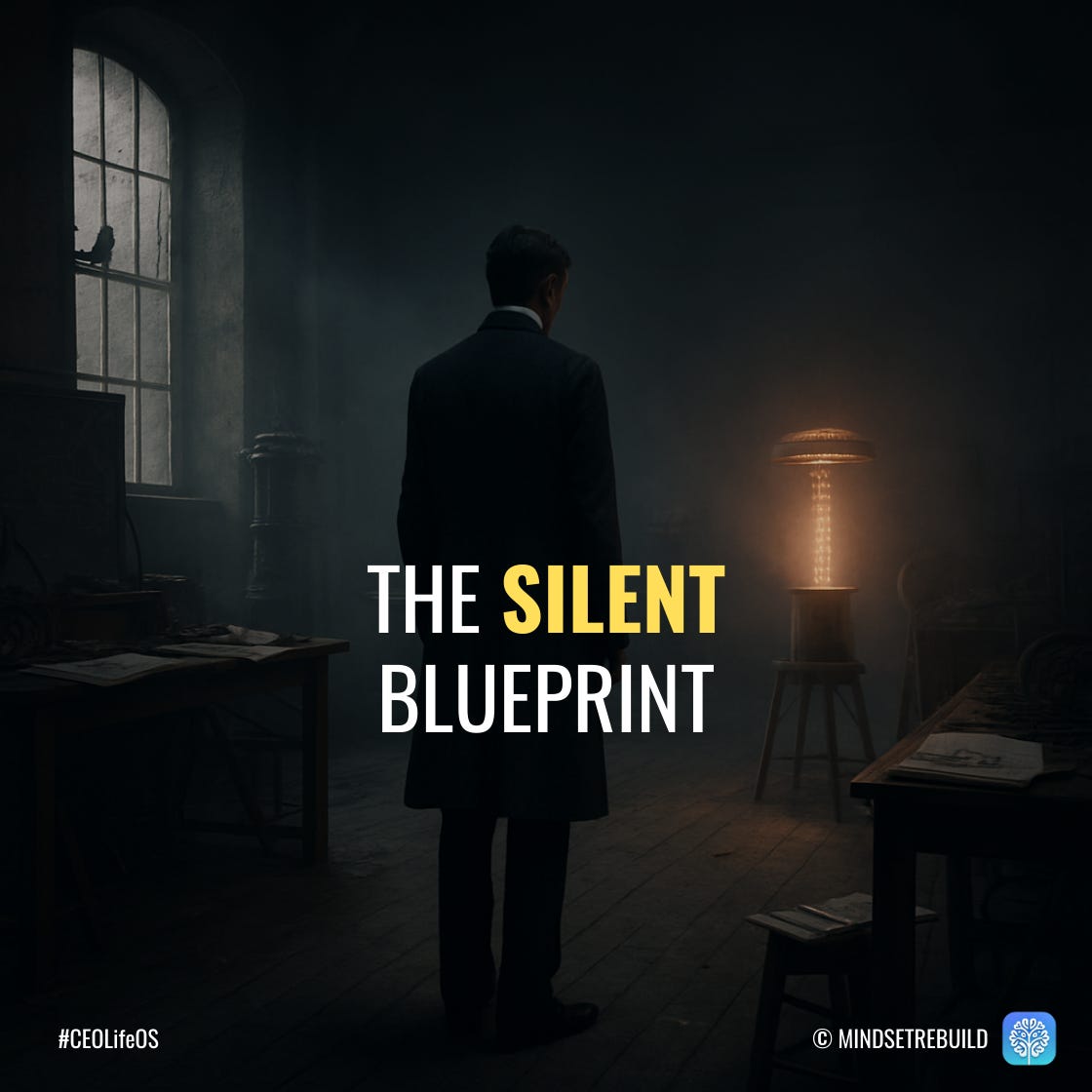
New York City, January 1943.
Room 3327 of the Hotel New Yorker is silent.
No crowd. No funeral. No obituary.
Outside, the city pulses with light powered by systems he invented.
Inside, Nikola Tesla lies dead, alone, and decades ahead of his time.
To most of the world, he had disappeared.
But what if Tesla didn’t fail?
What if he simply chose a different scoreboard?
Today, his story offers a radical blueprint for anyone who wants to lead life from the inside out—not the outside in.
And it starts with learning how to outrun the noise.
I. Genius Sounds Like Madness to the Untrained Ear
Nikola Tesla didn’t just think differently.
He thought faster. Deeper. Without guardrails.
He saw rotating magnetic fields in his mind before science had language for it. He sketched flying machines while people were still lighting lamps with whale oil.
He didn’t tinker. He downloaded.
But society didn’t applaud. It recoiled.
In an age of conformity, he was considered unstable. Eccentric. Dangerous, even.
His “lightning flashes” of insight weren’t seen as genius.
They were seen as symptoms.
What most of us miss is this: when you operate from a deeper internal OS, your speed and clarity will threaten people still buffering.
You will be misunderstood—not because you’re wrong, but because you’re early.
That’s what makes Tesla’s story so relevant. He didn’t slow down to get approval. He stayed loyal to the current of insight that ran through him.
CEO Life OS Insight:
"If you’re always waiting to be understood, you’ll never say anything worth remembering."
II. Solitude Isn’t Weakness—It’s the Forge of Mastery
Tesla didn’t fear isolation.
He required it.
He wrote, sketched, calculated, and refined in silence while others scrambled for recognition.
While Edison ran PR campaigns, Tesla fed pigeons and plotted systems that would power the globe.
And when his Manhattan lab burned down—destroying years of notes and prototypes—he didn’t rage or retreat.
He simply started again.
That’s a kind of mental toughness most never develop.
Because we’re trained to believe that being visible is being valuable.
That engagement equals success.
That if people aren’t watching, it doesn’t count.
But Tesla reminds us: Stillness is not stagnation. It’s strategy.
He didn’t need an audience to validate his ideas. The work itself was the reward.
III. He Chose Vision Over Victory
The War of Currents was brutal.
Edison lobbied politicians. Electrocuted animals to scare the public. Controlled the media narrative.
Tesla just kept showing up.
He didn’t play dirty.
He played long.
And when AC powered the Chicago World’s Fair in 1893, he won. Quietly.
But instead of celebrating, Tesla moved on to the next problem—wireless global power.
That dream would bankrupt him, lose him investors, and exile him from public life.
But he never stopped believing in it.
Because he wasn’t chasing applause.
He was chasing truth.
That’s what separates visionary leaders from performers.
They’re not here to entertain.
They’re here to build.
CEO Life OS Insight:
"If you only build what people can understand today, you’ll never shape tomorrow."
IV. Why the System Rejected Him—And Why That’s the Point
Tesla’s downfall wasn’t a lack of brilliance.
It was his refusal to compromise.
He couldn’t sell out.
Wouldn’t fake enthusiasm for quarterly profits.
Didn’t know how to water down genius to make it more digestible.
And that’s exactly why the system chewed him up and spit him out.
Because systems reward compliance, not clarity.
Tesla didn’t just push the boundaries—he redefined the map.
And for that, he was punished.
But let’s be honest:
How many of us are still waiting for permission to speak truth?
How often do we shrink because our work feels "too much"?
Tesla’s life is a permission slip to go the other way.
V. Build Anyway
Tesla didn’t die rich. Or famous. Or celebrated.
But outside that window in Room 3327, the city blazed with AC power.
That’s legacy.
He wasn’t remembered for his press releases.
He was remembered for his refusal to quit.
So if you’re creating something that no one gets yet…
If you feel alone, misread, or dismissed…
If the system says “no” but your inner compass says “yes”…
Build anyway.
Your genius may not be understood in real time.
But the work will outlive the resistance.
🔑 TAKE ACTION
✅ Solitude Challenge:
Spend 30 minutes today in quiet. No phone. No music. Just think.
(Tesla did this daily. You can too.)
✅ “Too Much” Reframe:
What part of your vision have you been diluting to make others comfortable?
Write it down. Cross out the filters. Commit to the full version.
✅ Tesla List:
Make a list of 3 projects you would build even if nobody ever noticed.
Those are your legacy projects. Start one this week.
👊 Final Word:
Most people run from being misunderstood.
Tesla ran toward it.
Because he wasn’t trying to win the moment.
He was building for the future.
So ask yourself:
Are you living for validation, or are you living on vision?
Because if you’re building from clarity, you’re already ahead.
That’s a Wrap
🔑 Ready to build your life like Tesla built his legacy—quietly, intentionally, and on your own terms? Here are 3 ways to start leading instead of reacting:
Rewire Your Mindset — Join the free 10-day course to stop drifting and start acting with clarity.
CEO Life OS Accelerator — This is for creators and solopreneurs who are done guessing. If you’re ready to stop spinning and start scaling with clarity, confidence, and systems that serve you, the Accelerator is your next move.
Offer-to-OS Strategic Retainer — You don’t need a cheerleader.
You need a strategic partner who helps you scale what actually matters.
See you in the next issue,
Warren
Read my full back story on Nikola Tesla 👇
Current of One

“The present is theirs; the future, for which I really worked, is mine.” (Nikola Tesla)