


Welcome to this issue of Clarity Letters from Mindset Rebuild.
If your team already knows the right call but keeps leaving it “in discussion,” you’re not dealing with a decision problem. You’re dealing with a permission problem. Today, we take a quick look at the container that makes it safe to say the obvious out loud and have it land.
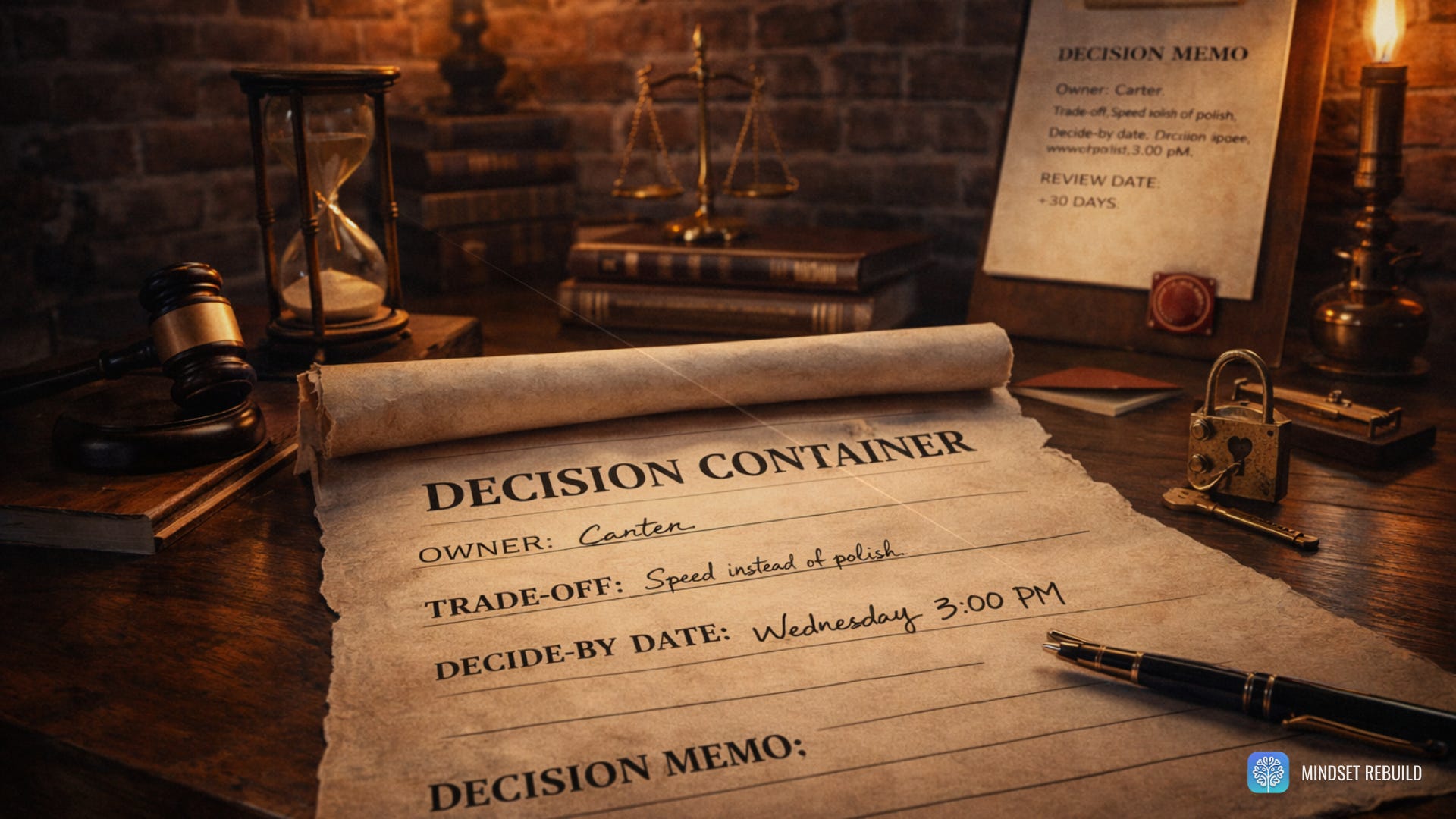
Here’s a weird thing I’ve noticed after decades in ops rooms, product rooms, board rooms, and “this is totally not a board meeting” Zoom calls.
Most teams already know what the right call is.
Not perfectly. Not with total certainty. Not with a guarantee it’ll work.
But they know.
You can feel it in the pauses.
You can see it in the way people look down at their notes, then look up, then choose a safer sentence.
You can hear it in the language that shows up right before the room avoids the truth:
“Maybe we should get more input.”
“Let’s revisit next week.”
“I’m aligned either way.”
“Can we take this offline?”
“We should probably do a bit more analysis.”
Those aren’t stupidity phrases. They’re not even laziness phrases.
They’re permission phrases.
They show up when a room has an answer but doesn’t have a container.
And without a container, saying the truth out loud feels risky, even when everyone in the room wants the same thing: momentum.
This isn’t a decision problem. It’s a permission problem.
Leaders often treat stuck decisions like a courage issue.
“If only people would speak up.”
“If only we had more ownership.”
“If only the team would stop hedging.”
Sometimes that’s part of it. People are human. Nobody loves being the person attached to a decision that might go sideways.
But here’s the part most leaders miss:
Permission doesn’t come from courage.
Permission comes from structure.
Here’s the container in one picture, the loop that turns noise into a closed call and keeps it closed.
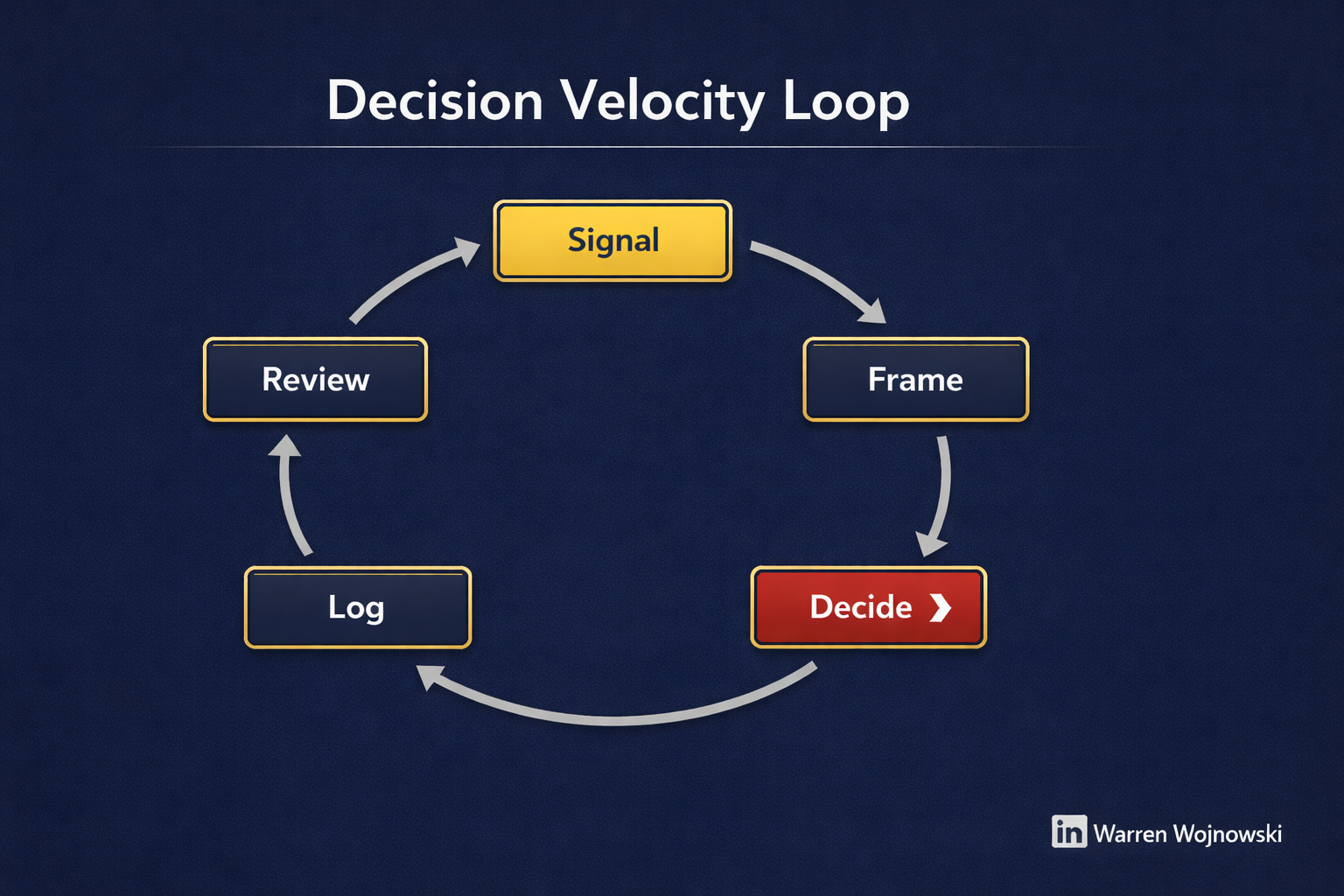
When the structure is missing, courage feels like volunteering to be the fall guy.
When the structure is present, speaking clearly feels normal.
That’s the shift. It’s not emotional. It’s mechanical.
The room doesn’t get braver.
The room gets a container.
What “permission” actually looks like in a leadership meeting
Permission is not a motivational speech.
Permission is when someone can point to something and say:
“This is the call.”
“This is who owns it.”
“This is the trade-off.”
“This is when it closes.”
“This is when we’ll review it again.”
That’s what makes it safe.
Because the decision stops being a social event and becomes an operational object.
No more “who said what” or “what did we mean.”
No more “I thought we agreed” two weeks later.
No more quiet lobbying in side channels.
A decision with a container has edges. It can land. It can stick.
And once decisions stick, execution gets calmer fast. People stop hedging. Work stops looping. The team stops living in two futures at once.
Why smart teams still stall
Smart teams stall for a simple reason.
They can see too many angles.
They can see the downside of every option. They can forecast second-order consequences. They can imagine the angry customer email and the board question and the internal Slack debate before it happens.
So they protect themselves with “more.”
More data. More stakeholder input. More comparisons. More meetings.
It feels responsible. It sounds mature.
But most of the time it’s not a thinking problem.
It’s a container problem.
Because without structure, saying the obvious thing out loud can feel like stepping into traffic.
The three things a decision container must do
A good container does three jobs.
1) It makes the call ownable
Not by a committee. By a person.
If two people “own” the decision, nobody owns it. The room stays polite. The decision stays open.
2) It makes the trade-off explicit
The trade-off is where the discomfort lives.
Most teams do not avoid decisions. They avoid trade-offs in public.
Once the trade-off is written down, the decision gets simpler because everyone is debating the same reality.
3) It makes closure real
A decide-by date with a real time. A review trigger so the team doesn’t reopen the decision emotionally.
This is the difference between a decision and a recurring discussion.
A story: The pricing decision that circled for six weeks
This is a real pattern I’ve seen more times than I can count.
Pricing decision. Six weeks. “In discussion.”
The data was there. The team had a view. Everyone had opinions. Sales had pain. Finance had constraints. Product had concerns. Marketing had positioning anxiety.
The PM eventually stopped bringing it up, because why keep touching the stove?
Each time it came up, it produced the same thing: conversation.
Not closure.
On the surface, it looked like a hard decision. Lots of nuance. Lots of stakeholders.
But underneath, it was simple.
The right call was already in the room.
What was missing was a container that made it safe to say it out loud and have it land.
So we did three things, and I want you to notice how boring they are.
Named one owner.
Wrote the trade-off in one sentence.
Set a decide-by date.
That was it.
No extra deck. No new framework rollout. No “alignment workshop.”
Once those three conditions were installed, the room could finally speak like adults.
And the decision closed.
Not in six more weeks.
In 90 minutes.
The hidden reason decisions keep reopening
If a decision keeps reopening, it usually means one of these was missing:
The owner was never named, or wasn’t empowered.
The trade-off was never written, so it kept resetting.
The date was fuzzy, so “later” became forever.
When those are missing, the decision floats.
Floating decisions create permission problems because nobody wants to be the person who turns a floating cloud into a hard object.
Because hard objects have consequences.
So the team keeps it soft. And polite. And “in discussion.”
The simplest decision container I know
If you want a practical container you can use without changing your whole company, start here.
Every time a decision is on the table, force four outputs before it leaves the room:
One named owner
One person owns closing the loop. Input is welcome. Ownership is not shared.Trade-off in one sentence
“We’re choosing ___ instead of ___.”
Speed instead of certainty. Margin instead of growth. Simplicity instead of flexibility.Decide-by date with a time
Not “end of week.” Pick a time. Times create action.A short decision memo
A few lines in writing. What we decided. Why. What changes tomorrow. When we review.
Writing is what makes it stick.
Meetings are memory machines. Memory is unreliable. Writing is stable.
This is permission, in concrete form.
Now when someone says, “But what if…” the room has something to point to.
“Good point. If that risk shows up, we’ll revisit on the review date.”
Or: “That risk doesn’t change the trade-off we’re choosing.”
That’s how a room stays calm and decisive at the same time.
Why the Executive Decision Sprint exists
This is the reason I built the Executive Decision Sprint.
Not to manufacture clarity out of thin air.
Most of the time, clarity is already possible.
It’s just trapped behind a permission problem.
So the Sprint creates the conditions where clarity can finally land.
It’s a 90-minute working session focused on one stuck decision. We leave with:
One named owner
Trade-off written in one sentence
A decide-by date
A short decision memo
That’s the container.
And once the container exists, the room doesn’t have to be heroic. It just has to be honest.
The team doesn’t need a new culture. It needs a structure that makes the right call safe to say.
A quick test you can run tomorrow morning
Pick one decision your team keeps circling back to.
Not ten. One.
The one that keeps getting called “in discussion.”
The one that quietly drags velocity and makes everyone a little more cautious.
Then ask four questions:
What exactly is being decided, in one sentence?
Who owns the final call?
What is the trade-off, written down?
When does it close, and when do we review?
If your team can answer those cleanly, you will feel momentum return fast.
If they can’t, that’s not a talent problem.
That’s your signal that the decision needs a container.
The question
What’s the one decision at your company that keeps reopening because nobody has made it safe to close?
Pricing. Contract terms. Roadmap trade-off. Org change. Vendor choice.
You already know which one it is.
It’s the one everyone is tired of talking about, but nobody wants to end.
If your team knows the right call but it still isn’t safe to say out loud, the Sprint gives it a container.
90 minutes. One stuck decision. Done.