


Welcome to this issue of Clarity Letters from Mindset Rebuild.
If your pricing decision keeps reopening and remaining “in discussion,” you’re not stuck on execution. You’re stuck because nobody owns the call, the trade-off isn’t documented, and there’s no review date to keep it closed. This is a quick look at the simple decision-close pattern that stops drift and restores momentum.
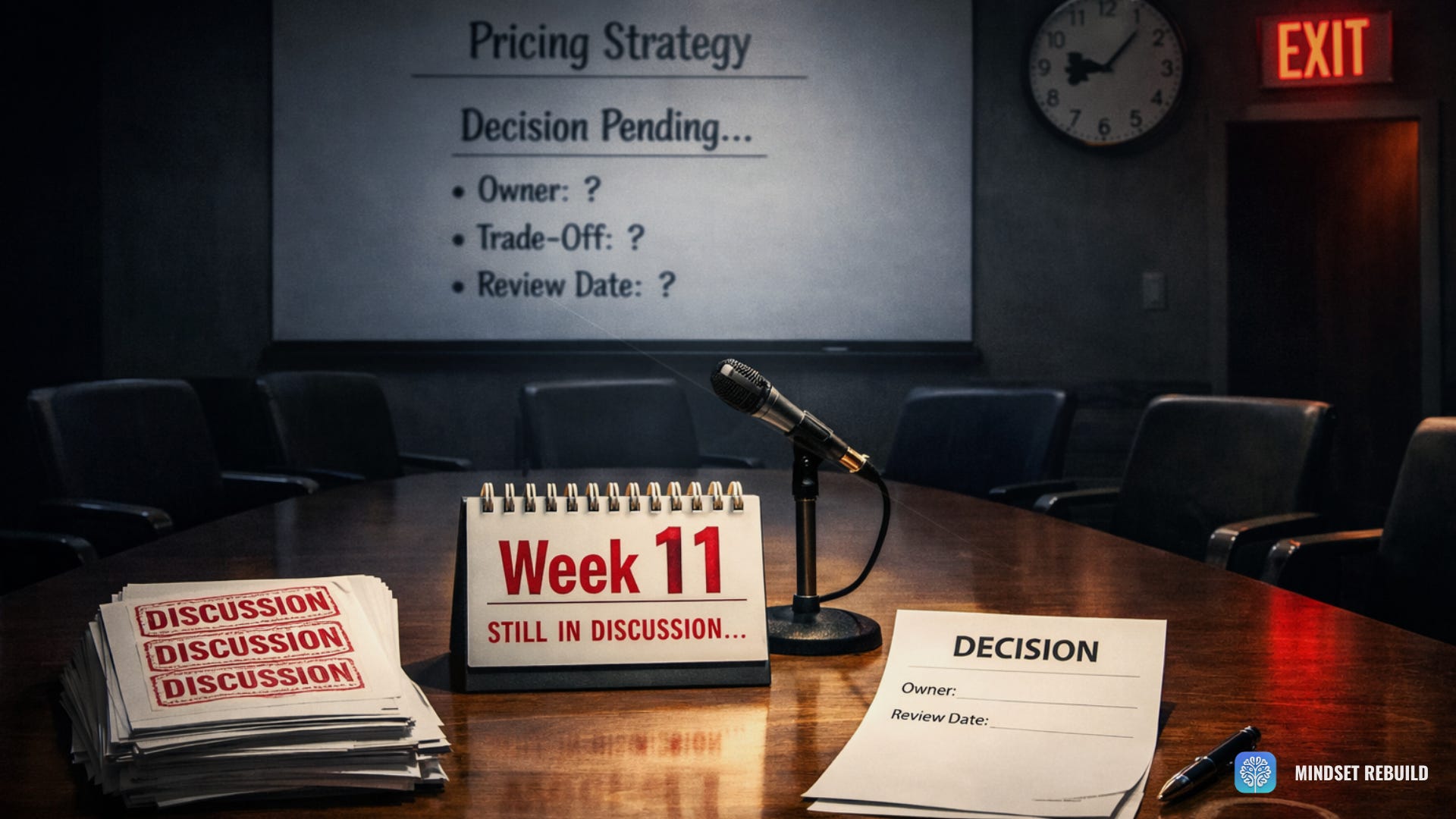
I can always tell which decision is killing velocity.
It’s the one leadership keeps calling “in discussion.”
Not because it’s the biggest decision. Not because it’s the most technical. Not because it’s the one with the most data.
It’s the one that keeps coming back like a bad sequel.
Same topic. Different meeting. New deck. Fresh spreadsheet. New “stakeholder input.”
Same outcome: nothing.
And the longer it stays open, the more expensive it gets, because everyone downstream starts building their week around a decision that may or may not land.
If you’ve ever felt that slow, grinding drag across a whole team, you know what I mean. The work doesn’t look blocked in the tools. People are “busy.” Updates are flowing. Standups are happening.
But you can feel it.
Everything takes longer than it should.
That’s the cost of an unowned decision.
The 11-week pricing decision that taught me (again)
In 2024, I watched a pricing decision sit open for over eleven weeks.
Eleven.
Weeks.
The team did everything “right” on paper.
They did analyses. They modeled scenarios. They gathered stakeholder input. They debated edge cases. They asked for more data. They ran more spreadsheets. They held more meetings.
Meanwhile, revenue sat on the table.
Sales kept asking, “What are we telling customers?”
Marketing kept waiting, “What are we positioning?”
Product kept hedging, “What are we building for?”
Finance kept stalling, “What are we forecasting?”
The team wasn’t slow.
They were waiting for a call that never came.
Then, finally, someone did two small things that should have happened in week one:
We assigned one owner.
We wrote the trade-off in one sentence.
Four days later, it closed.
Not because we suddenly got smarter.
Because the decision finally had a place to land.
And once it landed, the whole organization started moving again like someone unclogged a drain.
That’s what most leaders underestimate.
The cost of a stuck decision isn’t the decision.
It’s the stall field it creates around it.
There’s always one decision that keeps reopening
Maybe it’s pricing.
Maybe it’s a contract term that needs “one more look.”
Maybe it’s a roadmap trade-off waiting for “the right time.”
Maybe it’s whether you hire now or “hold off until we see Q2.”
Maybe it’s a vendor swap that’s been “in review” since last quarter.
Whatever it is, there’s usually one.
The decision that keeps resurfacing.
It gets discussed so many times the team starts speaking about it like weather.
“We’ll see where we land.”
“It’s still in discussion.”
“We’re not quite there yet.”
“We’ll circle back.”
And eventually the team stops expecting closure.
They start expecting discussion.
That’s when velocity dies.
Because a team that expects closure prepares differently than a team that expects debate.
Here’s the rule I use: If a decision reopens, it was never made
Not really.
You debated it.
You agreed in principle.
You got “alignment.”
But you didn’t do the three things that make a decision real:
Assign an owner
Write the trade-off
Set the review date
So the decision doesn’t stay made.
It floats.
And floating decisions don’t fail.
They just drain.
They drain time. They drain trust. They drain momentum.
Then they reappear in the next meeting, wearing a slightly different outfit.
Same problem. New language.
Why leadership teams accidentally design for drift
Most leadership teams design for consensus.
Then act surprised when nothing moves.
Consensus sounds noble. It sounds mature. It sounds like “good leadership.”
But most teams confuse consensus with clarity.
Here’s what consensus often means in practice:
“No one objects loudly enough in the meeting.”
And that is not a decision.
It’s an armistice.
The real problem is that no one knows who decides when consensus fails.
So consensus becomes the gate.
And since consensus is hard, the decision stays open.
Not because people are stubborn.
Because the system has no closure mechanism.
So decisions sit in limbo.
Revenue sits on the table.
And your team learns, slowly and painfully, that nothing actually sticks.
Your team isn’t misaligned. They’re under-governed.
This is the part I want to say cleanly, because it’s easy to misread the situation.
When decisions reopen, leaders often say:
“We’re misaligned.”
“We need better communication.”
“We need to get the right stakeholders in the room.”
Sometimes that’s true.
But more often, the team is not misaligned.
They are under-governed.
They don’t have clear decision rights.
They don’t have a shared way to close.
They don’t have a habit of writing decisions down.
So they keep talking.
Not because they love meetings.
Because nothing in the system says, “This is now closed.”
The Decision Close Ritual: owner, trade-off, review date
If you want decisions to stay made, you don’t need a fancy framework.
You need a closure ritual.
Here’s the simplest version I’ve found that works almost everywhere.
1) Assign one owner
Not a committee. Not “we all own it.” One owner.
Owner means:
collects input
frames the options
makes the recommendation
closes the loop by the date
The owner can consult anyone.
But the owner is accountable for closure.
If nobody owns it, the decision will reopen.
Every time.
2) Write the trade-off in one sentence
Most reopenings happen because the trade-off was never made explicit.
So write one sentence:
“We’re choosing ___ instead of ___.”
Examples:
“We’re choosing speed instead of certainty.”
“We’re choosing margin instead of growth.”
“We’re choosing simplicity instead of flexibility.”
“We’re choosing focus instead of coverage.”
If you can’t write the trade-off, you are still negotiating it.
And if you’re still negotiating it, the decision isn’t made.
3) Set a review date
This is the move that makes people comfortable committing.
Because it separates “we are closing” from “we are locking this forever.”
The review date says:
“We’re committing now, and we’ll revisit only if new evidence shows up.”
That stops the constant “what if” looping.
You don’t need to re-litigate the decision every meeting.
You need a scheduled, intentional checkpoint.
A review date turns reopening from a bad habit into a planned mechanism.
The moment when decisions stop floating
When you apply those three elements, something changes fast.
The decision stops being a topic.
It becomes an artifact.
An owned call with a written trade-off and a future checkpoint.
That artifact can be referenced.
It can be shared.
It can be defended.
It can be acted on.
Most importantly, it doesn’t depend on memory or mood.
It doesn’t rely on “what we meant.”
It states what you decided.
This is why decisions that are written down tend to stay made.
Because they exist outside the meeting.
Meetings are emotional. Meetings are social. Meetings are political.
Writing is boring, and boring is good.
Boring is stable.
Stable is fast.
A quick way to spot your “decision killer”
If you want to find the decision that’s draining velocity right now, here’s a simple test.
Ask your team:
“What’s the decision we’ve discussed at least three times, but still haven’t closed?”
Then watch what happens.
Someone will smile in that tired way.
Someone will roll their eyes.
Someone will say the name of the decision like they’re naming a long-standing family problem.
That’s your velocity killer.
Not because it’s hard.
Because it’s unowned.
Tomorrow morning: pick one decision that’s been open longer than three weeks
Don’t fix the whole system tomorrow.
Fix one decision.
Pick the one that keeps reopening.
Then do three things:
Name the owner
Write the trade-off
Set the review date
That’s it.
And if you do it right, you’ll feel the air come back into the org.
Meetings get shorter.
People stop hedging.
Work stops stalling in the hallway.
Revenue stops waiting on “alignment.”
Because the decision finally has a place to land.
The question
What’s the one revenue decision that keeps reopening at your company?
And more importantly:
Who owns closing it?
If you can’t get clear answers after trying, that’s when having someone outside the team helps.
I run a 90-minute working session that surfaces the real constraint, assigns clear ownership, and produces a written Decision Memo within 48 hours to keep it closed.
I take 2 Sprints per week.
If you’ve got a decision that’s been stuck for 3+ weeks, DM me.