


Welcome to this issue of Clarity Letters from Mindset Rebuild.
If a decision has been “in discussion” for weeks and nobody can name the constraint, the decider, and the written trade-off, you’re not stuck on execution. You’re stuck because the decision can’t pass a simple three-question test. This is a quick look at that diagnostic and how it gets decisions moving again.
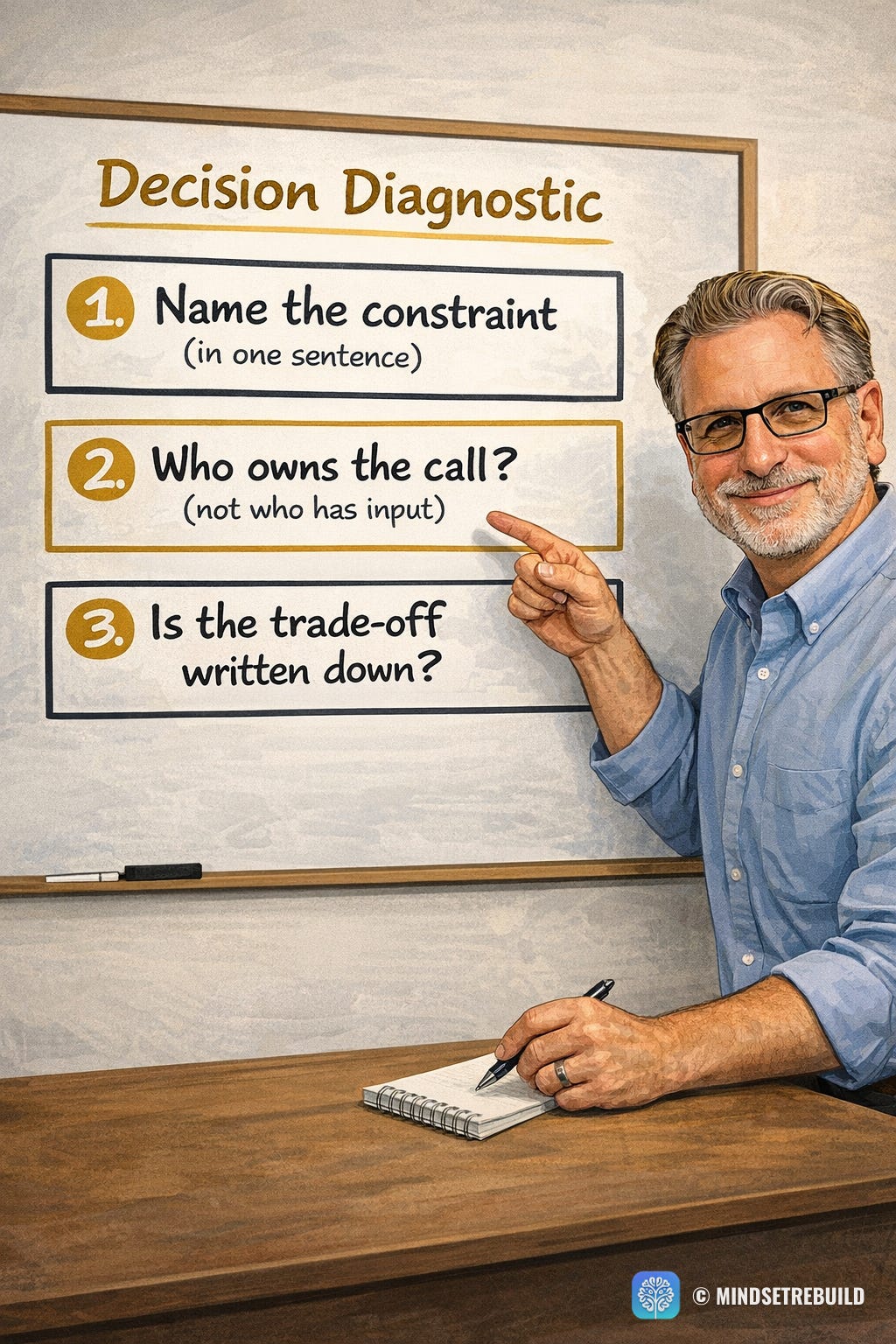
If you’ve been in leadership long enough, you’ve lived through this exact scene.
A decision is “important,” so it gets put on the agenda.
Everyone shows up sharp. Everyone has opinions. Everyone cares.
And somehow, after 45 minutes of smart conversation, the decision is still sitting there like a dead fish on the table.
So the group reaches for the usual comforts:
“Let’s get more data.”
“Let’s pull in one more stakeholder.”
“Let’s do a bit more analysis.”
“Let’s take this offline.”
“Let’s revisit next week.”
It feels responsible. It feels thoughtful. It feels … adult.
But most of the time, it’s the opposite.
It’s avoidance with better vocabulary.
Because every stuck decision I’ve seen has the same problem, and it’s never what the team thinks it is.
They don’t need more inputs.
They can’t answer three basic questions about the decision.
And until they can, the decision will keep looping, no matter how many meetings you throw at it.
The pattern that creates “smart” gridlock
Here’s the quiet truth: smart teams are often the easiest teams to trap.
They can see ten angles. They can forecast second-order effects. They can argue both sides with real conviction.
So they keep the decision alive in the name of “quality.”
But what’s really happening is simpler:
They don’t agree on what constraint they’re solving for.
They don’t know who can actually close the call.
They haven’t written down the trade-off, so the decision keeps reopening.
This is not a talent problem.
It’s decision hygiene.
And if you fix the hygiene, the speed comes back without anyone “trying harder.”
The Three-Question Decision Diagnostic
If you only take one tool from this letter, take this one.
When a decision is stuck, don’t ask for more opinions.
Ask these three questions.
1) Can you name the constraint in one sentence?
Not a paragraph. Not a strategy doc. One clean sentence.
Examples:
“One dev team, two features. Pick one.”
“Jennifer’s maternity leave starts March 1st.”
“We’ve got $30K left in Q4 budget.”
“Our biggest customer renews in 21 days.”
“We can’t change pricing without breaking three enterprise contracts.”
If you can’t clearly name the constraint, a hidden constraint is blocking the decision.
And when the constraint is hidden, everybody starts solving for a different limit.
One person is optimizing for speed.
Another is optimizing for optics.
Another is optimizing for margin.
Another is optimizing for risk.
Another is optimizing for “not getting blamed.”
So the conversation becomes a polite tug-of-war between invisible goals.
That’s why it feels like you’re talking in circles. Because you are.
You’re not debating the decision.
You’re debating the constraint, without admitting it.
Quick test: If you ask five people, “What are we really constrained by here?” and get five different answers, you don’t have a decision problem. You have a constraint problem.
2) Who owns the final call?
Not who has input.
Not who gets consulted.
Not who feels strongly.
Who makes the call when time runs out?
If you can’t name that person in five seconds, lack of ownership is blocking the decision.
Because decisions without owners become discussions that never end.
This is where teams fool themselves.
They’ll say things like:
“We want alignment.”
“We want consensus.”
“We want to be collaborative.”
All good goals.
But collaboration is not a decision-making mechanism.
Somebody still has to close the loop.
And when nobody has the authority (or the courage) to be that person, the decision stays open until reality makes the call for you.
The vendor gets chosen by delay.
The pricing model gets chosen by exhaustion.
The org change gets chosen by attrition.
If you’ve ever watched a team “accidentally” drift into an outcome, that’s what happened.
The decision didn’t get made. It got inherited.
A line that saves weeks: “Who owns the call?”
Then wait through the discomfort until you get a real answer.
3) Is the trade-off written down?
This one is the killer.
Because most teams talk about trade-offs endlessly, but they don’t write them down.
And if the trade-off is not written, the decision lives in conversations.
Every meeting reopens it. Nothing sticks.
A written trade-off looks like this:
Option A costs X, delivers Y by Z, and carries risk R.
Option B costs A, delivers B by C, and carries risk D.
That’s it.
Not a novel. Not a deck. Not a 37-slide war.
A plain written comparison.
Writing does something conversation can’t:
It creates closure.
It gives the team a shared reference point that doesn’t change based on who spoke last.
It stops the decision from turning into a recurring debate club.
And it gives leadership something solid to support.
Because supporting a decision is hard when it exists only as “what we kind of said in that meeting.”
If you’ve ever heard, “Wait, I thought we decided…”
That’s not a memory problem.
That’s a writing problem.
Why these three questions work
Because they force reality into the room.
The constraint forces the choice.
The owner forces closure.
The written trade-off forces stability.
When all three are clear, decisions stop being theatrical.
They become operational.
The team can still disagree. The team can still debate. The team can still push for better options.
But the decision will move.
Because the system supports closure.
And when the system supports closure, speed isn’t a personality trait anymore. It’s an outcome.
The “decision loop” you want to avoid
Let me name the loop I see all the time, because once you see it, you can’t unsee it.
Decision gets stuck
Team asks for more data
Data comes back messy or mixed
Team asks for more stakeholders
Stakeholders add competing goals
Constraint gets blurrier
Nobody owns closure
Decision stays open
Work slows
Leaders push harder on execution
Team feels pressure
Decision gets even riskier to own
Repeat
It’s a perfect little machine for turning smart people into cautious people.
And it has nothing to do with motivation.
It’s structure.
A quick example: the feature that never ships
Here’s how this shows up in product teams constantly.
You’ve got one dev team. Two features. Both “important.”
Feature A is a customer ask.
Feature B is technical debt.
Everyone agrees both matter.
So you debate. You analyze. You gather input. You create a scoring model.
But the decision keeps bouncing.
Why?
Because nobody has named the real constraint.
Is the constraint revenue? Then Feature A wins.
Is the constraint stability? Then Feature B wins.
Is the constraint “we cannot lose this customer”? Then Feature A wins.
Is the constraint “we cannot keep shipping fragile code”? Then Feature B wins.
Until you name the constraint, you’re not deciding between features.
You’re deciding what your organization is optimizing for right now.
And that’s why it gets political.
Because that decision has consequences.
So teams hide from it in spreadsheets.
The fix is not a better spreadsheet.
The fix is a one-sentence constraint and one clear owner who can close.
Then you write the trade-off down, and you stop reopening it in three meetings.
What to do when the answers are still fuzzy
Sometimes you ask the three questions and the room still can’t answer.
That’s valuable information.
It usually means one of three things:
1) The constraint is emotional or political, not technical
Nobody wants to say it out loud.
“We’re worried about upsetting a key customer.”
“We don’t trust the forecast.”
“We don’t want to admit the plan failed.”
“We’re afraid the CEO will override us.”
If you can’t name the real constraint, you’ll keep solving for the fake one.
2) The decision rights are broken
The “owner” isn’t actually empowered to close the call.
They can gather input. They can draft options. But they can’t decide.
So the decision keeps floating upward or sideways.
This is why your VP is postponing the org change.
It’s not because they forgot. It’s because they don’t want to own the blast radius alone.
3) The trade-off is too complex to hold in conversation
So it stays fuzzy.
This is where writing is non-negotiable.
If you cannot write the trade-off in plain language, the decision will reopen forever.
The moment decisions start moving again
You can feel it when it happens.
The meeting gets quieter.
Not awkward-quiet. Focused-quiet.
Because the team finally knows what they’re solving for, who owns the closure, and what the trade-off actually is.
At that point, the decision stops being “a thing to discuss.”
It becomes “a call to make.”
And once you start closing calls, something else changes too:
People stop using language as a shield.
You hear fewer “let’s circle back” phrases.
You hear more:
“Here’s the constraint.”
“I own the call.”
“This is the trade-off.”
“We’re choosing A, and we’ll revisit in 30 days if X happens.”
That’s decision hygiene.
And it’s one of the biggest hidden multipliers in execution.
A simple way to run the diagnostic in your next meeting
If you want to make this real, try this the next time a decision starts looping.
Stop the conversation and say:
“Before we keep going, can we answer three questions?”
Then put them on the screen or whiteboard:
Constraint (one sentence)
Owner (one name)
Trade-off (written)
If you can’t fill those in, don’t keep debating.
You’re not debating a decision. You’re debating ambiguity.
And ambiguity always wins.
The question to take away
What decision on your team fails this three-question test right now?
The one that’s been “in discussion” for weeks.
The one that keeps coming back.
The one that has a trail of Slack replies and zero closure.
Start there.
Because when you fix one stuck decision, you don’t just get one thing done.
You change how the team makes decisions.
And that shows up everywhere.
If you can’t get clear answers after trying, that’s when having someone outside the team helps.
I run a 90-minute working session that surfaces the real constraint, assigns clear ownership, and produces a written Decision Memo within 48 hours to keep it closed.
I take 2 Sprints per week.
If you’ve got a decision that’s been stuck for 3+ weeks, DM me.