


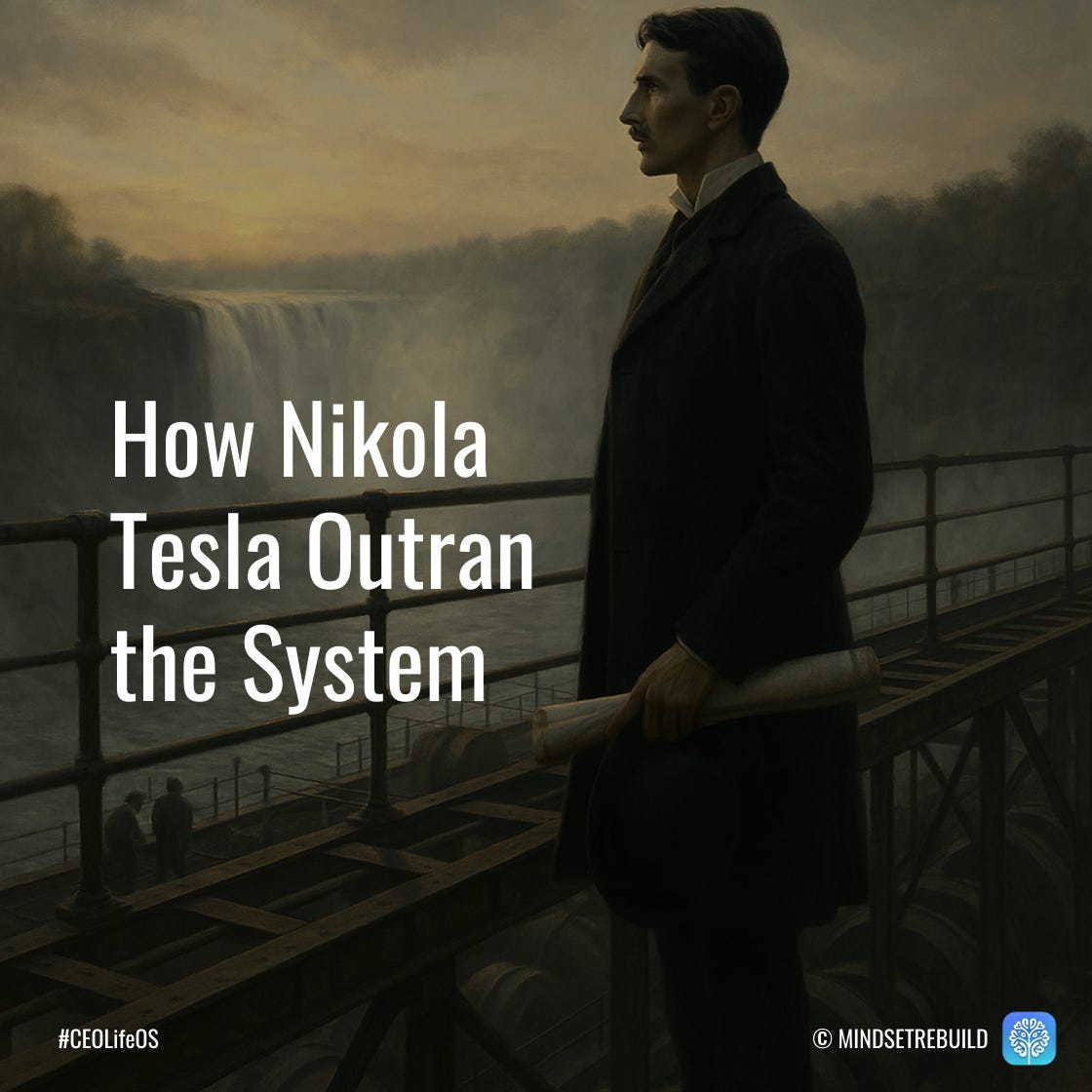
“The present is theirs; the future, for which I really worked, is mine.” (Nikola Tesla)
Prelude: A Mind Out of Step
New York City, January 1943.
Room 3327 of the Hotel New Yorker is silent, save for the rustle of pigeons outside the frosted window. Inside, the body of Nikola Tesla—once the most electrifying mind on Earth—lies still, a man who once dreamed of lighting the entire planet, dead, alone, and forgotten by the system he had tried to elevate.
There’s no funeral procession. No grand obituary in the scientific journals that once ignored him. No parade of world leaders for the man whose inventions paved the modern world.
But rewind the clock just 50 years, and you would find a man electrifying the globe—literally.
Tesla’s mind birthed technologies that would define the 20th and 21st centuries: alternating current, radio, radar, wireless communication, robotics, and more.
And yet, society refused to make room for a genius who wouldn't play by its rules.
Tesla is a case study in what happens when someone lives too far ahead of their time—and refuses to dumb it down.
This is the kind of story we study inside CEO Life OS.
It’s about what it takes to lead your life on your terms, not by consensus. To choose purpose over approval.
To be the current, not the conductor.
And it’s a blueprint for anyone who’s ever been told their vision is “too much.”
Origins: The Spark in Smiljan
Nikola Tesla was born in 1856 in Smiljan, a small village in what is now Croatia, then part of the Austrian Empire.
He was the son of a Serbian Orthodox priest, Milutin Tesla, and Đuka Mandić, a woman who, though never formally educated, invented household tools and memorized epic poems.
While his father wanted him to join the clergy, Tesla’s most profound influences stemmed from his mother—one of the earliest signs that he would consistently prioritize the intuitive over the institutional.
She could weave intricate patterns and memorize entire epic poems. Tesla would later credit her as the true inventor in the family.
From early childhood, Tesla experienced what he called "lightning flashes" of insight—detailed mental images of inventions, often arriving whole.
These weren’t rough drafts; they were functioning designs. He claimed he rarely sketched or prototyped. He saw, refined, and executed inside his head.
Tesla never fit into school. He often read entire libraries by candlelight and could recall entire texts by memory.
His teachers didn’t know what to do with him. His peers often mocked him. But Tesla didn’t measure his value through their eyes.
He was already living by a different set of operating principles.
What we now celebrate as “visionary” was, in his time, considered odd—eccentric at best, unstable at worst.
The lesson? Your gifts will often be misinterpreted as liabilities when viewed through a narrow cultural lens.
If you’re building your life as a CEO—if you're living with intention—you must be willing to stand in that tension.
Crossroads: War of Currents and the American Dream
Tesla arrived in New York in 1884 with four cents in his pocket, a book of poems, and a letter of recommendation addressed to Thomas Edison.
He quickly landed a job working for Edison, only to resign within six months.
Edison had promised Tesla $50,000 if he could improve the efficiency of his DC motor system.
Tesla delivered—but Edison claimed it had been a joke. "When you become a full-fledged American," Edison laughed, "you will appreciate an American joke."
Tesla didn’t laugh. He walked away.
This marked his first major fork in the road—a moment most people would call failure, but which Tesla treated as redirection.
Soon after, he met George Westinghouse, who believed in Tesla’s vision of alternating current (AC).
Unlike Edison’s direct current (DC), which required power stations every few blocks, Tesla’s AC system could transmit electricity over vast distances with minimal loss.
The ensuing "War of Currents" wasn’t just about wires—it was about world views.
Edison weaponized fear, staging public electrocutions of animals to show AC’s danger.
He lobbied politicians. He smeared Tesla in the press.
Tesla responded by working harder and demonstrating results.
The moment of triumph came in 1893 when Tesla and Westinghouse lit the Chicago World’s Fair with AC, stunning the world and cementing its future.
Later, when Tesla helped build the first hydroelectric power plant at Niagara Falls, it was clear: AC had won.
But Tesla didn’t gloat. He moved on to the next impossible problem—wireless global energy.
What most people saw as his peak, Tesla saw as just the beginning.
Resistance: A System That Rewards Safety, Not Vision
In 1895, Tesla’s Manhattan laboratory burned to the ground. Years of notes, prototypes, and inventions were lost in a single night.
Most people would collapse. Tesla barely paused.
He began again.
What he couldn’t rebuild, he reimagined.
He shifted his focus to wireless transmission, dreaming of a global grid of free energy, where people anywhere could tap into unlimited power via the Earth itself.
With the backing of financier J.P. Morgan, Tesla began constructing Wardenclyffe Tower on Long Island—a massive prototype of his wireless dream.
But Tesla never mastered the art of fundraising. He had no patience for investors’ quarterly metrics.
When Morgan learned that Tesla’s invention might not be monetizable—because it would give away power rather than sell it—he pulled funding.
“You propose to give power away for free?” Morgan asked. “Where do we put the meter?”
The tower was never completed.
Tesla’s financial backers vanished. His ideas were declared impractical. He was labelled a dreamer, then a crank, then a footnote.
This is the part of the story that hits hardest for creators and entrepreneurs: the world loves visionaries, but only when they conform.
Tesla refused to.
He wouldn’t chase trends. He wouldn't dilute his purpose.
And so the system, which rewards compliance, not clarity, shut him out.
