


Welcome to this issue of Clarity Letters from Mindset Rebuild.
If you open on Monday and see three decisions that were supposed to close last week, you’re not dealing with a backlog problem. You’re dealing with a missing container. This is a quick look at the five conditions that make decisions stick, so they stop reopening and your week stops getting hijacked.
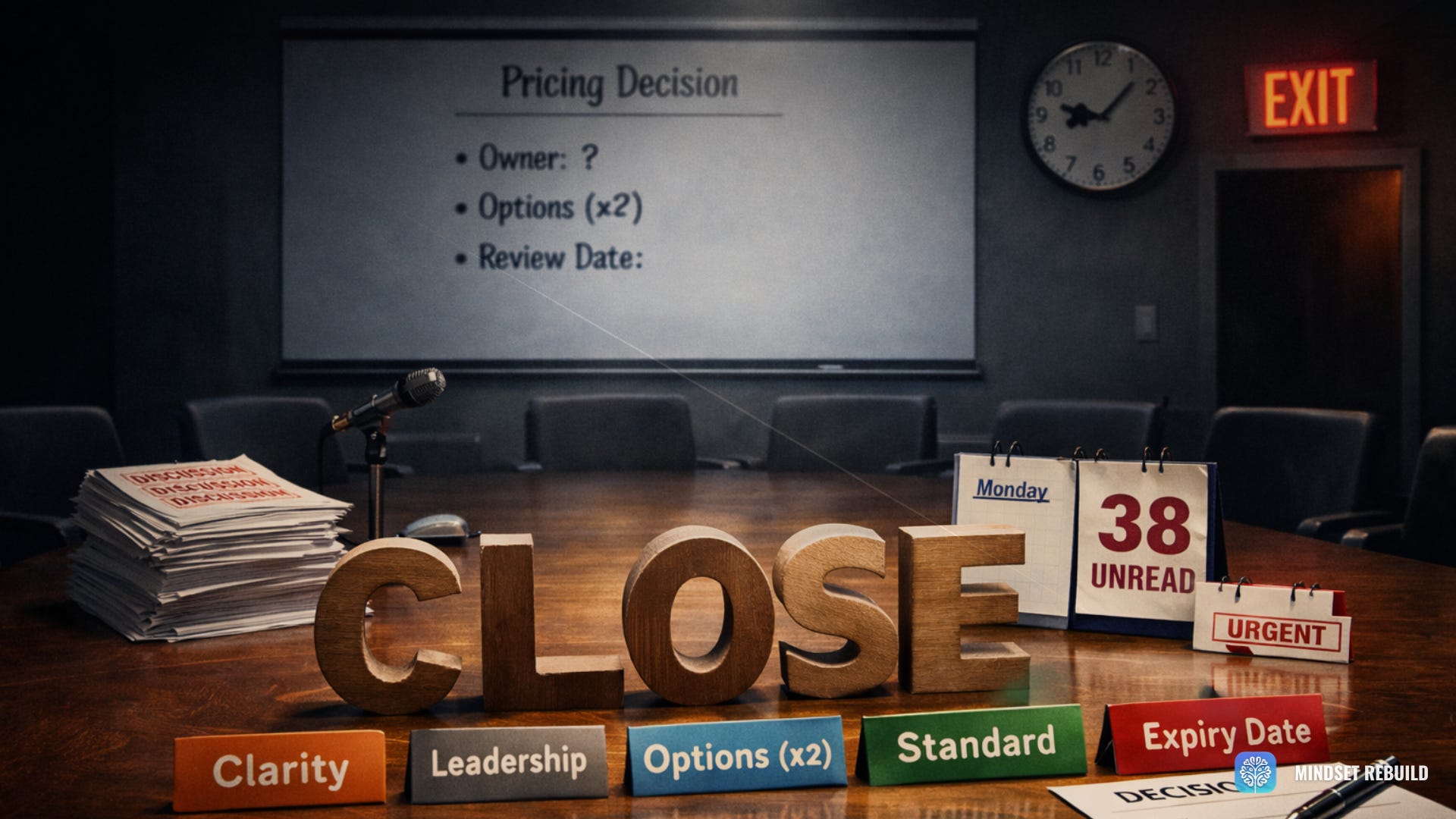
Monday morning hits.
You open Slack and there are 38 unread messages waiting for you like they paid rent.
Three of them are decisions. The kind that were “basically agreed” last week. The kind that were “almost there.” The kind that were “just waiting on one last look.”
And now they’re back. Again.
That’s not a backlog problem.
That’s a design problem.
Because decisions don’t stall because people are slow. Most leadership teams are stacked with smart, driven, capable people. They stall because the conditions for closing them were never set up.
No owner. No constraint. No deadline. No definition of done. No trigger that keeps the decision closed.
So the decision floats.
Then it drifts into the next meeting.
Then it quietly becomes a recurring part of your company’s personality.
“We’re still discussing pricing.”
“We’re still reviewing the vendor.”
“We’re still thinking about the org change.”
“We’re still aligning.”
If you’ve heard those phrases, you already know the real cost.
Work stalls downstream. People hedge. The roadmap turns into fan fiction. Revenue sits on the table. And everyone becomes a little more careful about committing, because experience has taught them that nothing really sticks.
The uncomfortable thing nobody says out loud
Most leadership teams don’t have a decision problem.
They have a decision container problem.
They treat decisions like conversations that should “naturally conclude.”
They don’t.
Conversations naturally expand. They naturally wander. They naturally reopen the moment someone brings a new angle, a new risk, or a new opinion.
If you want a decision to close, you need a container that forces closure and protects it after the meeting ends.
That’s what I mean by “design.”
Not corporate process for the sake of process. Not bureaucracy. Not a 40-page decision policy.
A simple set of conditions that make it easier to close the decision than to keep it open.
Over the years, watching this play out across leadership teams, I noticed something consistent:
Stalled decisions almost always miss the same five conditions.
So I gave them a name.
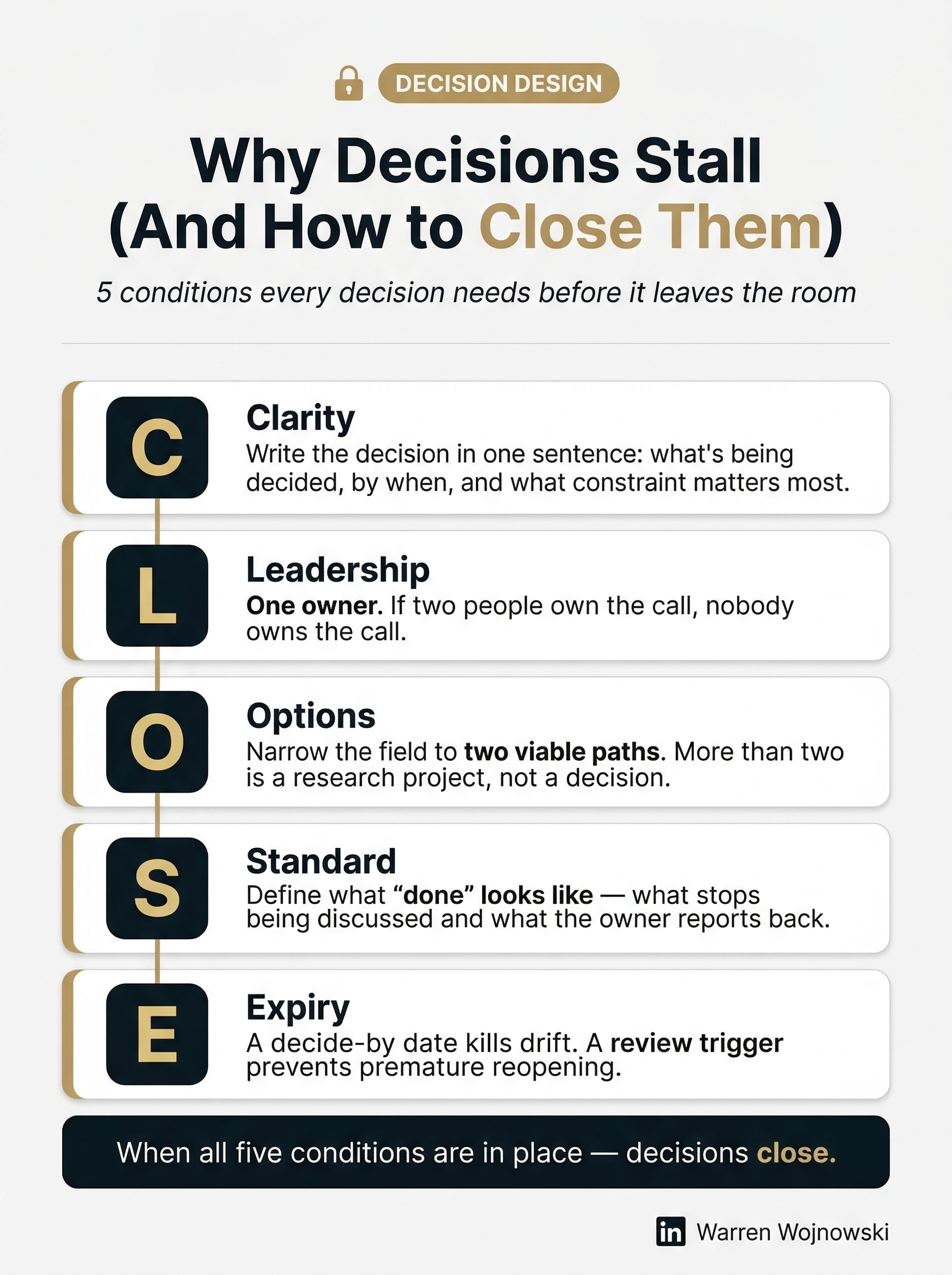
The CLOSE framework
CLOSE is not a methodology to study.
It’s not a culture initiative.
It’s a set of conditions you install before a decision leaves the room.
When all five are present, decisions close.
When one is missing, decisions drift.
Here they are.
C — Clarity on what’s actually being decided
Most decisions drag because the question is wrong.
The meeting sounds productive, but everyone is answering a slightly different question. So you get motion, not closure.
Clarity means writing the decision in one sentence:
What are we deciding, by when, and what constraint matters most?
Examples:
“Decide pricing model for Tier 2 by Friday 3pm, constrained by margin floor of 72%.”
“Decide whether we replace Vendor A with Vendor B by March 15, constrained by data residency requirements.”
“Decide which feature ships this sprint by Tuesday 10am, constrained by one dev team and an enterprise commitment.”
If you can’t write it in one sentence, you don’t have a decision yet. You have a topic.
Topics never end. Decisions can.
A quick tell: if you hear “we should probably define what we mean by…” halfway through the meeting, clarity was missing at the start.
L — Leadership: one owner, not a committee
If two people own the call, nobody owns the call.
Committees are great at producing discussion.
They are terrible at producing closure.
“Leadership” here doesn’t mean job title. It means decision ownership.
One person needs to be able to say:
“I own this call. I’m accountable for the outcome. I’ll take input, but I’m closing it.”
When ownership is fuzzy, language turns into a shield:
“Let’s circle back.”
“I’m aligned either way.”
“Can we take it offline?”
“We should get more data.”
Those phrases are often code for: “I don’t want to own the consequences.”
So define the owner before the debate gets spicy.
If it’s a true shared decision, fine. But then you must be honest about the trade-off: shared decisions move slower and need tighter closure, not looser closure.
A simple line that changes the room:
“Who owns the call when time runs out?”
If nobody can answer in five seconds, you just found the reason the decision keeps reopening.
O — Options narrowed to two
Having more than two options is a research project, not a decision.
This is where a lot of leadership meetings quietly fail.
People bring five options, seven variations, three hybrids, and a “maybe we combine them” proposal.
Now your decision is a maze.
Two options forces clarity. Two options forces trade-offs. Two options forces commitment.
Not because there aren’t more possibilities. Because at the moment of decision, what you need is a clear comparison.
Option A vs Option B.
Then you can say, in adult language:
A gives us speed, costs us polish.
B gives us polish, costs us time.
If you can’t narrow to two, you’re still in exploration. That’s fine. Just don’t pretend you’re deciding.
A practical move: ask someone to do the narrowing before the meeting, not inside it. The meeting is for choosing, not collecting.
S — Standard for what “done” looks like
A decision isn’t closed until the team knows what changes tomorrow.
This is where decisions die after they’re “made.”
People leave the room with different interpretations.
One person thinks it’s final. Another thinks it’s provisional. Someone thinks it’s “directionally agreed.” Someone else thinks it’s “pending.”
So the decision reopens in Slack.
Then it reopens in the next meeting.
Then it becomes the company’s longest running series.
A Standard means you define what “done” looks like in plain terms:
What stops being debated
What action starts immediately
What the owner will report back
When the next checkpoint is
Done should feel like a door closing, not a foggy handshake.
Simple test: If you can’t say what will be different by tomorrow morning, the decision isn’t closed.
E — Expiry date with a review trigger
This is the part that protects the decision from drift.
Two dates matter:
Decide-by date (with a time)
Review trigger (when it’s allowed to reopen)
The decide-by date kills drift.
The review trigger prevents premature reopening.
Because reopening is often what teams do when they feel anxious. It’s an emotional reflex that looks like prudence.
A review trigger makes reopening legitimate instead of habitual.
Examples:
“We’ll revisit only if churn exceeds X.”
“We’ll revisit in 30 days after customer feedback from the pilot.”
“We’ll revisit after legal reviews the new clause language.”
Without a review trigger, every new comment becomes an excuse to reopen. With a trigger, the team learns: “We stick with the decision unless the trigger is hit.”
That’s how decisions stay made.
Why CLOSE works (and why “better meetings” doesn’t)
A lot of leaders try to fix this by tightening agendas.
Better facilitation. Cleaner notes. More structured updates.
Helpful, but it won’t solve decision drag.
Because decision drag isn’t a meeting quality problem. It’s a missing conditions problem.
You can run the best meeting in the world and still end with nothing if the decision never had:
a clear question
a single owner
two viable options
a definition of done
a decide-by date and a review trigger
CLOSE is the difference between a meeting that produces motion and a meeting that produces closure.
And closure is what your team is starving for.
Not motivational speeches. Not more alignment. Not another dashboard.
Closure.
The fastest way to apply this starting tomorrow
Pick one decision that has reopened at least twice.
The one that keeps coming back. The one that’s “still in discussion.”
Then do this:
Write the decision in one sentence (Clarity).
Name one owner (Leadership).
Narrow to two options (Options).
Define what changes tomorrow (Standard).
Set decide-by time and review trigger (Expiry).
You’ll feel resistance.
That’s normal.
Because CLOSE forces the thing teams often avoid: trade-offs in public.
But once you install this, something shifts quickly.
Slack gets quieter.
Meetings get shorter.
Work stops hedging.
People stop waiting for “one more look.”
Not because the team got more disciplined.
Because the system stopped rewarding drift.
The question
Which decision in your world keeps getting called “in discussion”?
Pricing. Vendor. Roadmap. Org. Contract terms.
You already know which one it is.
It’s the one you’re tired of hearing about.
P.S.
If you want to check your decision-making system, my free Decision Drag Audit takes about 10 minutes to complete. Click here to run the audit.