


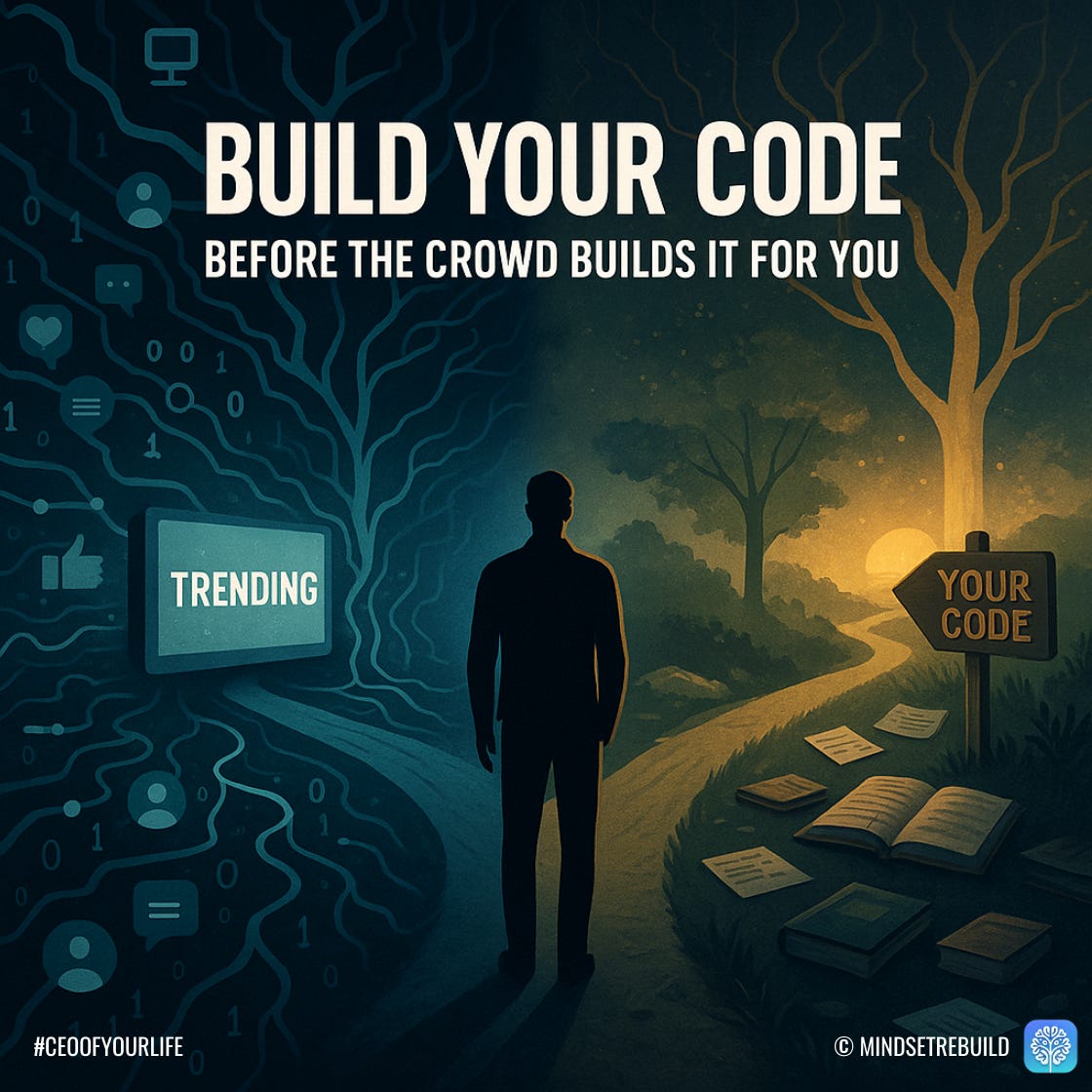
I. The Borrowed Life Isn’t Worth Living
Your calendar looks full. Your task manager looks clean.
Your social feed says you’re crushing it.
But deep down, something feels… off.
You’re doing all the “right” things—
—but they don’t feel right.
You followed the frameworks.
You studied the greats.
You’ve mimicked successful creators, entrepreneurs, mentors.
And still, you feel like a guest in your own life.
That quiet emptiness?
It’s the cost of running your business (and your mindset) on borrowed beliefs.
II. Enter Nietzsche: The Philosopher Who Refused to Conform
Before he became a meme on motivational posters…
Before his quotes got slapped onto startup slides and coffee mugs…
Friedrich Nietzsche was a young man who lost his father, lost his health, lost his friends—and still refused to lose himself.
Born in 1844 and raised by devout women in a small German town, Nietzsche learned young that inherited answers couldn’t protect you from reality.
He watched as religion collapsed under the weight of science.
He saw how nationalism seduced the masses.
He noticed how morality could be manipulated by fear.
His conclusion?
If you don’t forge your own values, someone else will sell them to you—disguised as purpose.
III. The Crisis You Don’t Know You’re In
Today’s version of this crisis isn’t about church vs. science.
It’s about something sneakier.
Every scroll, click, and like feeds you ideas about what matters:
“Success looks like this.”
“Real creators post every day.”
“You should be making $10K/month by now.”
It’s not that these goals are bad.
It’s that they’re not yours—and your nervous system knows it.
When your life is running on values you didn’t choose, burnout isn’t just likely—it’s inevitable.
You can’t scale a life that doesn’t feel like yours.
IV. The Choice Nietzsche Forces You to Make
In 1882, Nietzsche wrote the now-infamous words:
“God is dead. And we have killed him.”
He wasn’t gloating. He was grieving.
What he meant was: the old value systems—religion, tradition, obedience—had lost their authority.
And in their place? A dangerous vacuum.
Left unchecked, that vacuum gets filled by:
Pop culture
Political dogma
Hustle ideology
Self-help clichés
Nietzsche's warning: If you don’t consciously build your beliefs, you’ll unconsciously adopt someone else’s.
And when life gets hard, those borrowed beliefs won’t hold.
V. The CEO Life OS Starts with Self-Authorship
To live like the CEO of your life, you need more than goals.
You need a code.
And that code can’t be outsourced.
Here are 3 of Nietzsche’s most powerful mindset principles to help you build that internal operating system:
1. Don’t Perform—Become
“Become who you are.”
It’s a strange phrase until you realize it’s an indictment of modern life.
We’re all performing.
Performing for algorithms.
Performing for imaginary followers.
Performing for success metrics we didn’t invent.
Nietzsche’s challenge is surgical: Strip away the layers of performance and excavate who you were before the world told you who to be.
CEO Life OS Prompt:
🧠 What are you doing today because you “should”?
What would you still do if no one ever saw it?
2. Avoid the Herd. Even When It’s Popular.
“The crowd seeks comfort. You seek freedom.”
Nietzsche didn’t hate people.
He distrusted the psychological gravity of groups.
He called it “herd morality”—the idea that once enough people believe something, we stop questioning it.
Sound familiar?
“Post daily to grow.”
“If you’re not monetizing, you’re wasting time.”
“Your brand should sound like this.”
Herds protect the average.
But you’re not here for average.
CEO Life OS Prompt:
🔥 What’s one “best practice” you’ve followed that feels off?
What might happen if you broke it—on purpose?
3. Power = Ownership, Not Control
“Will to power = will to responsibility.”
We often mistake power for dominance.
Nietzsche flips the script.
He says real power begins when you stop blaming:
The algorithm
The economy
Your past
Your parents
Your personality
You may not control the circumstances.
But you control how you relate to them.
That’s ownership. That’s power. That’s your edge.
CEO Life OS Prompt:
✍️ What’s one challenge you’ve been blaming on something external?
Now ask: What’s my part in this?
That’s where your leverage begins.
VI. From Philosophical Collapse to Your Personal Clarity
In 1889, Nietzsche collapsed in a public square—mentally broken, emotionally fried, physically unwell.
He died in silence.
But decades later, his words found their way into the journals of Holocaust survivors, the footnotes of leadership manuals, and the whiteboards of top performers.
Why?
Because his core message was always the same:
Don’t inherit your values.
Forge them.
That’s not self-help fluff. That’s a blueprint for identity in a noisy world.
VII. The Bottom Line: If It’s Not Yours, It Won’t Last
You can borrow tactics.
You can borrow tools.
But you can’t borrow your truth.
If you’re building a life that’s meant to scale, endure, and feel real—you need values that are homegrown, not mass-produced.
Nietzsche isn’t just a philosopher.
He’s the godfather of self-authorship.
And if you’re ready to become the CEO of your life, his work isn’t ancient history.
It’s a playbook.
VIII. TL;DR Takeaways
✅ Self-authorship is the only path to self-leadership.
✅ The herd rewards comfort. But growth lives on the edge.
✅ Power begins where blame ends.
✅ You can’t fake alignment. And you shouldn’t try.
That’s a Wrap
🔑 Want to build your life on values that actually belong to you? Here are 3 more ways I can help you build a life that leads instead of reacts:
Rewire Your Mindset — Join the free 10-day course to stop drifting and start acting with clarity.
CEO Life OS Accelerator — A done-with-you program to help clarify your offer, build your first evergreen content asset, and install your CEO Life OS dashboard in 30 days.
Offer-to-OS Strategic Retainer — If you’re serious about building something that lasts and want a strategic partner, not a cheerleader, this is for you.
See you in the next issue,
Warren
Want the full back story on Friedrich Nietzsche?
Read the deep dive 👇
