


Welcome to this week’s issue of Leadership Architecture from Mindset Rebuild, providing you with design choices that travel without you.
🔒 This mid-week edition is for paid subscribers. If this was forwarded to you and you want Wednesday’s deeper pieces (plus templates and archives), you can upgrade anytime.
New Year’s Eve has a sound to it.
Not fireworks; the other sound.
The one inside the house when the good glasses are out, someone’s cutting the last orange for drinks, and the living room is quieter than usual.
It’s the sound of a clock you can finally hear.
I don’t want a bigger plan tonight. I want a kinder clock.
Something that lets January start with room to move, not a list to perform.
I want one page that tells the truth in plain language and can survive a hallway.
When I need that tone, I keep Seneca close.
He wasn’t a motivational speaker; he was a friend who wrote letters from a desk.
In On the Shortness of Life, he doesn’t scold, he reminds: most of us don’t lack time; we spend it without noticing.
His fix is startlingly simple: own a little of your day on purpose.
Not all of it. A corner. Enough to put your hands back on the wheel.
That’s the energy for tonight. Not a reinvention. A page.
how I’m thinking about January
There’s a difference between a goal and a thing that will exist.
The first can wait for motivation. The second has gravity.
If you and I can hold something up on Monday and say, “We made that on purpose,” the week starts differently.
People relax. You get fewer clarifying pings. The work picks up its own rhythm.
So I’m writing a page I can live with: clear enough for my team to execute, small enough to keep promises, and honest enough to course-correct without drama.
It reads like a note on the fridge, not a proclamation.
Here’s the heart of it:
What we will care about for seven days.
One decision we’ll try while the feeling is fresh.
The shape that decision will take so anyone can point to it.
The day we will look again and say what we learned out loud.
You can call that a template if you want. I call it a place to stand.
the page (as I’d write it to my own team)
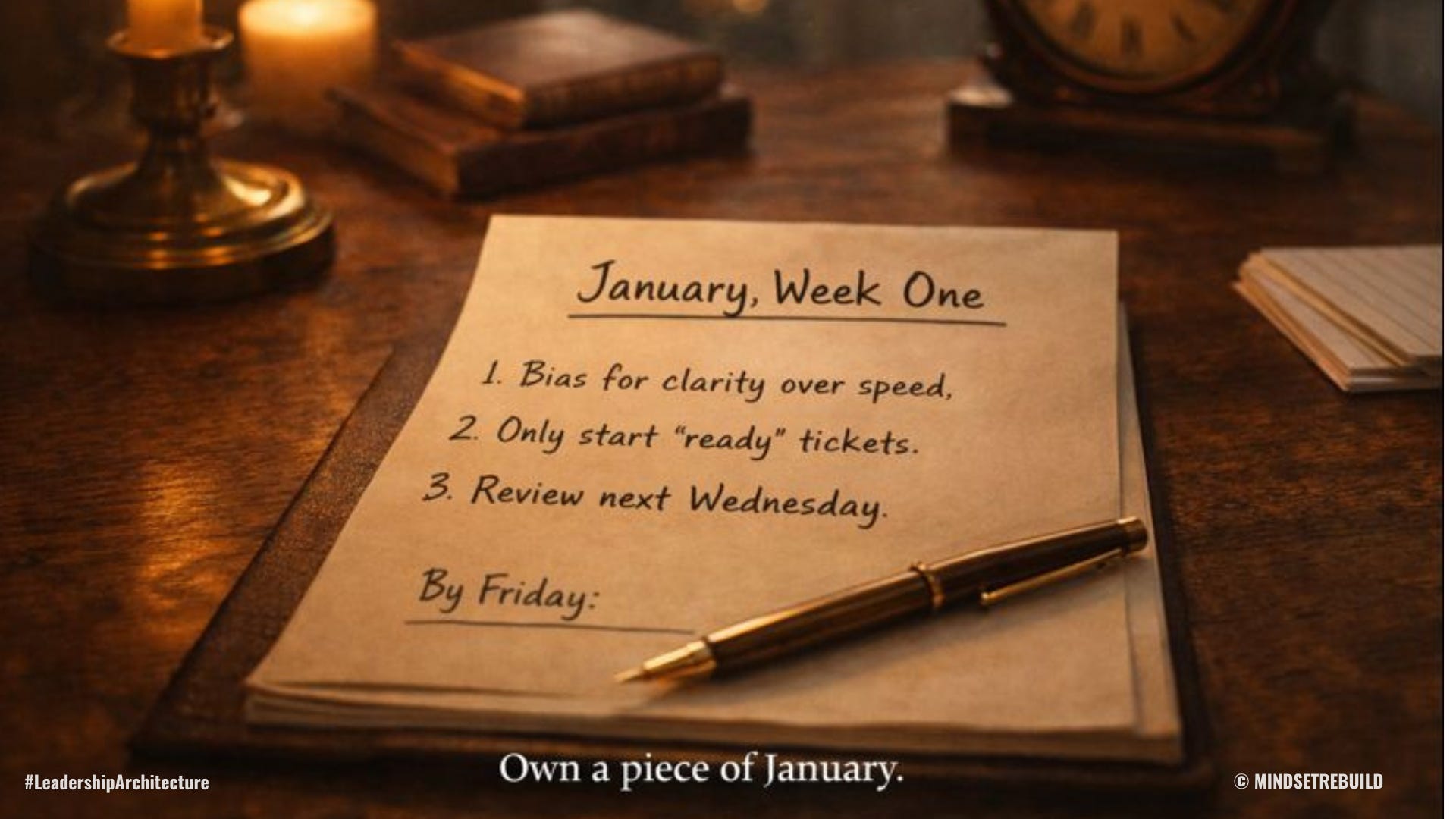
January, Week One — what we’ll care about
We’ll bias for clarity over speed in handoffs this week. If something hurts because it’s unclear, we’ll fix the words, not each other.One decision we’ll try
For seven days, a change is “ready” only if the ticket has a tiny checklist and a name people can see. Bigger work goes in the backlog with a single sentence about why; we’ll pick it up when the ground is steady.The shape it will take
There will be a short status people can forward by Tuesday. It will say: what’s done, what’s next, and the first thing that will exist by Friday.We look again
Next Wednesday at 10:15, we check: Did the checklist keep a night calm? Did anyone need the old way? Keep, change, or scrap.
That’s it.
It’s not clever. It doesn’t try to be complete.
It gives January a hand-hold and leaves oxygen in the room.
why Seneca belongs here
Seneca writes like someone who has already tried too hard.
He doesn’t shout about “grind.” He writes about ownership of minutes.
He tells a friend that a person who guards their money but not their mornings is confused about what’s valuable.
And he’s practical: when your time is limited, tend to the part you can touch.
I read him as an operations guy: choose the part of the day the world can’t steal, and put something there you can point to.
That’s what this page is for.
It’s not a vow. It’s a shelf; wide enough for one bowl, not a pantry.
small, specific, and seen
If that page is going to work in the real world, it needs three qualities:
Small enough for a week.
If it takes paragraphs, it’s a project, not a page. A sentence people can remember is usually the right length.
Specific enough to notice.
“Communicate better” dies in the hallway. “A tiny checklist on the ticket before we start” lives.
Seen where work lives.
A plan in a slide deck is a rumour. A line on the issue template is a nudge that appears when people need it.
None of that is exciting.
It’s just what allows grown adults to keep their dignity while working together.
We’ve all had enough of manufactured urgency. Teams want words that let them move without performing.
a real corner to start with
If you’re feeling the pull to make something big tonight, step back.
Pick a corner that actually touches other people’s days and put your hand there.
You could choose the handoff note and make it breathable.
You could choose a status and make it forwardable.
You could choose the review and put it on a real calendar while everyone still remembers why it matters.
Whatever you pick, write it as if you’re talking to a friend you respect.
No heroics. No “north star” lines.
Just a sentence the week will recognize.
