


Welcome to this issue of Clarity Letters from Mindset Rebuild.
If your pricing model thread has 47 unread replies and it’s still “in discussion,” you’re not stuck on execution; you’re stuck on decisions that don’t close. This is a quick look at what open threads really cost and the decision hygiene system that gets momentum back.
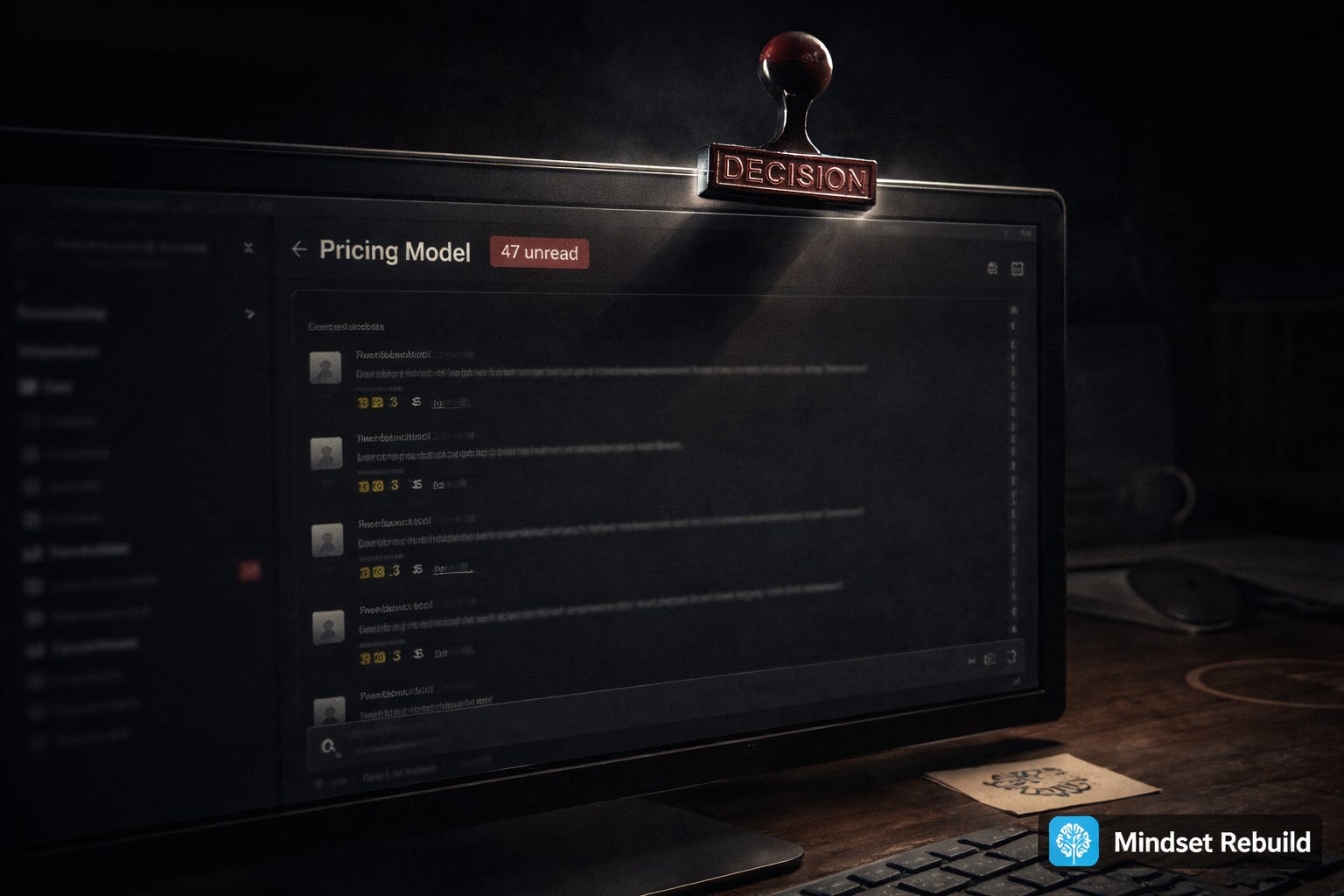
If you’ve ever stared at a Slack thread that reads like a small novel, you know the feeling.
Someone asked a simple question.
It turned into a debate.
Then a clarification.
Then a follow-up.
Then someone dropped a spreadsheet.
Then someone said, “Good context,” and added three more variables.
Then… silence.
And now the thread is sitting there like a haunted house.
47 unread replies.
Three weeks old.
Still open.
Not because your team is lazy.
Because the decision never closed.
And while that thread sits open, your roadmap is quietly paying interest.
Not task velocity.
Decision velocity.
The modern bottleneck isn’t work. It’s open loops.
Most teams aren’t blocked by “doing.”
They’re blocked by choosing.
Right now, you probably have:
A vendor choice waiting on “one more comparison”
An org change your VP keeps postponing
A feature scope debate looping through its fourth meeting
A pricing model discussion that has turned into a Slack miniseries
None of these are tasks.
They are gates.
And gates don’t show up on burn-down charts.
They show up as:
“We’re waiting on…”
“We can’t proceed until…”
“We’ll need alignment first…”
“Let’s revisit…”
Which is just polite language for “we’re stuck.”
And here’s what makes it expensive:
When a decision stays open, your team starts building two futures in parallel.
One where Option A happens.
One where Option B happens.
So they hedge.
They do partial work.
They create workarounds.
They build “temporary” solutions that become permanent.
They hold meetings to avoid committing to a direction.
You don’t lose speed because people aren’t trying.
You lose speed because the system is forcing them to live in ambiguity.
A story: Five days lost. Eleven decisions hiding in plain sight.
I watched a team burn five days wondering why nothing shipped.
They had talent. They had effort. They had daily standups and sprint boards and a roadmap that looked clean.
But nothing moved.
There was no single “blocker.”
It was death by open loops.
So we did something that felt almost stupid because it was so simple:
We listed every open decision. Not tasks. Decisions.
In ten minutes we had eleven.
Eleven decisions sitting open across three channels.
Slack threads. Doc comments. Side conversations. Meetings with no closure.
No owners. No deadlines. Just… threads.
And the team was acting like this was normal.
Like living with 11 open decisions was just the cost of doing business.
It’s not.
It’s the cost of not having decision hygiene.
So we made a single document. Nothing fancy.
It’s called a Decision Log.
Eleven rows.
Then we did three things:
Assigned one person to each decision. Not a committee.
Set a close-by date with an actual time. Tuesday by 3pm, not “end of week.”
Named the trade-off that was keeping the decision alive.
And then we watched what happened.
Eight decisions closed in five days.
Two got killed because they didn’t matter.
One escalated with a clear trade-off framed.
Momentum wasn’t a morale problem.
It was a decision hygiene problem.
Why decisions don’t close (even when everyone wants them to)
The most common mistake teams make is assuming that decisions are naturally self-closing.
They’re not.
Most decisions require one of two things:
A decider who is accountable for closure
A forcing function that makes staying open painful
If you don’t have either, decisions default to open.
Because open is safe.
Open means nobody is wrong.
Open means nobody is blamed.
Open means nobody has to disappoint anyone.
Open means you can keep gathering inputs and feel productive.
But open also means your execution becomes a guessing game.
Open is a tax.
And the biggest lie in modern work is this:
“We’ll decide later.”
No, you won’t.
You’ll decide under pressure, in a rush, with a worse set of options.
Or you’ll drift into a default and call it a choice.
The real cost of 47 unread replies
Let’s make the cost visible, because that’s where the shift happens.
A long Slack thread isn’t just annoying.
It creates:
1) Duplicate work
Different people interpret the “likely direction” differently and start building mismatched things.
2) Coordination overhead
Every downstream person has to check in, ask, follow up, and wait.
3) Rework
When the decision finally lands, parts of what was built no longer fit.
4) Trust erosion
People stop believing timelines. They start buffering. They hedge their commitments.
5) Meeting inflation
Open decisions don’t sit quietly. They reappear. They get “revisited.” They multiply.
Your roadmap can’t account for this because it’s not tracking the gates.
So leaders start pushing harder on execution when the real constraint is closure.
Decision velocity is a leadership system, not a personality trait
Some teams act like decision speed is a vibe.
“It’s our culture.”
“We’re fast.”
“We move quickly.”
Usually, what they mean is:
“We have a few strong people who force closure.”
That works until those people burn out or leave.
Fast teams don’t debate less.
They don’t magically have fewer opinions.
They have a better system for keeping decisions visible, owned, and time-boxed.
They treat decision closure like hygiene.
Not as a heroic act.
The fix: Decision Hygiene in four moves
Here’s the playbook I’ve found works almost everywhere, especially in teams drowning in threads.
1) List every open decision (not tasks)
This is the moment of truth.
Decisions sound like:
“Do we go with vendor A or B?”
“Do we change the pricing model now or later?”
“Do we ship scope X in Q1 or cut it?”
“Do we restructure the team this month, yes or no?”
If it can’t be phrased as a clear choice, it’s not ready.
But if it is a choice, it belongs in the log.
2) Assign one owner to each (not a committee)
Owner does not mean “does all the work.”
Owner means:
gathers input
frames the options
names the trade-off
closes the loop by the date
Committees don’t close decisions. Committees keep decisions alive.
3) Set a close-by date with a time (not “soon”)
The time is the point.
“Friday” becomes “Friday at 3pm.”
Because “Friday” is a suggestion.
“3pm” is a forcing function.
When you add a time, people prepare.
When you don’t, the decision floats until someone gets annoyed.
4) Review it weekly (make it visible)
Pick one cadence and stick to it.
I like Friday because it cleans up the week and prevents decisions from aging into resentment.
The review doesn’t need to be long.
Ten minutes.
The questions are simple:
What’s open?
What’s past due?
What closes next?
What gets killed?
Visibility creates pressure in a healthy way.
It turns decision closure into a normal rhythm, not a heroic rescue.
The “trade-off sentence” that makes decisions close faster
Most decisions stay open because the real trade-off hasn’t been spoken.
So here’s a line I use constantly:
“The trade-off we’re making is ___ instead of ___.”
Examples:
“We’re choosing speed instead of certainty.”
“We’re choosing margin instead of growth.”
“We’re choosing simplicity instead of flexibility.”
“We’re choosing focus instead of coverage.”
Once the trade-off is named, the decision becomes adult.
It stops being about personalities and starts being about priorities.
And priorities are easier to own.
What to do when a decision keeps looping
Some decisions won’t close even with a log. That’s useful data.
It usually means one of three things:
1) The decision is too big
Break it into smaller decisions.
Instead of “pricing model,” decide:
“Do we test pricing changes with 10 customers, yes/no?”
“Do we introduce tiering, yes/no?”
“Do we allow discounting above X, yes/no?”
2) The owner isn’t actually empowered
If someone “owns” the decision but can’t close it, the log will reveal that fast.
That’s not a people problem. That’s a decision-rights problem.
3) The team is avoiding a consequence
Sometimes the trade-off is political. Or emotional. Or reputational.
Naming that out loud is uncomfortable, but it’s often the fastest way through.
“I think we’re avoiding the fact that this will upset a key customer.”
“I think we’re avoiding telling the board we missed.”
“I think we’re avoiding admitting the old plan isn’t working.”
When you name it, you can work with it.
When you don’t, it owns you.
The uncomfortable truth: Most teams carry a hidden decision backlog
If you only take one idea from this letter, take this:
You probably have a backlog you’re not tracking.
Not of tasks.
Of decisions.
And those decisions are what’s actually controlling your velocity right now.
Not your sprint board.
Not your standup.
Not your productivity tools.
Your open loops.
The quarter slips when decisions stay open long enough to create parallel realities inside the team.
That’s why a decision log feels like cheating once you try it.
It doesn’t make your team smarter.
It makes the bottlenecks visible.
And when something becomes visible, it becomes solvable.
A quick test you can run today
Open Slack.
Search for “pricing.”
Or “vendor.”
Or “org.”
Or “scope.”
Find the thread you’ve been avoiding.
Ask yourself:
Is this a decision or just a discussion?
Who owns closing it?
What is the close-by date and time?
What trade-off is being avoided?
If you can’t answer those in under 60 seconds, you don’t have a thread.
You have a leak.
Close it, kill it, or escalate it
Here’s the rule I wish more teams followed:
Every open decision should be one of three things:
Close it (make the call)
Kill it (it doesn’t matter, stop pretending)
Escalate it (it needs a higher-level trade-off)
What you cannot do is let it live in Slack for three weeks while your quarter bleeds out.
That’s not “collaboration.”
That’s avoidance dressed as teamwork.
The question
What’s one decision sitting in your threads right now that’s costing you velocity?
Be honest.
You already know which one it is.
It’s the one you can feel every time someone says, “We’re waiting on…”
If you want a quick way to surface your hidden decision backlog, take the Decision Drag Audit. It’ll help you identify where decisions are getting stuck, what it’s costing you, and which calls will unlock the most momentum fastest.